About the data
FUSION ENERGY GUIDE

What is fusion energy?

Explore how fusion energy works, how it differs from fission, its fuels, safety and commercialization challenges through primary sources. Compare three approaches and explore research, companies and policy in Japan.

Fusion energy is released when light atomic nuclei join. Fusion also powers the Sun, but a terrestrial power plant uses different fuels and ways to sustain the reaction.

A guide to the mechanism, the challenges on the path to power generation and developments in the industry. Explore comparison diagrams, glossary entries and explainers for more detail.

Reference: QST's introductory explanation ↓
Content updated / sources checked Editorial policy and corrections

How fusion works and differs from fission

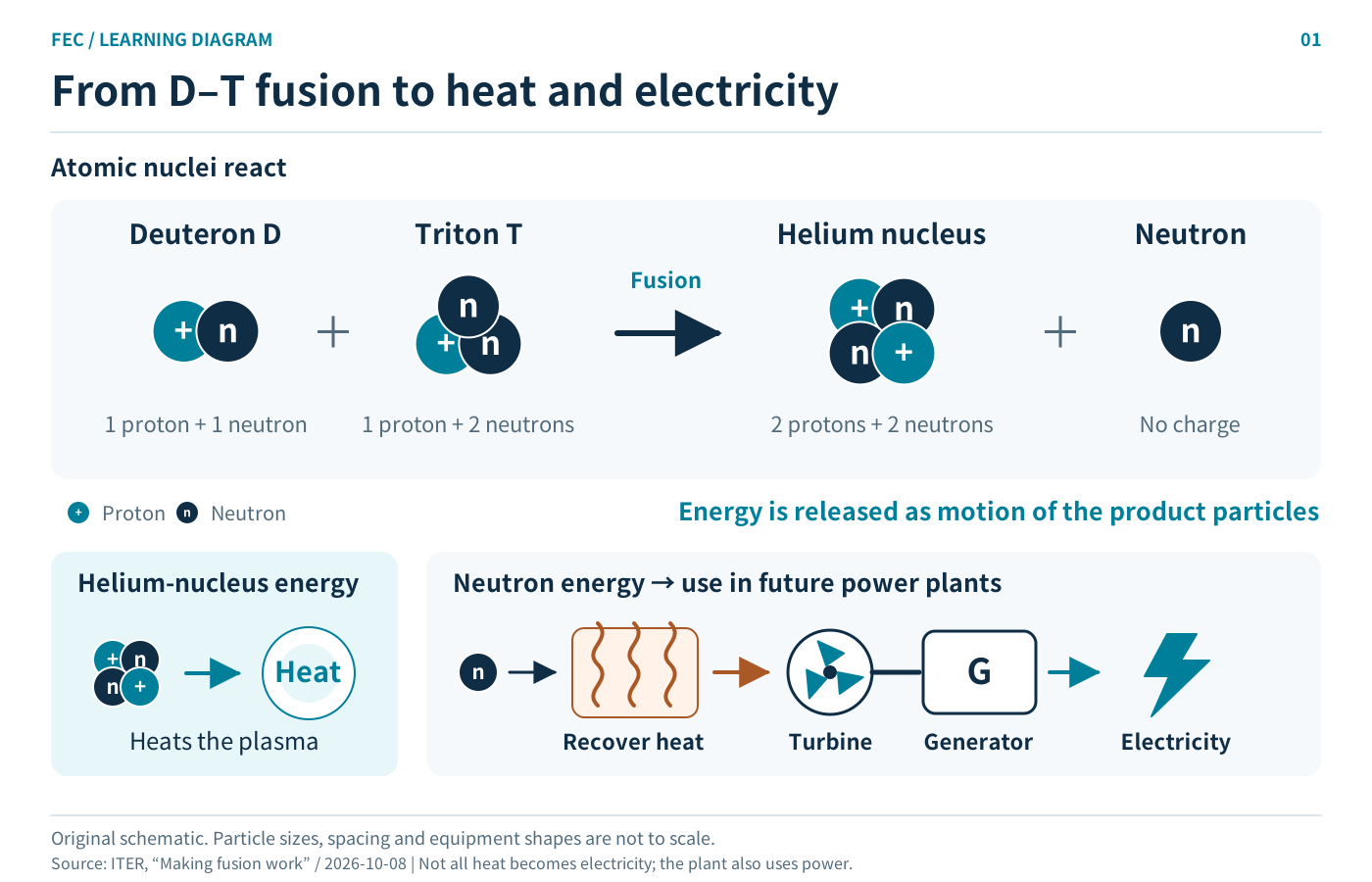
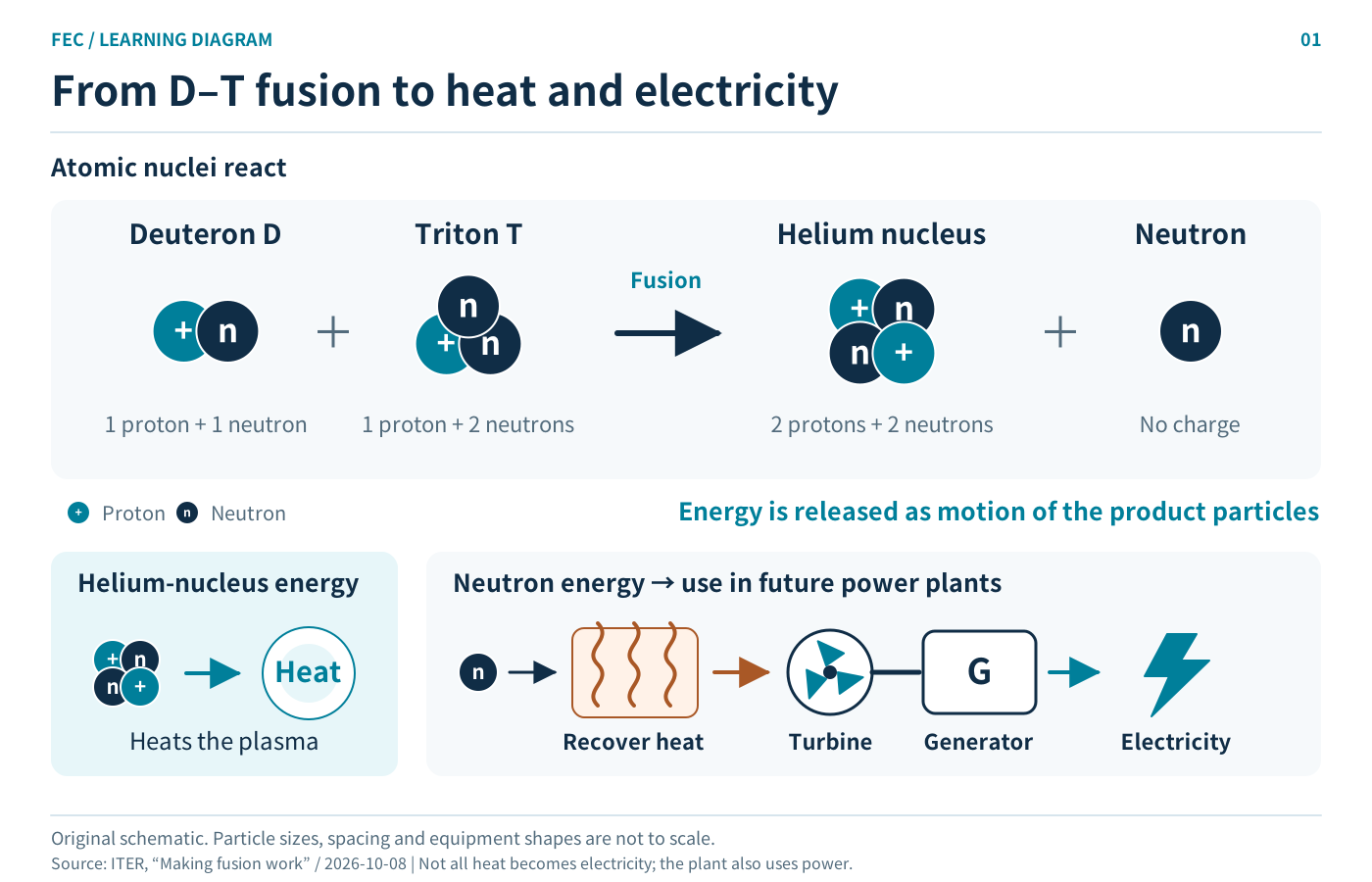
Fusion joins light atomic nuclei; fission splits heavy ones. Fusion therefore differs from the reactions used in today's nuclear power stations.

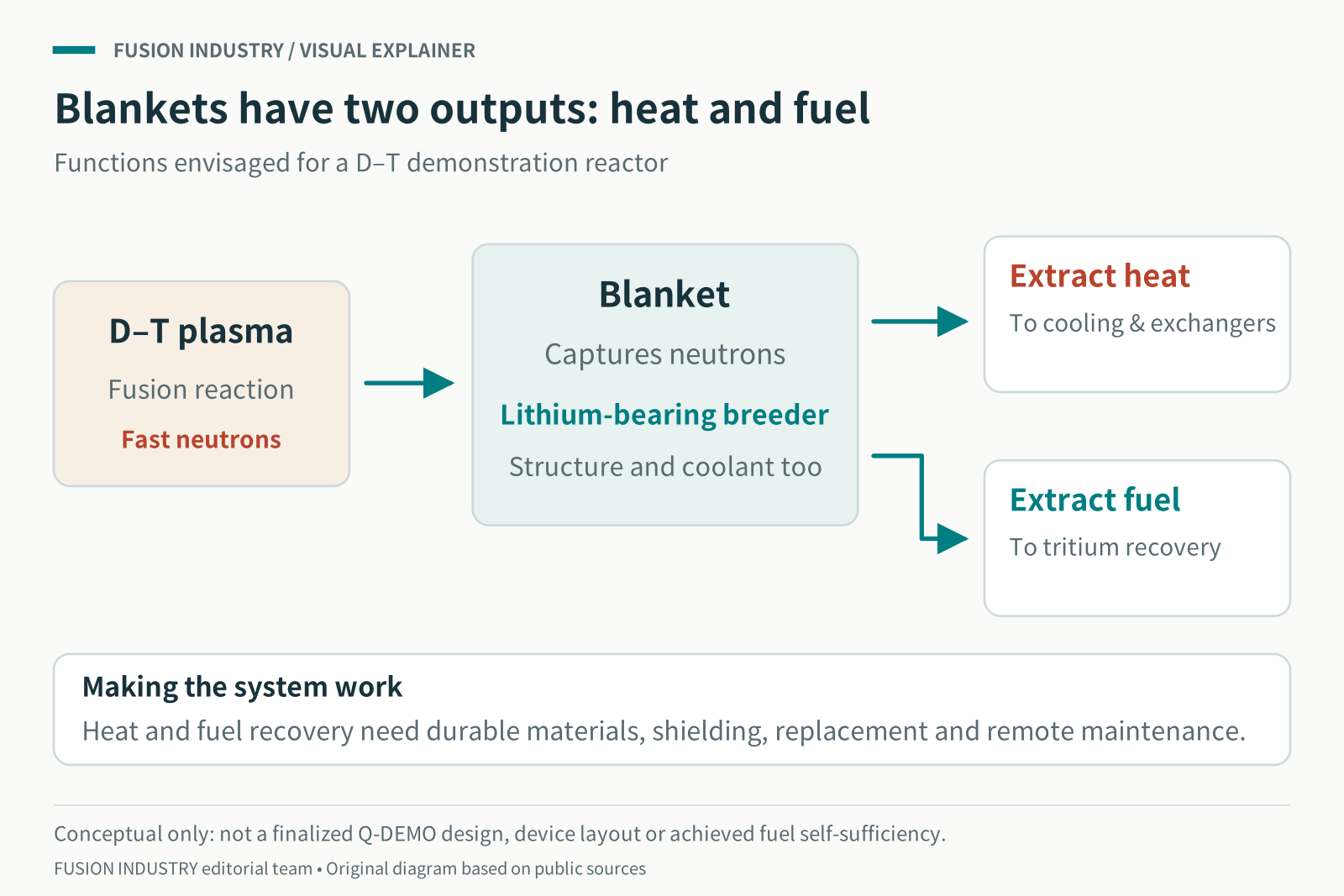
In D–T fusion, using deuterium and tritium, a blanket captures the energy of the emitted neutrons as heat and transfers it to power-generation equipment. Producing a reaction is only part of the process: the heat must also be converted to electricity.

Sources:QST: fundamentals / NIFS: fuel and heat recovery

What is the fuel? Is seawater enough?

D–T fusion uses two forms of hydrogen: deuterium and tritium. The resources from which deuterium can be obtained are distinct from the processes needed to prepare reactor-ready fuel.

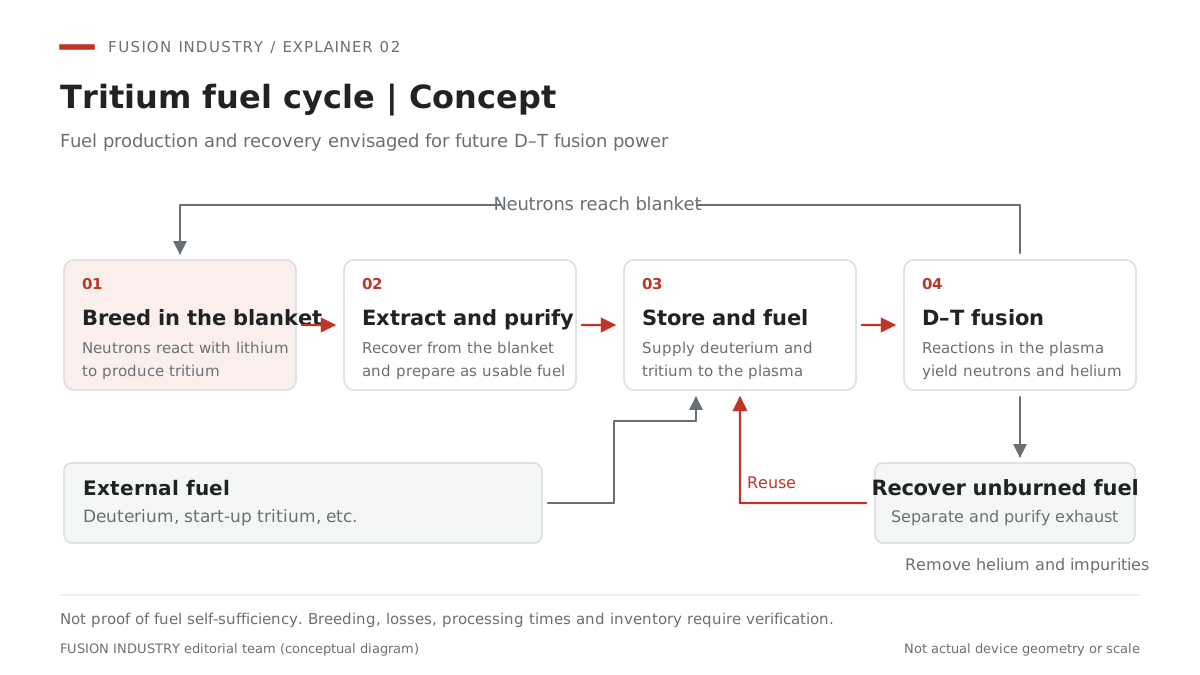
Tritium occurs naturally only in very small quantities. Establishing a cycle that breeds it through lithium–neutron reactions and recovers, purifies and reuses it remains a challenge. Abundant resources do not automatically ensure a reliable fuel supply.

Sources:NIFS: fuel and heat recovery / QST: reactor engineering

Benefits, safety and radioactive-waste challenges

The fusion reaction itself emits no carbon dioxide. Together with potentially abundant fuel resources, this may support decarbonization and energy security. Generation costs and reliable operation still need to be demonstrated.

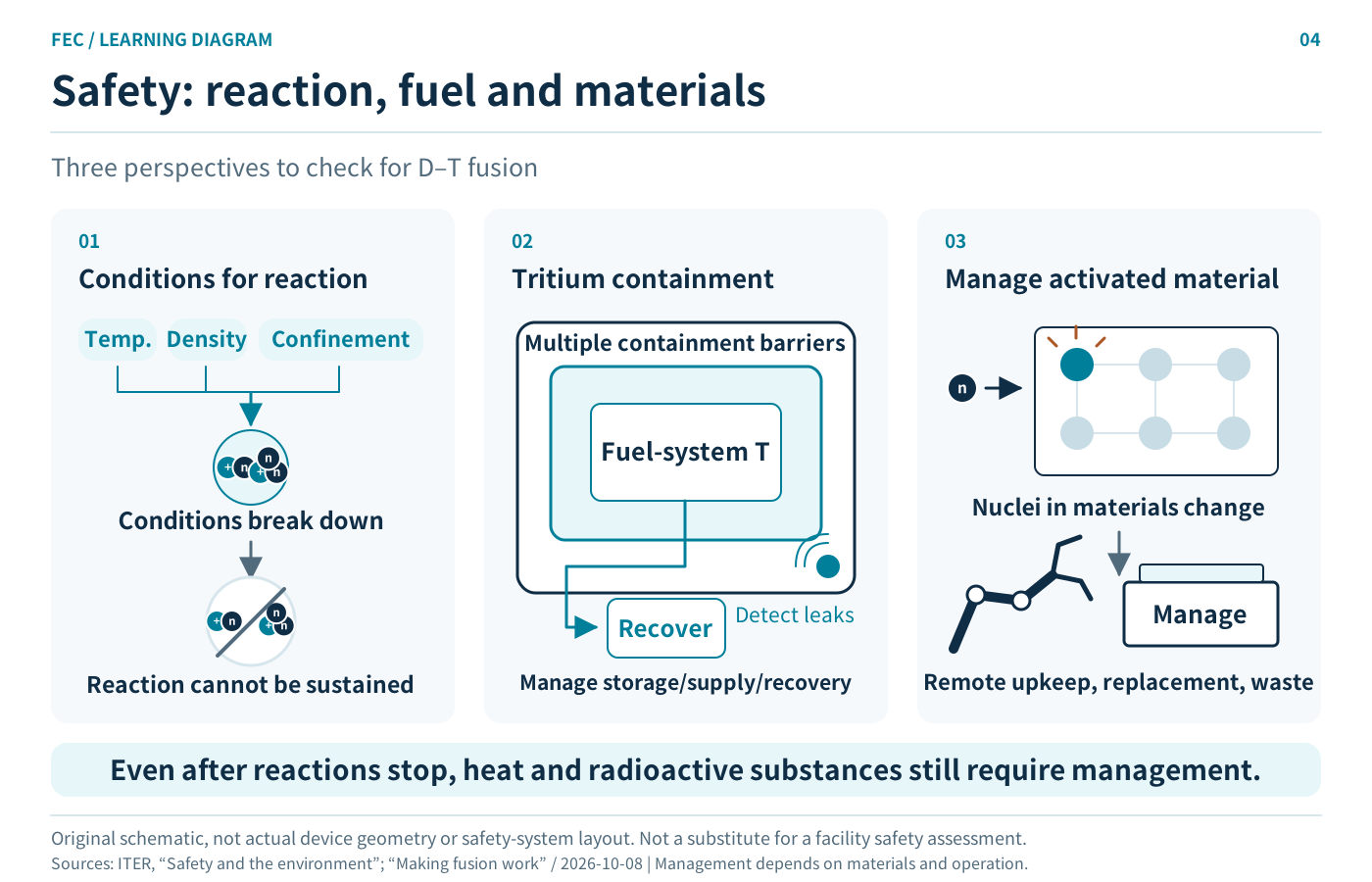
A fusion reaction continues only while conditions such as fuel supply and high temperature are maintained. Unlike a fission chain reaction, it stops when its required fuel supply or power is removed.

D–T systems nevertheless handle radioactive tritium, neutrons and activated structural materials. They require shielding, containment and waste management, as well as precautions for high temperatures, strong magnetic fields and other equipment hazards. Easy reaction shutdown does not mean that safety management is unnecessary.

Sources:Cabinet Office: national strategy / QST: reactor engineering

When could fusion be used? Experiments and power demonstrations

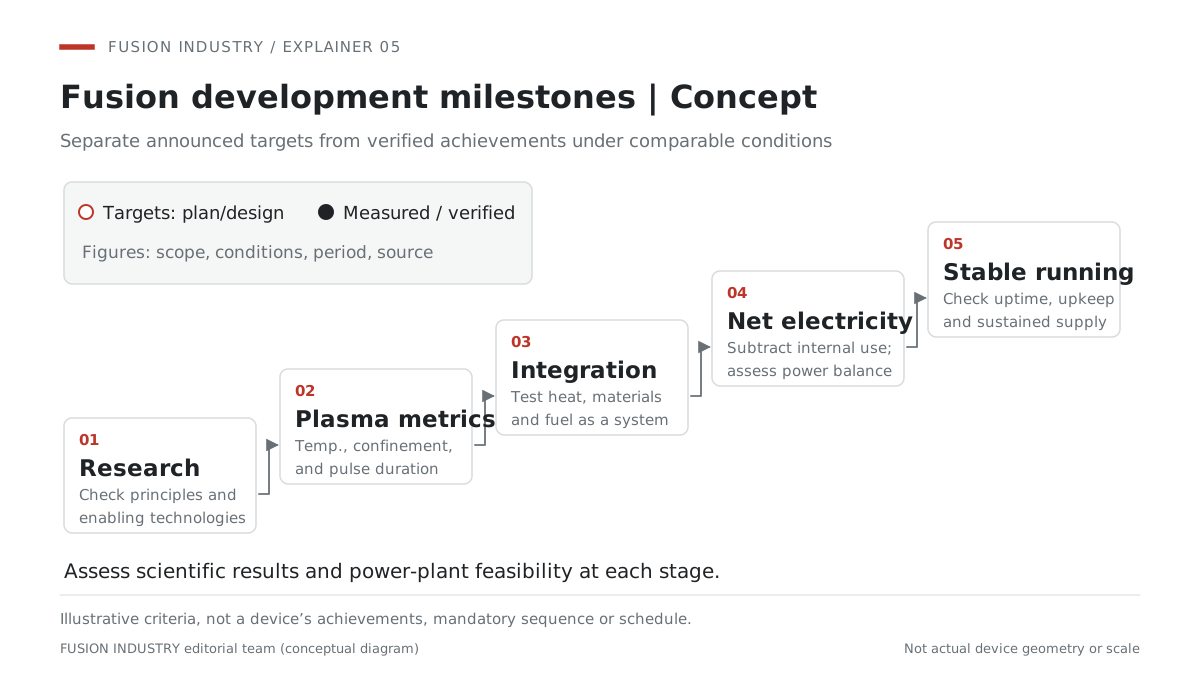
Japan aims to demonstrate fusion power generation in the2030s. This is a development target, not a confirmed date for electricity supply to homes. Producing reactions, delivering net electricity and supplying power economically and continuously are separate stages.

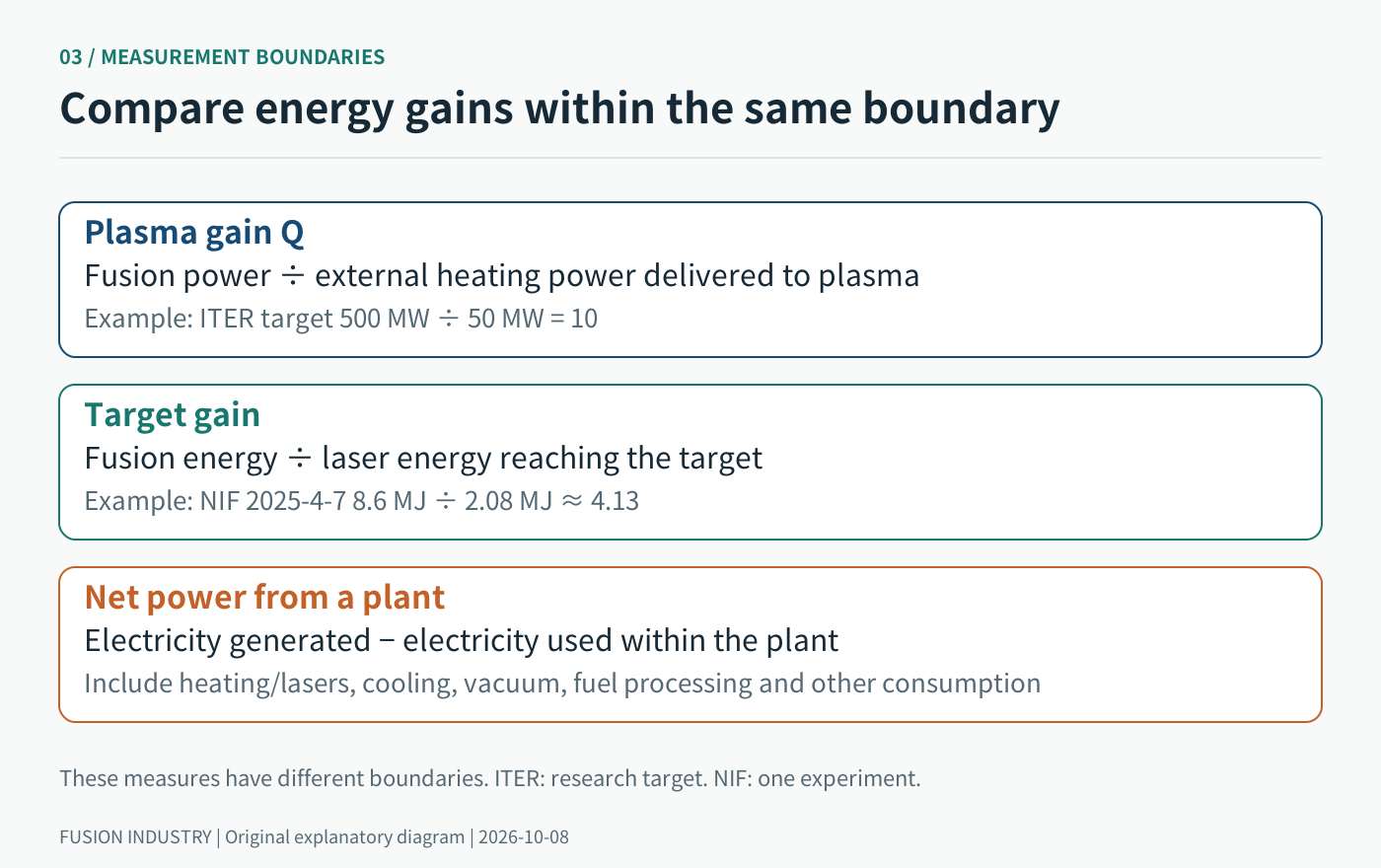
An energy-gain figure depends on the boundary used to compare input and output. The whole power plant must be assessed, including heating and cooling loads, fuel supply, material lifetimes and equipment replacement.

Sources:Cabinet Office: national strategy / QST: fundamentals / QST: reactor engineering

RESEARCH TO INDUSTRY

Explore research, companies and policy in Japan

Distinguish the roles of research institutions and devices from the equipment and technologies supplied by companies. Explore the path from research to business through machines, supply chains and policy.

Research devices and development stages

Read about the purposes and verified development stages of ITER, JT-60SA and demonstration plants.

Explore projects →

Companies and supply chains

From reactor development to materials, vacuum, superconductors and maintenance: identify each company's role and evidence of its work.

Explore companies →Start with the technology you need →

Policy and opportunities to participate

Distinguish national policies from individual programmes and calls; check participation requirements in official documents.

Explore policy and regulation →Explore opportunities and procurement →
Sources and primary documents for this guide
  1. QST: frequently asked questions ↗

    Fusion reactions, fuels, plasma and energy gain

  2. NIFS: the fuel cycle and energy extraction ↗

    D–T heat recovery, blankets and tritium breeding

  3. QST: Blanket Research and Development Department ↗

    Fuel breeding, shielding, heat recovery and safe handling technologies

  4. Cabinet Office: Fusion Energy Innovation Strategy ↗

    National strategy, pathways to deployment and fundamental safety principles

This guide is edited from public sources. It does not imply review or endorsement by the research institutions. Image sources appear below each figure.

START HERE

Your first fusion reading path

Start with principles, methods, research devices or power generation, wherever your interest lies.

  1. 01

    Understand the principles

    Start with how fusion releases energy.

  2. 02

    Compare three approaches

    Explore the differences between tokamak, helical and laser approaches.

    View the downloadable comparison chart ↓
  3. 03

    Explore devices and research

    Learn what JT-60SA and ITER are each designed to investigate.

  4. 04

    Explore the path to power generation

    Explore demonstration power plants and the technologies needed across the power-generation system.

Search the glossary ↓
SAVE & LEARN / 3 METHODS

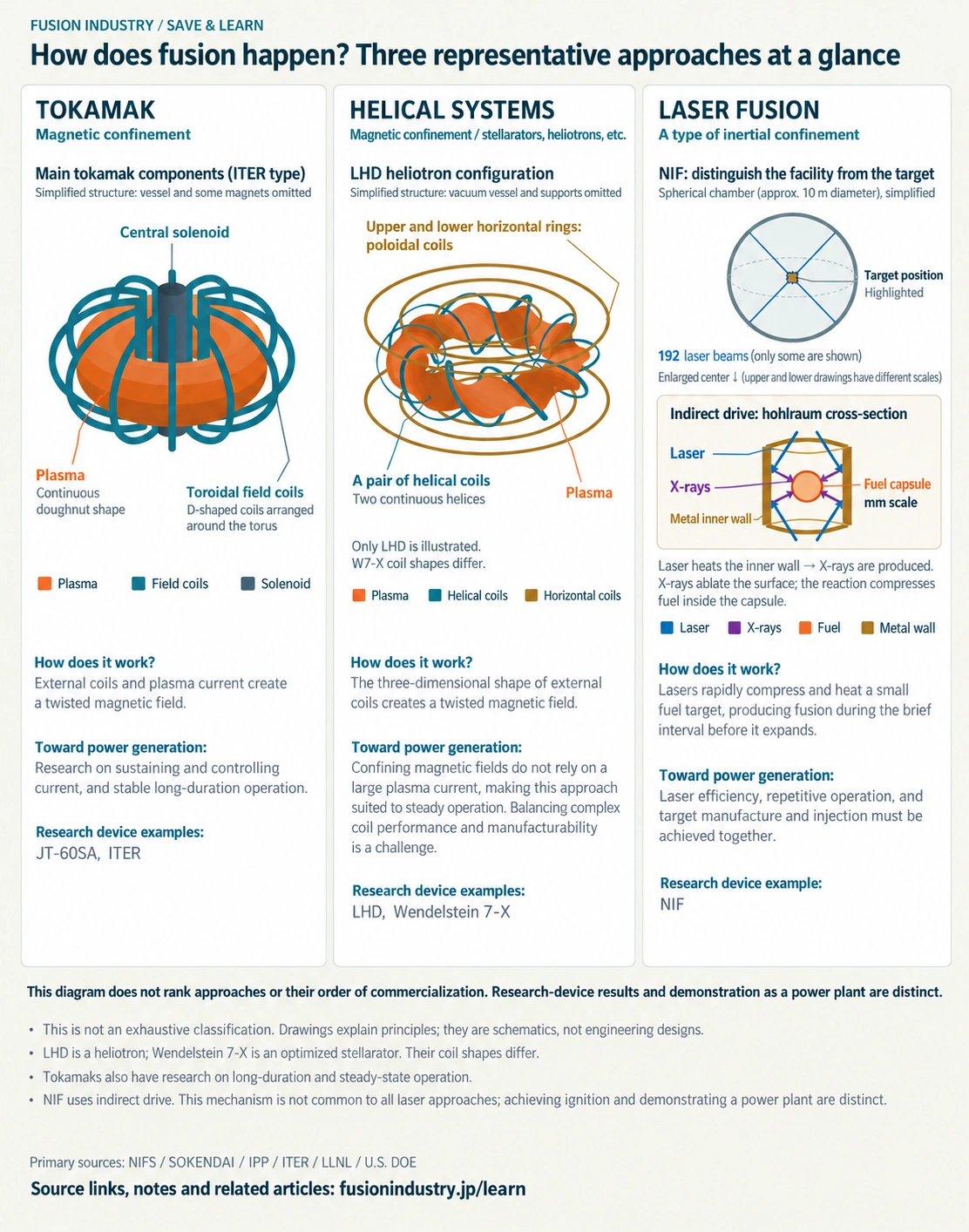
How does fusion happen? Compare three approaches

Compare confinement approaches and the challenges of power generation. Save the diagram for explanation and review.

Tokamak

Magnetic confinement

Simplified ITER-type tokamak: an orange toroidal plasma, teal D-shaped toroidal-field coils and a grey cylindrical central solenoid.
How does it work?
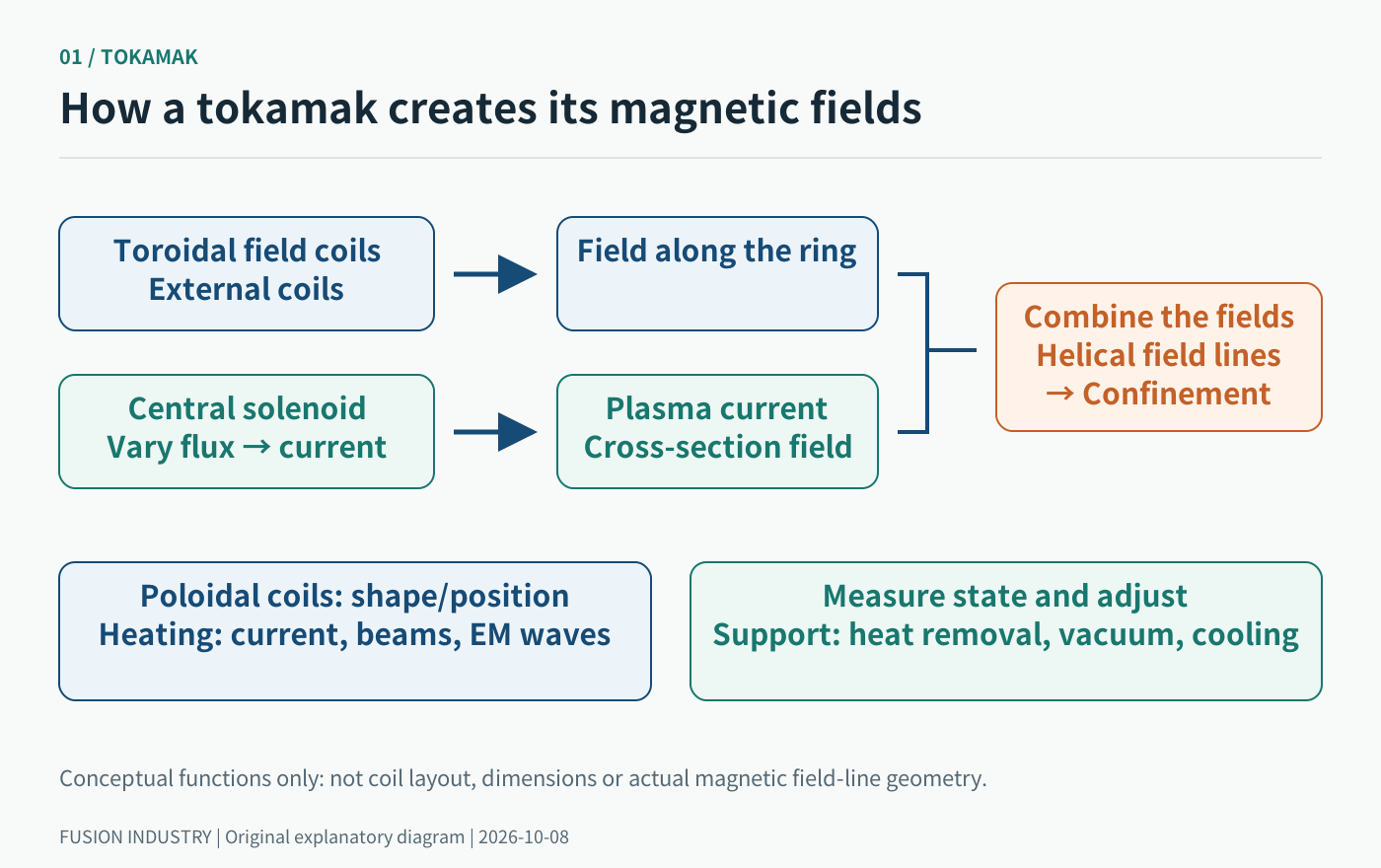
External coils and a plasma current create a twisted magnetic field.
Towards power generation
Research addresses current sustainment and control, and stable long-duration operation for power generation.
Examples of research devices
JT-60SA、ITER
Tokamak: read the explainer →

Stellarator / heliotron

Magnetic confinement: stellarators, heliotrons and related devices

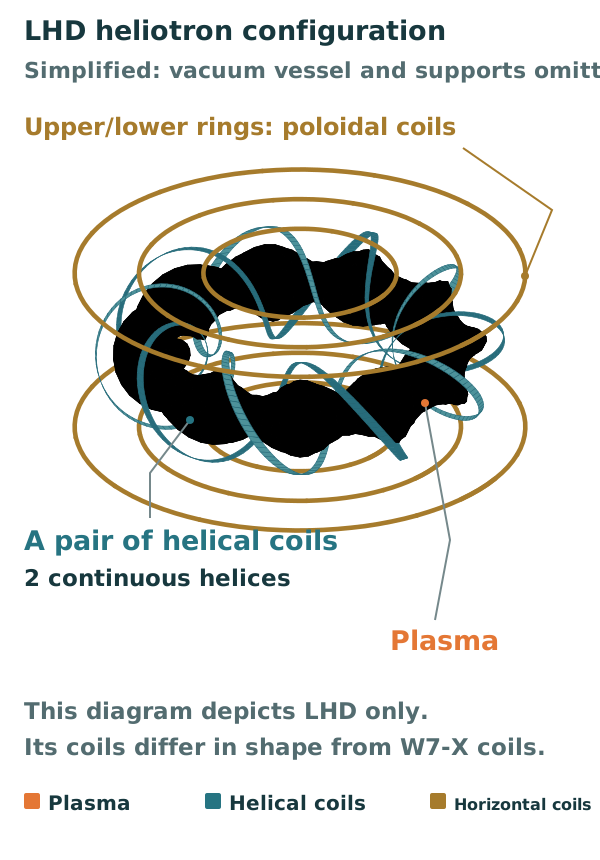
Simplified LHD example: two teal continuous helical coils surround an orange toroidal plasma, with gold horizontal poloidal coils above and below. W7-X is not depicted.
How does it work?
The three-dimensional shapes of external coils create a twisted magnetic field.
Towards power generation
Its confinement field does not rely on a large plasma current, making it suited to steady-state operation. Achieving both magnetic performance and manufacturable complex coils remains a challenge.
Examples of research devices
LHD、Wendelstein 7-X
Stellarator / heliotron: read the explainer →

Laser fusion

A form of inertial confinement

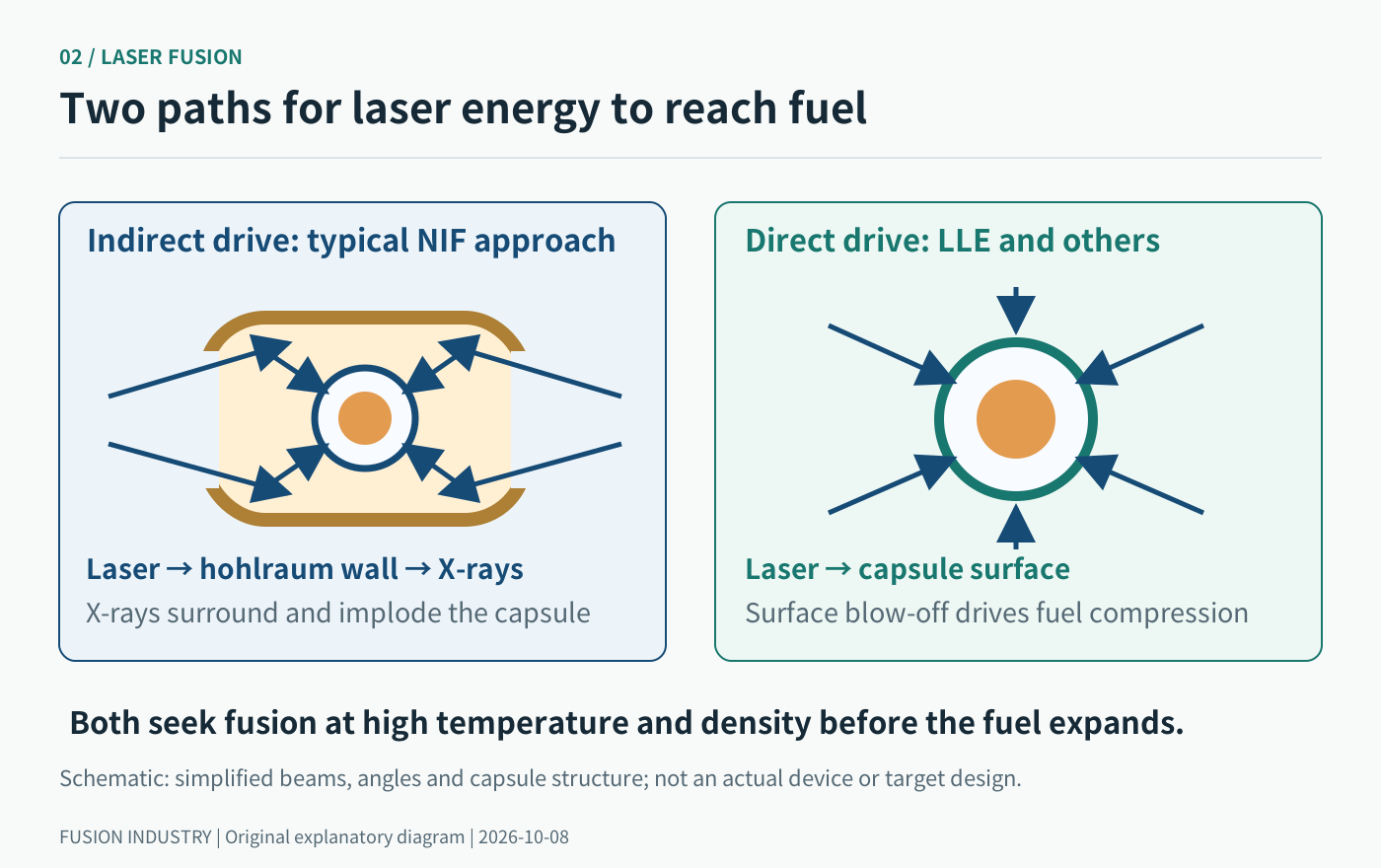
NIF's spherical chamber is about10m in diameter; the central millimetre-scale target is shown at a different scale. Blue laser beams enter a cylindrical hohlraum and strike its metal walls. Purple X-rays heat the orange fuel capsule; surface ablation drives inward compression. Only some of the192beams are shown.
How does it work?
Lasers rapidly compress and heat a small fuel target, producing fusion during the brief period before it expands.
Towards power generation
Power generation requires efficient lasers, repetitive operation, and reliable target manufacture and injection.
Examples of research devices
NIF
Laser fusion: read the explainer →

This diagram does not rank approaches or commercialization prospects. Results from research devices are distinct from demonstrating a power plant.

Save the comparison PNG ↓

An original FUSION INDUSTRY comparison diagram, credited to fusionindustry.jp/learn.

How to read the diagram and caveats
  • This is not an exhaustive classification. The drawings explain principles; they are not engineering designs.
  • LHD is a heliotron; Wendelstein7-X is an optimized stellarator. Their coil shapes differ.
  • Tokamaks also conduct research into long-duration and steady-state operation.
  • NIF uses indirect drive. This does not describe every laser-fusion approach; achieving ignition is distinct from demonstrating a power plant.
23 terms
Basic terms

Fusion energy

Nuclear fusion

From the fusion reaction to electricity supply, this guide explains fuel, confinement, heat recovery and plant consumption. Primary sources help distinguish fusion's benefits and challenges, deployment targets and the conditions needed for viable businesses.

Read the definition and related information
Research institutions and sites

QST

National Institutes for Quantum Science and Technology

QST stands for the National Institutes for Quantum Science and Technology. This Japanese research institution advances ITER, JT-60SA and demonstration-reactor development through its Naka and Rokkasho sites.

Read the definition and related information
Research institutions and sites

Naka institute

Naka Institute for Fusion Science and Technology

QST's institute in Naka City, Ibaraki. It advances JT-60SA plasma research and component and reactor-engineering work supporting ITER.

Read the definition and related information
Research institutions and sites

Rokkasho institute

Rokkasho Institute for Fusion Energy

QST's institute in Rokkasho, Aomori connects fusion to power systems through research on demonstration-reactor design, materials, neutron sources, blankets and fuel.

Read the definition and related information
Machines and projects

ITER

ITER (fusion experimental reactor)

ITER is an international fusion experiment under construction in southern France. It studies burning plasma and machine technology, but will not generate or transmit electricity.

Read the definition and related information
Machines and projects

JT-60SA

JT-60SA (JT-60 Super Advanced)

Japan–Europe superconducting tokamak at Naka, supporting ITER, future demonstration reactors and fusion research training.

Read the definition and related information
Machines and projects

Q-DEMO

Q-DEMO (conceptual design for an ITER-sized fusion demonstration reactor)

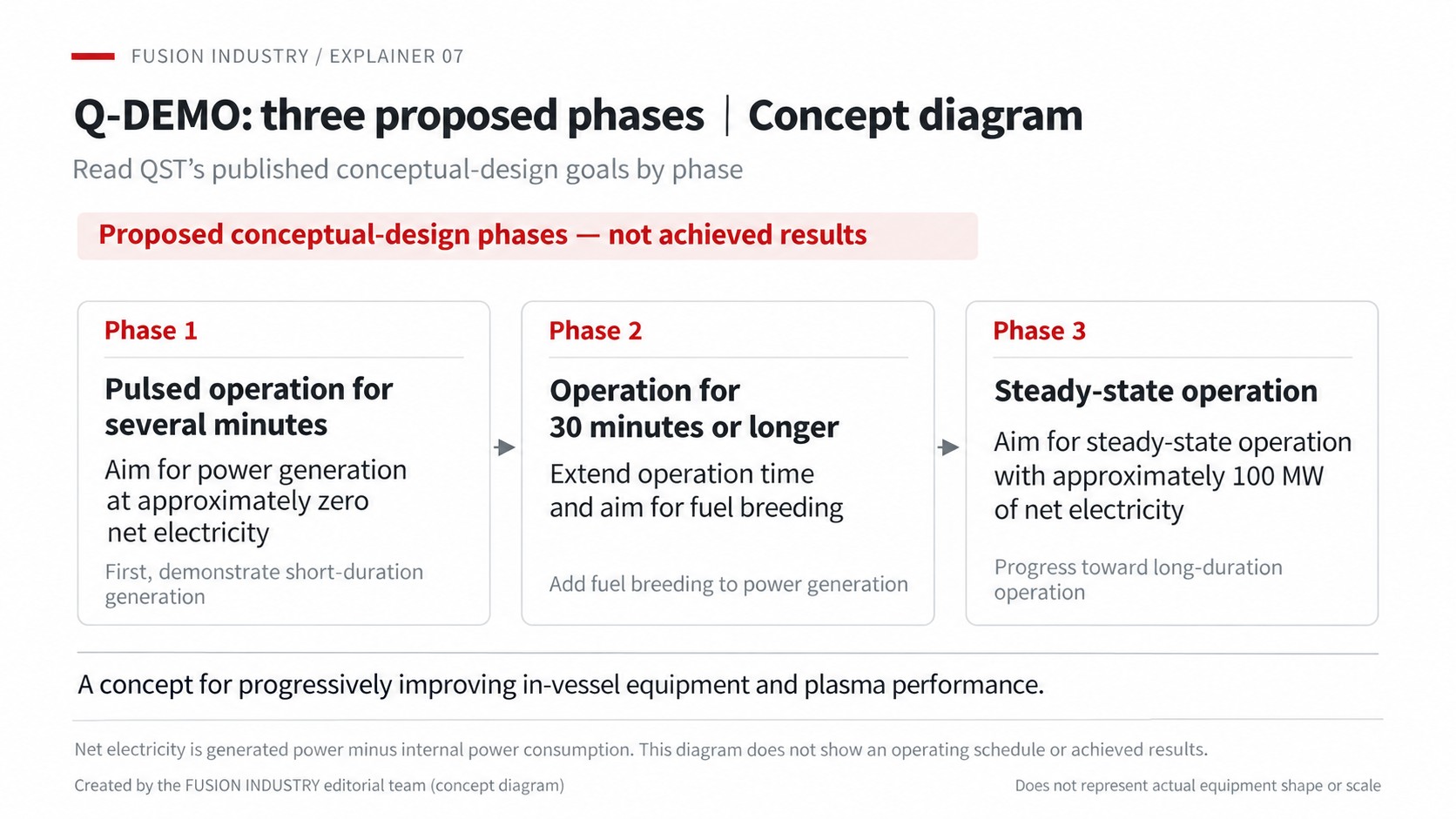
QST’s ITER-sized demonstration-reactor concept, targeting phased validation of electricity generation, fuel breeding and steady-state operation.

Read the definition and related information
Basic terms

Activation

Activation and radioactive waste

Fusion still requires management of activated materials and tritium. Conditions vary with the approach, materials and fuel.

Read the definition and related information
Approaches and technologies

Blanket

Fusion reactor blanket

In a D–T fusion reactor, the blanket receives neutron energy as heat and also supports tritium breeding. Heat extraction and material durability are crucial.

Read the definition and related information
Basic terms

Commercialization

Commercialization of fusion energy

Look beyond company target years to what each project plans to demonstrate and its stage of development.

Read the definition and related information
Power and energy recovery

Direct energy conversion (DEC)

Direct energy conversion

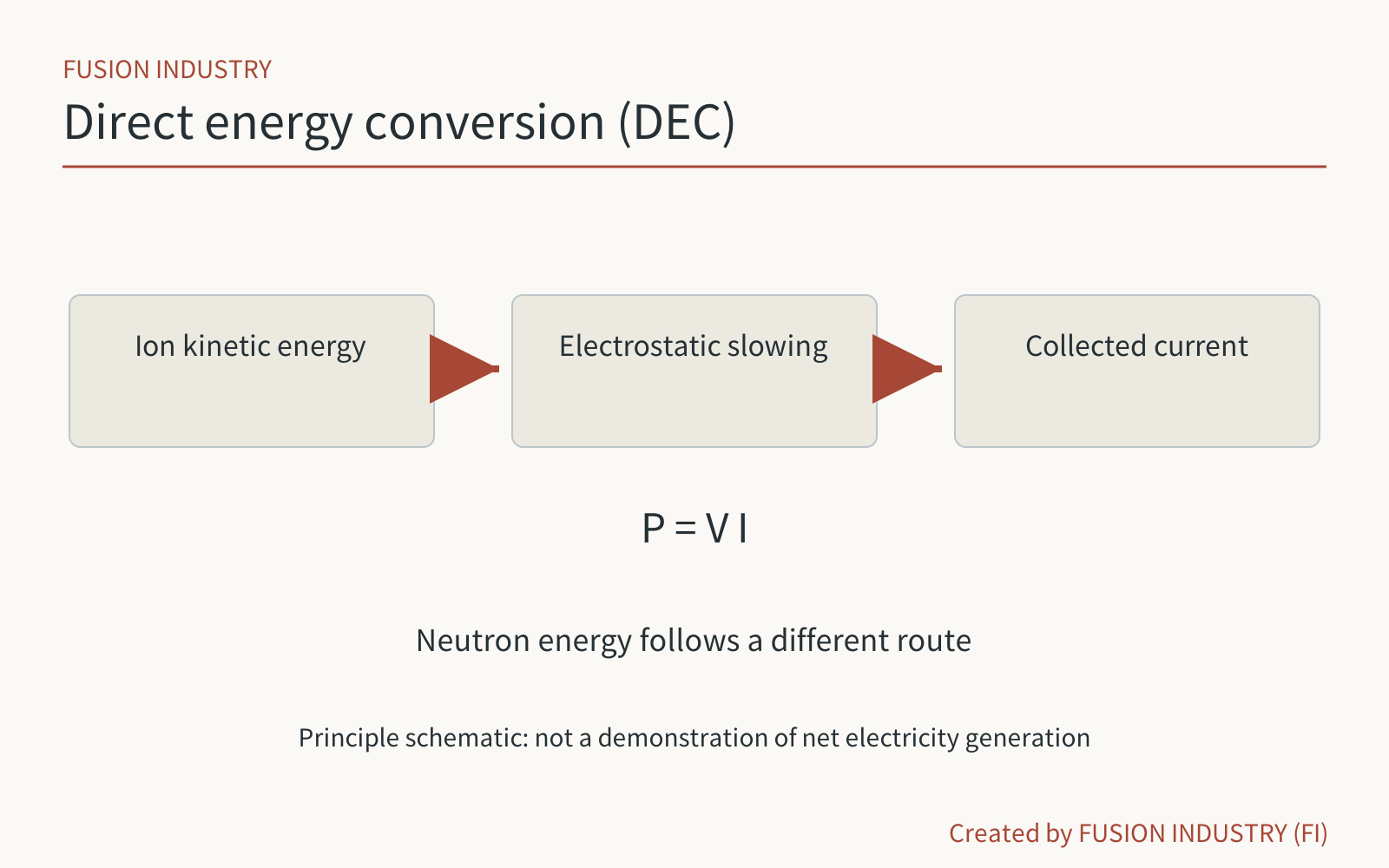
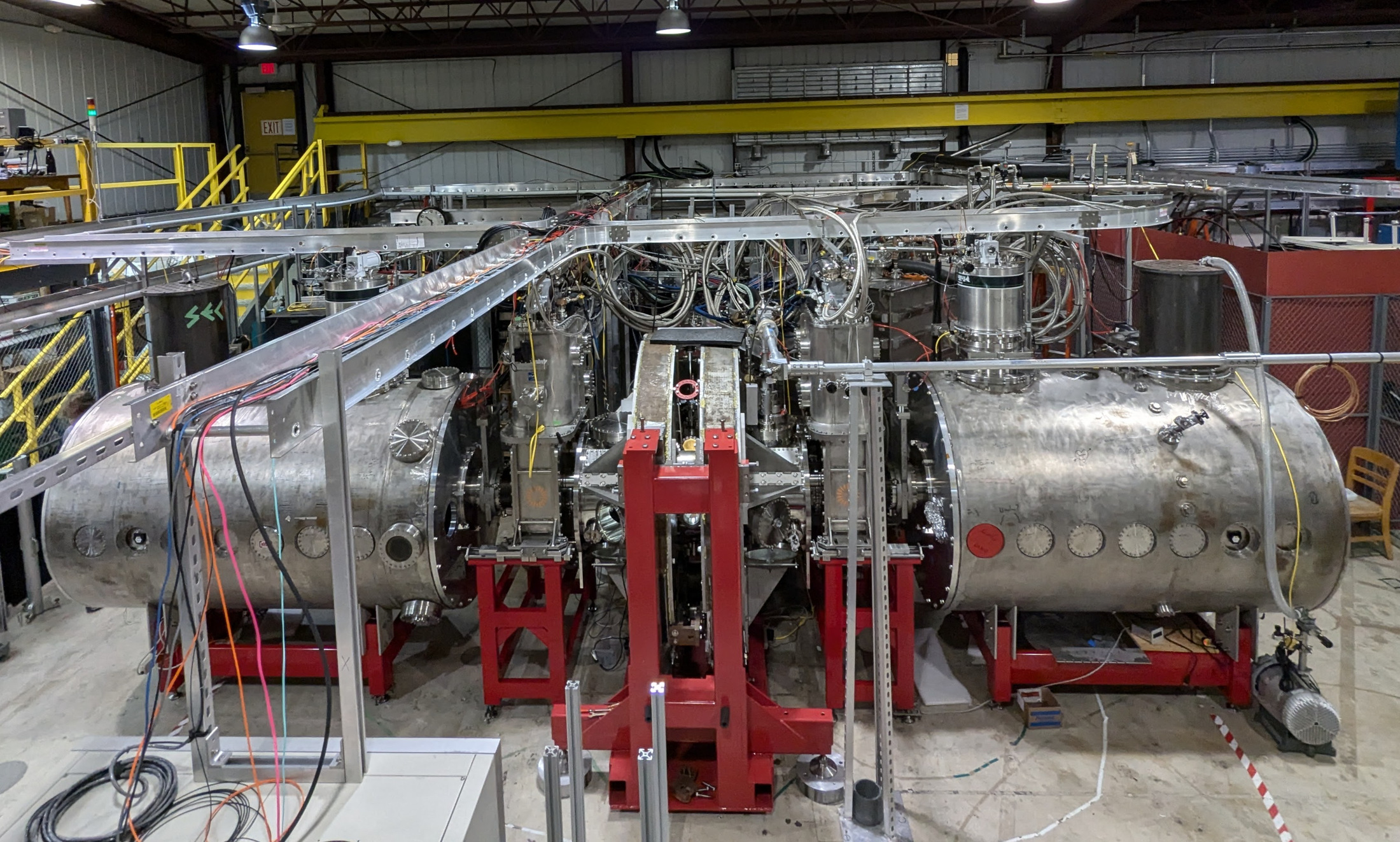
DEC recovers charged-particle kinetic energy without a heat engine. Learn why magnetic mirrors offer a suitable exhaust path and why WHAM’s demonstration is not net-electricity generation.

Read the definition and related information
Basic terms

Fission

Nuclear fission

Fusion joins light nuclei; fission splits heavy nuclei. An overview of their different principles and technical challenges.

Read the definition and related information
Approaches and technologies

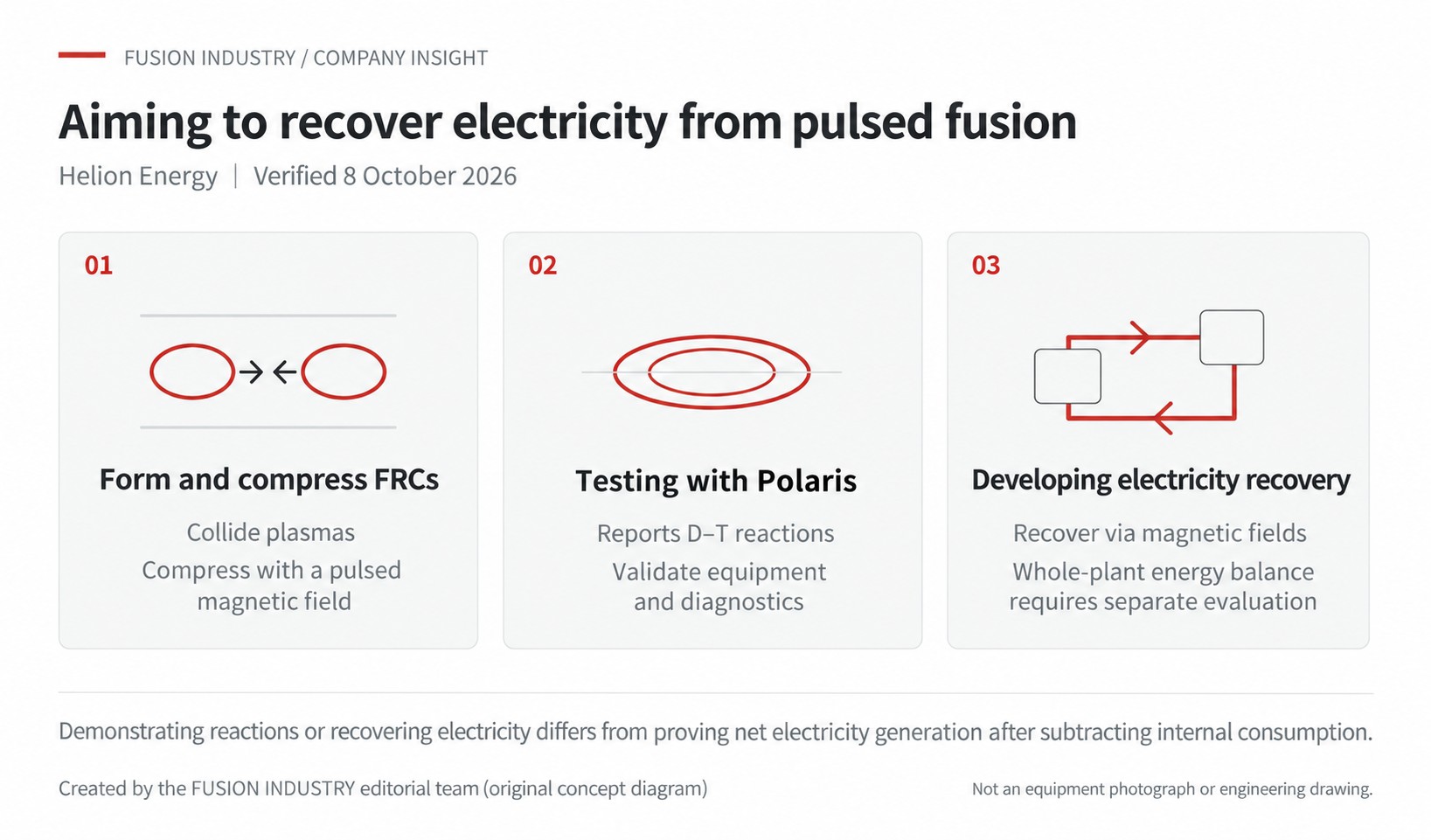
FRC

Field-reversed configuration

This approach uses a plasma structure called a field-reversed configuration. Helion's magnetic compression and TAE's beam-driven approach differ in operation and fuel strategy.

Read the definition and related information
Approaches and technologies

Fuel cycle

Fusion fuel cycle

Fusion fuel does not simply pass through a reactor once. Understand the separate tasks of recovering unburned fuel from a D–T system’s exhaust, replacing consumed tritium, and preparing fuel for reuse.

Read the definition and related information
Approaches and technologies

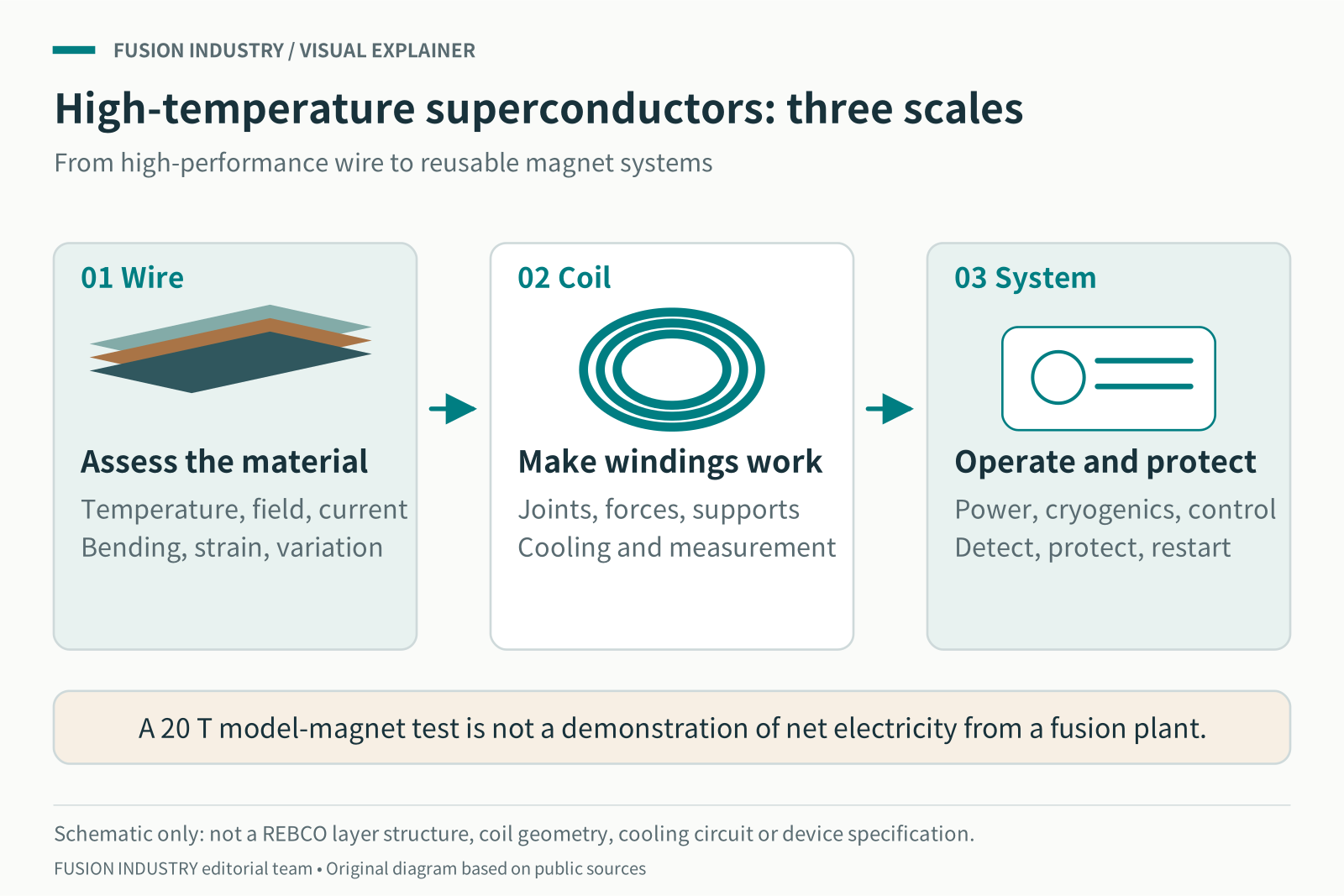
High-temperature superconducting magnets

Magnets using high-temperature superconducting materials

Magnet technology for producing strong magnetic fields. CFS uses REBCO high-temperature superconducting materials in more compact high-field tokamaks.

Read the definition and related information
Approaches and technologies

Laser fusion

Laser-driven inertial-confinement fusion

Lasers compress and heat tiny fuel targets. For power generation, integrating high-repetition-rate irradiation with target supply is a challenge.

Read the definition and related information
Confinement and plasma

Loss cone

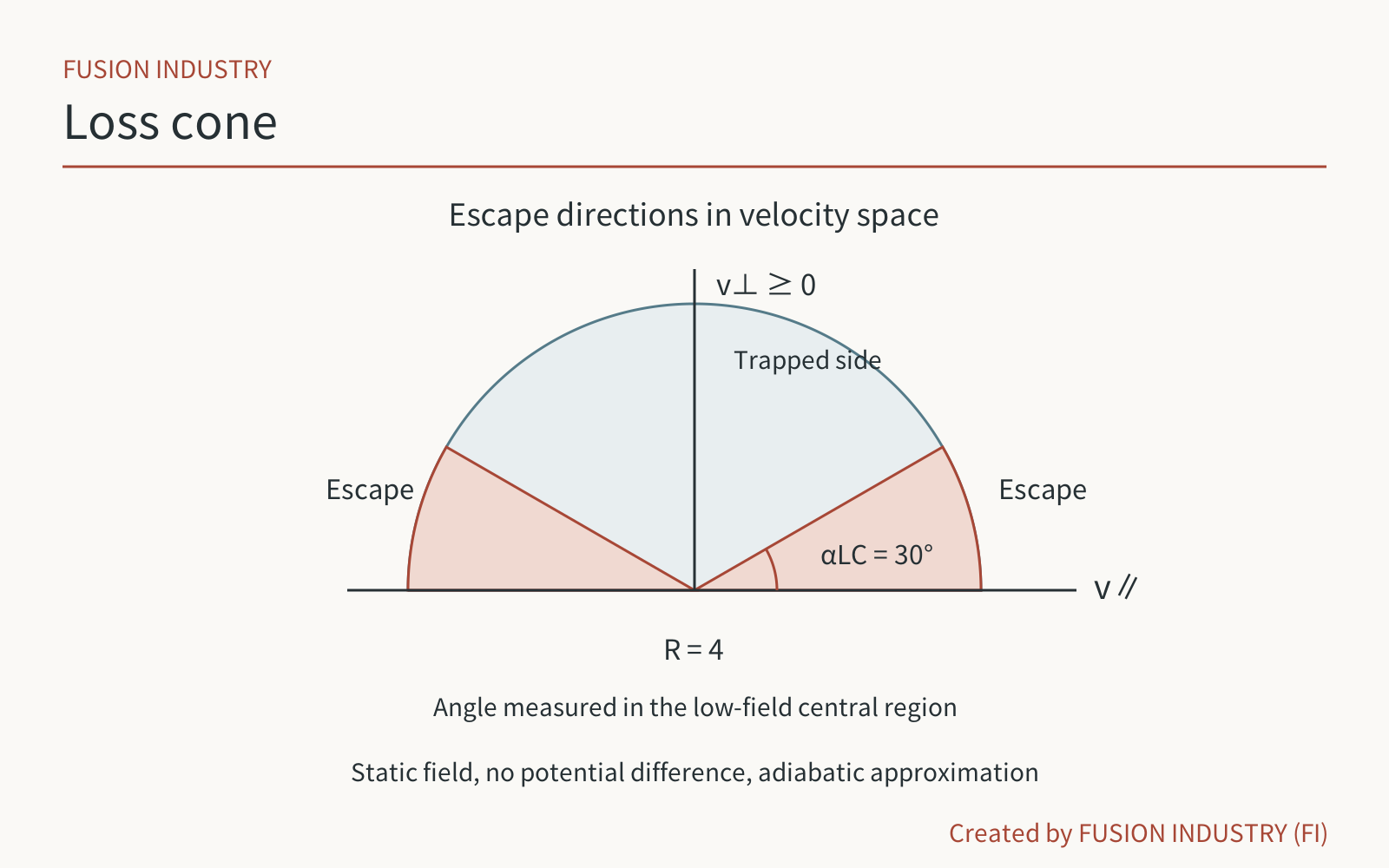
The loss cone describes velocity directions for particles that escape without magnetic reflection. It is a region in velocity space, not a cone-shaped hole in the vessel.

Read the definition and related information
Confinement and plasma

Magnetic mirror

A magnetic mirror reflects some charged particles using a magnetic field that becomes stronger toward its ends. Learn the reflection condition, end losses and the WHAM example.

Read the definition and related information
Confinement and plasma

Mirror ratio

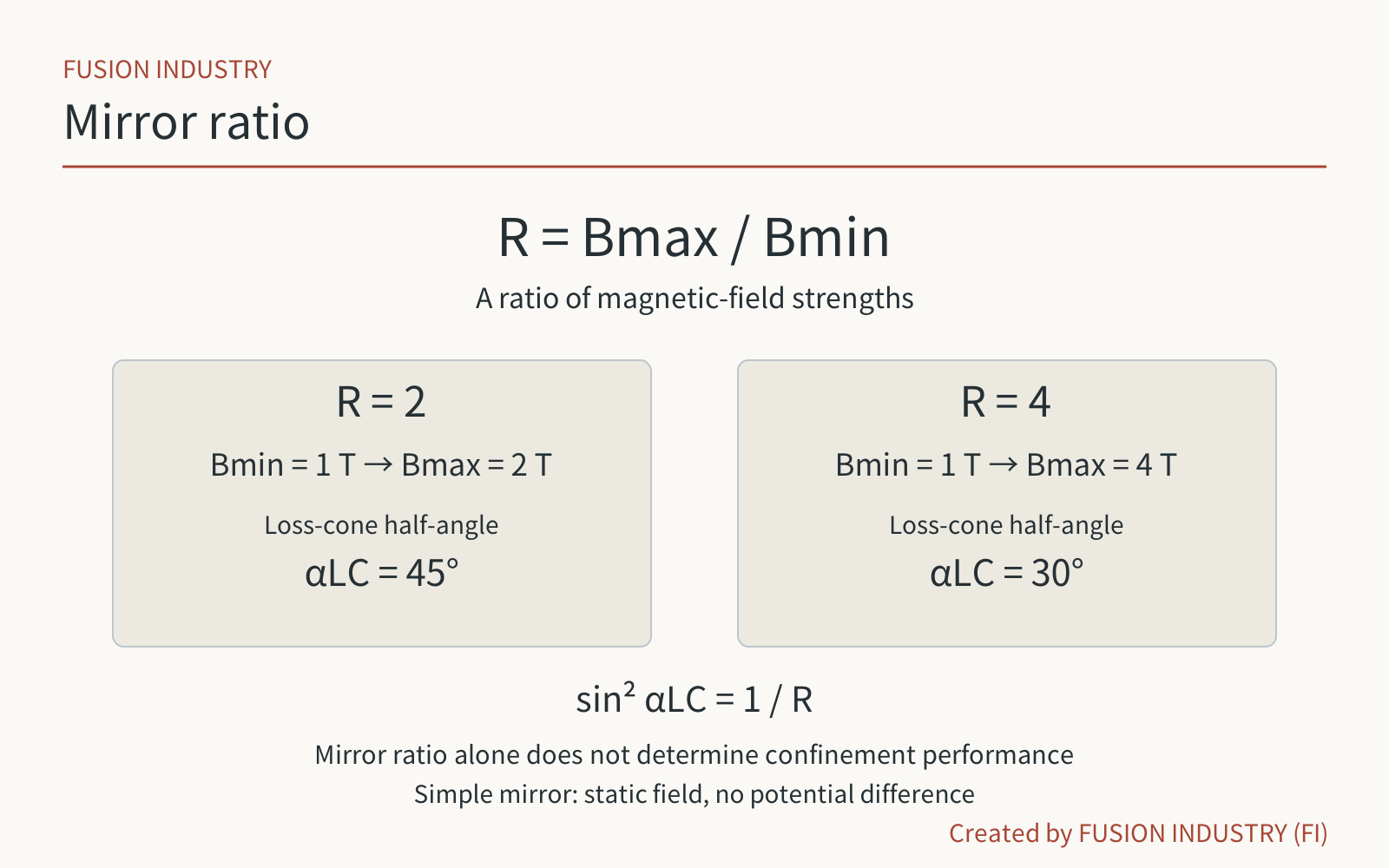
The mirror ratio compares the strong end field with the weaker central field. The same peak field can give different ratios, and one number cannot describe device performance.

Read the definition and related information
Approaches and technologies

Plasma gain Q

Ratio of fusion power to external plasma heating

Plasma energy gain Q and net electricity after subtracting the entire plant's power consumption are different metrics. Check the measurement boundary before comparing numbers.

Read the definition and related information
Confinement approaches

Stellarator

Stellarator (helical-family magnetic confinement)

How do external coils confine a hot plasma? Explore stellarator magnetic fields, the differences between LHD and W7-X, long-pulse results and the engineering challenges on the path to fusion power.

Read the definition and related information
Confinement and plasma

Tandem mirror

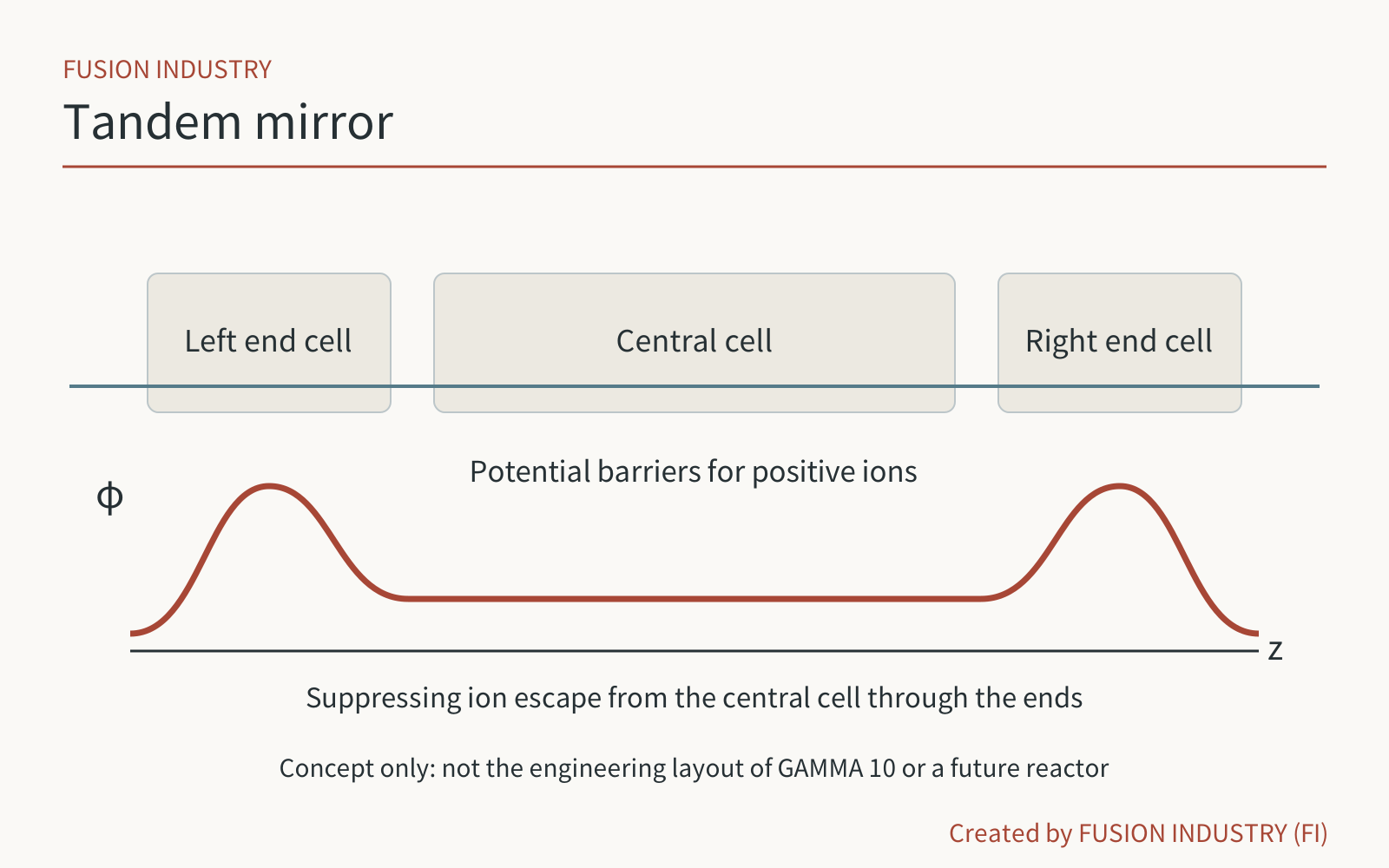
A tandem mirror connects a central plasma region to end plugs. Their electrostatic potential helps reduce particle escape. Learn how this differs from a simple mirror and why WHAM is not a complete tandem device.

Read the definition and related information
Approaches and technologies

Tokamak

Tokamak magnetic confinement

A tokamak uses magnetic fields to confine hot plasma in a toroidal vessel. Integrated design covering heating, control and materials is essential.

Read the definition and related information

Each page explains one key term. Entries for institutions and devices share their project information pages. For news and in-depth analysis, follow the related articles on each page.

Revisit the fundamentals

What is fusion energy? Start with principles, approaches, devices or the challenges of power generation. You do not need to know every abbreviation first.

Where should a beginner start?

Start by understanding how fusion energy works. Use the glossary on this page to check unfamiliar terms, then explore the approaches and devices that interest you.

How do fusion and fission differ?

Fusion joins light nuclei, while fission splits heavy nuclei. Explore not only their reactions but also differences in fuel, control and the challenges of generating electricity.

How does ITER differ from JT-60SA and Q-DEMO?

They have different purposes and development stages. Focus on what each device or plan aims to research or demonstrate to understand the path from research towards power generation.