What Is a Stellarator? Principles, Helical Configurations and Tokamak Differences
- Official name
- Stellarator (helical-family magnetic confinement)
- ENGLISH
- Stellarator
How do external coils confine a hot plasma? Explore stellarator magnetic fields, the differences between LHD and W7-X, long-pulse results and the engineering challenges on the path to fusion power.
Read the Japanese original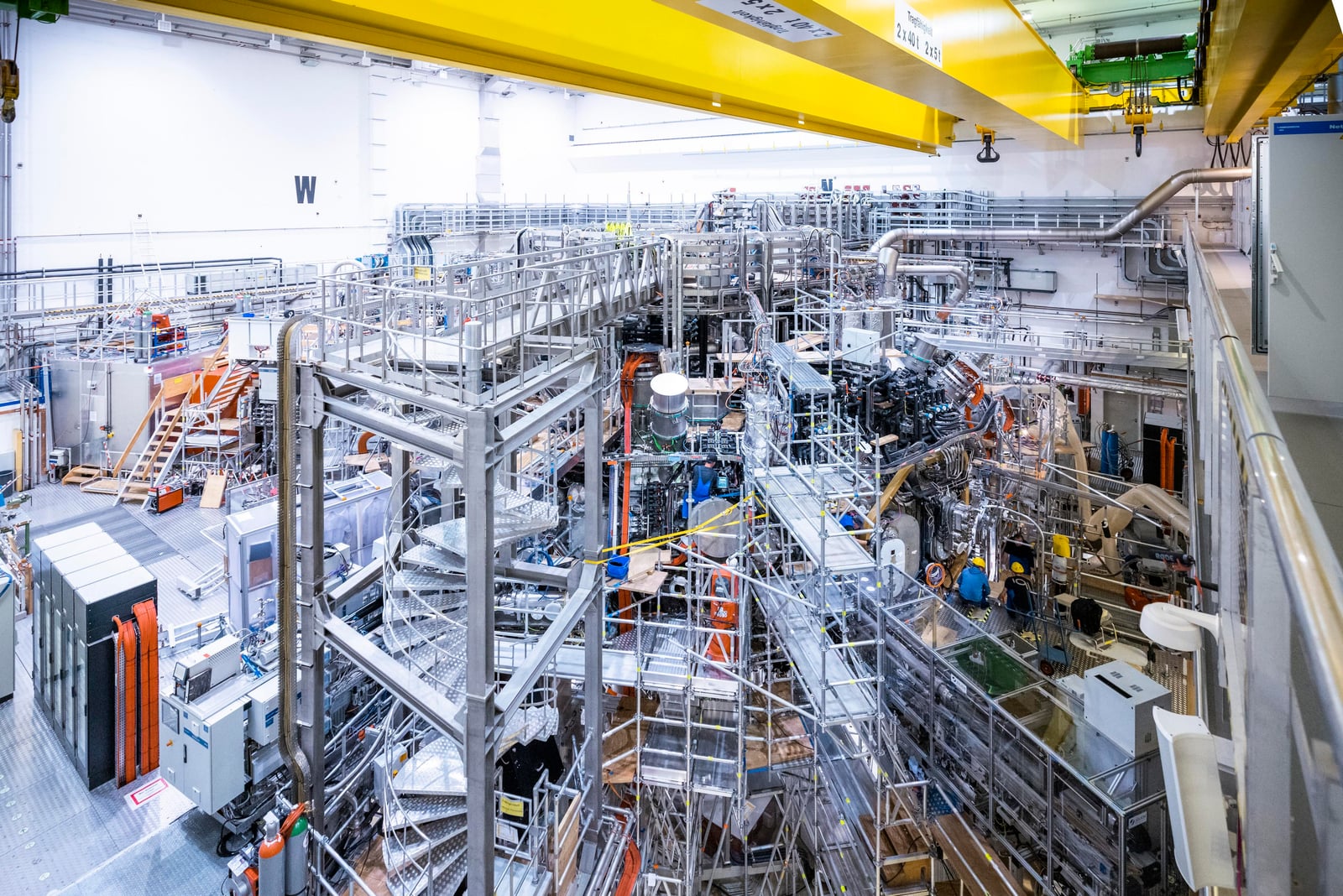
What is a stellarator? A fusion approach that builds its magnetic cage from the outside
A stellarator confines hot plasma in a ring using a three-dimensionally twisted magnetic field produced mainly by magnets outside the plasma. Its defining feature is that it can create the field needed for confinement without relying on a large plasma current.
Fusion requires a hot plasma in which electrons and atomic nuclei are separated. Contact with a wall removes energy, so magnetic fields keep the hot region away from the surrounding surfaces. The stellarator approach is to engineer this magnetic cage into the external structure. It is well suited to long-duration operation, but the magnets that make this possible can be difficult to design and manufacture.
Magnets alone do not make the plasma hot. Heating, fuel supply, heat exhaust and diagnostics are also essential. Successful stellarator experiments and a completed power station supplying electricity are different stages of development. IPP's stellarator introduction and DOE's introductory explanation describe the principle and its design implications.
Why must a doughnut-shaped magnetic field also twist?
Electrons and ions spiral around magnetic field lines while moving along them. A straight magnetic field has ends; bending it into a ring avoids losses through those ends. A simple ring is not enough, however. Differences in field strength and geometry between the inside and outside of the ring cause particles to drift out of the confinement region.
The solution is to make field lines travel around the cross-section as they also travel around the long way of the ring. The long way is the toroidal direction, while the direction around the cross-section is poloidal. A quantity called rotational transform describes this winding. It does not mean mechanically rotating the entire plasma.
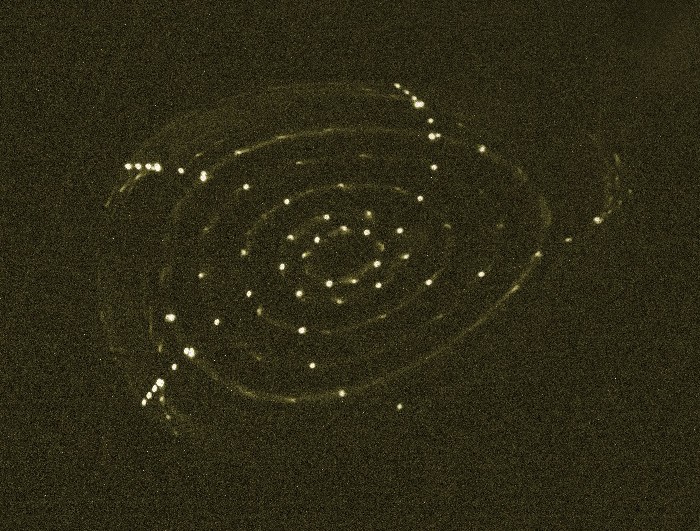
The surfaces traced out by many field lines are called magnetic flux surfaces. In the core, the aim is to form nested surfaces like the layers of an onion. Real particles still experience collisions, fluctuations and motion caused by variations in the magnetic field. Creating flux surfaces therefore does not eliminate losses. IPP's magnetic-confinement explanation
Are helical devices and stellarators the same thing?
Japanese discussions sometimes use “helical type” or “stellarator type” for the family of approaches that twist field lines using external coils. When describing hardware, however, it is useful to distinguish continuous helical windings from sets of separate three-dimensional coils. The terms overlap, but that does not mean every device has the same structure.
Japan's Large Helical Device, LHD, used a heliotron configuration. A pair of helical coils played the central role in creating its twisted field. Germany's Wendelstein 7-X, or W7-X, is a stellarator using optimized, non-planar modular coils.
Here, stellarator refers to the broader family. Within that family, we compare LHD's heliotron configuration with W7-X's optimized modular approach. NIFS's description of LHD and the heliotron
The key difference from a tokamak: what creates the twist?
Both tokamaks and stellarators confine ring-shaped plasma with a twisted magnetic field. The main difference is how they produce that field.
- Tokamak: The field from external coils combines with the field generated by a current flowing through the plasma. This allows a relatively axisymmetric geometry, but sustaining and controlling the current is important.
- Stellarator: External magnets provide the twist needed for confinement. This reduces dependence on a large toroidal plasma current, while making the field and coil geometry three-dimensional.
Tokamak operation based on transformer-induced current has a time limit. Research also pursues long-pulse and steady-state operation using non-inductive current drive, including radio-frequency methods. It would be inaccurate to say that tokamaks must always stop after a short pulse.
Stellarators can still have currents arising from pressure profiles and other effects, as well as plasma instabilities. Their advantage is not that every control problem disappears. It is that the main confinement configuration can be designed without depending on a large plasma current. IPP's tokamak introduction
Magnets are only one part of the machine
It helps to separate the different roles of a stellarator's systems.
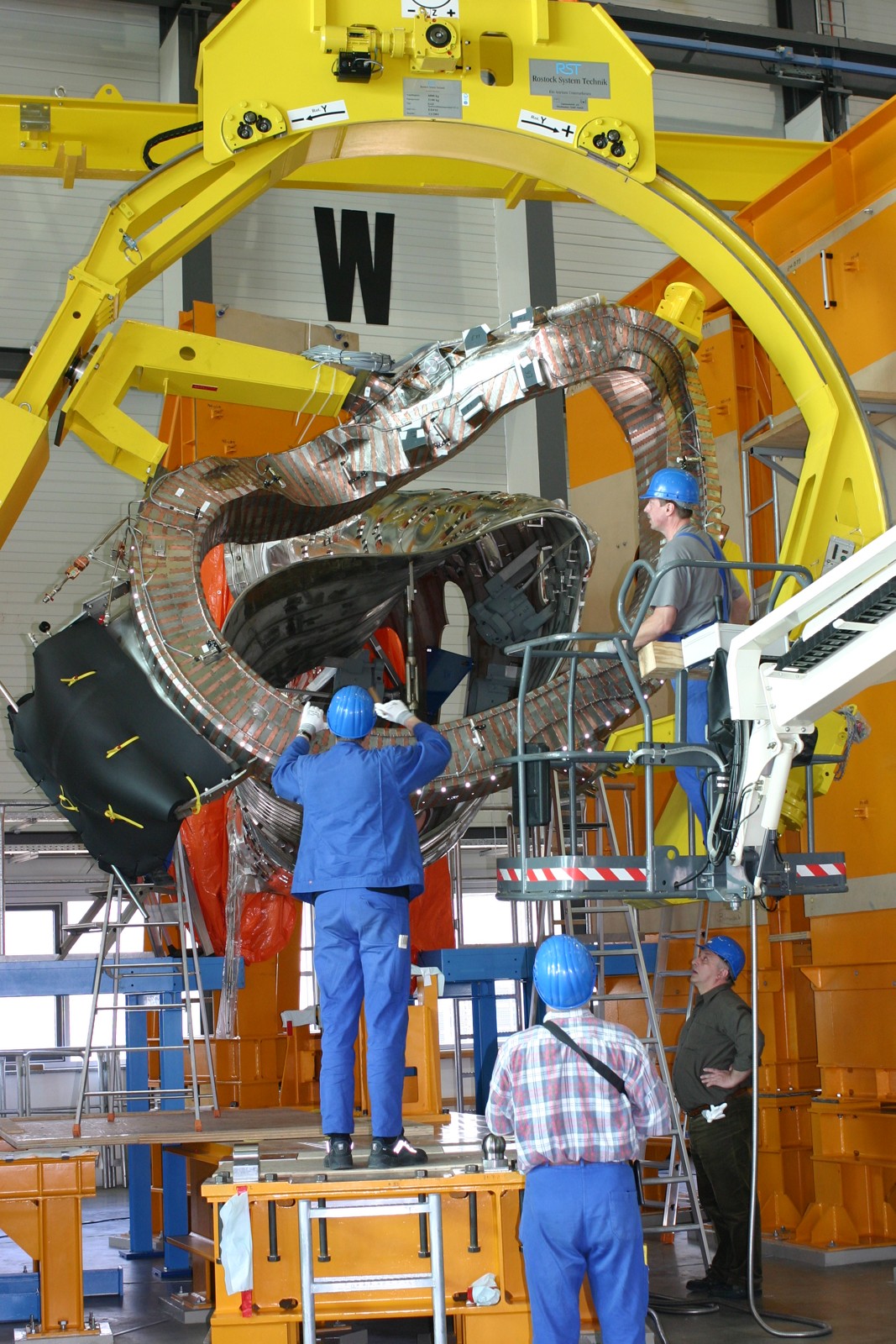
- Magnetic-field coils: Produce the confinement field. Machines using superconducting coils also need refrigeration to keep them cold.
- Vacuum vessel: Allows air to be pumped out and limits unwanted material entering the plasma. It is a physical structure, distinct from a magnetic flux surface.
- Heating and fueling systems: Supply energy through microwaves, particle beams and other methods, and inject gas or frozen fuel pellets.
- Diagnostics and control: Measure temperature, density, radiation, magnetic fields and other quantities to understand operating conditions.
- Plasma-facing components, including divertors: Receive heat and particles leaving the edge and work with the pumping system to manage the plasma environment.
Electron cyclotron resonance heating, or ECRH, is a major heating method at W7-X. IPP and its partners started the HiPMiB development project in January 2026 to develop 2 MW gyrotrons and high-power microwave transmission systems. This is a plan to increase heating capability, not a demonstrated electrical power output. IPP announcement, 27 July 2026
Optimization means designing fewer escape routes for heat and particles
A three-dimensional field is not only harder to build; it also provides design freedom. Which shapes retain particles, maintain plasma stability, allow practical coil construction and permit heat removal? Stellarator optimization uses calculations to balance these requirements.
One important challenge is neoclassical transport: the movement of heat and particles caused by the combination of collisions and variations in the geometry and strength of the toroidal field. W7-X's field was designed to suppress these losses. An analysis reported in 2021 demonstrated the design's effectiveness in reducing neoclassical energy losses.
Turbulent transport, caused by small eddies and fluctuations inside the plasma, nevertheless remains. Future reactors must also confine the fast particles produced by fusion. Reducing neoclassical transport is not the same as solving turbulence, fast-particle confinement and stability simultaneously. IPP's 2021 optimization result, IPP's theory research
Magnetic islands and divertors: engineering the way out as well as confinement
Where heat and particles go after leaving the hot core is also important. Parts of a magnetic configuration can form magnetic islands, which look like islands in a cross-section. Islands that disturb core confinement are undesirable, but edge islands can also be used to direct heat toward exhaust surfaces.
The island divertor used in the W7-X approach and LHD's helical divertor have different configurations. Both deal with the paths taken by heat, particles and impurities in a three-dimensional magnetic field.
The bootstrap current matters here too. It is a current that arises naturally from pressure gradients and particle motion, and it exists even in W7-X, where external magnets provide confinement. Changes in current can alter the magnetic field and therefore the locations where heat strikes the surrounding components. Keeping this current small was one of W7-X's design priorities partly to stabilize those heat-exhaust locations. IPP's divertor explanation, bootstrap-current measurements
LHD and W7-X: what two large experiments have demonstrated
LHD was a major experimental foundation for Japan's helical research. Located at the National Institute for Fusion Science in Toki, Gifu Prefecture, it began experiments on 31 March 1998 and completed its plasma experiments on 25 December 2025. Over more than 27 years, it performed more than 200,000 discharges for research on toroidal plasmas, heating and diagnostics. Its experimental record and continuing use of its accumulated data should not be confused with ongoing plasma operation. NIFS's experiment-completion announcement
W7-X tests the performance of an optimized stellarator. Located in Greifswald, Germany, it uses 50 non-planar superconducting coils to produce its main magnetic field. It achieved its first plasma on 10 December 2015 and its first hydrogen plasma on 3 February 2016. Its purpose is to investigate whether the approach is suitable for a future power reactor by combining good confinement with long-duration operation. IPP's machine overview
LHD's heliotron and W7-X's modular configuration are different designs addressing shared research challenges. Rather than judging them by size or a single temperature record, it is more useful to consider their magnetic configurations, experimental objectives, heating conditions and pulse durations together.
Do not confuse “43 seconds,” “triple product” or “1.8 GJ” with electricity generation
On 22 May 2025, W7-X achieved a high triple product sustained during a 43-second discharge. IPP announced the result on 3 June 2025 as an important record in the long-pulse regime. Tokamaks have achieved higher peak triple products in shorter pulses, so this does not mean that W7-X surpassed tokamaks under every condition.
The triple product multiplies density, temperature and energy confinement time. Energy confinement time is not the total duration of a plasma discharge; it describes how effectively the plasma retains its thermal energy. The 1.8 GJ over 360 seconds reported from the same campaign concerns heating-energy turnover, not electricity generated by fusion. IPP's 2025 results
A separate paper published on 1 July 2026 reported another high-performance scenario, sustaining a triple product of (1.10 ± 0.15) × 10²⁰ m⁻³ keV s for 1.9 seconds. That number must not be reassigned to the 43-second experiment. The result connects turbulence suppression through density profiles with fueling and heat-exhaust conditions. Bannmann and colleagues, Physical Review E
From the 1951 idea to shapes defined by computation and precision manufacturing
The stellarator was proposed in 1951 by Princeton University's Lyman Spitzer. Early concepts included figure-eight-shaped machines that looked different from today's modular-coil configurations. The idea of confining plasma using external magnetic fields has endured, while computing, plasma theory, manufacturing and measurement techniques have changed the designs. PPPL's historical account
Private companies are also pursuing reactors with different configurations. Helical Fusion is developing a helical fusion reactor; Proxima Fusion combines quasi-isodynamic magnetic fields with high-temperature superconductors in its stellarator approach; Type One Energy describes a program connecting stellarator technology with power-generation projects. These are the companies' stated development directions, not evidence that they have already generated or sold electricity. Helical Fusion, Proxima Fusion, Type One Energy
A power reactor needs more than long-lasting confinement
Even a magnetic configuration well suited to steady-state operation cannot run for extended periods without continuous fueling, heat removal and protection of walls and components. A future D–T reactor also needs to address neutron damage, tritium breeding and the fuel cycle, heat recovery and component replacement. Success in a plasma experiment alone does not demonstrate a viable power station integrating all of these functions.
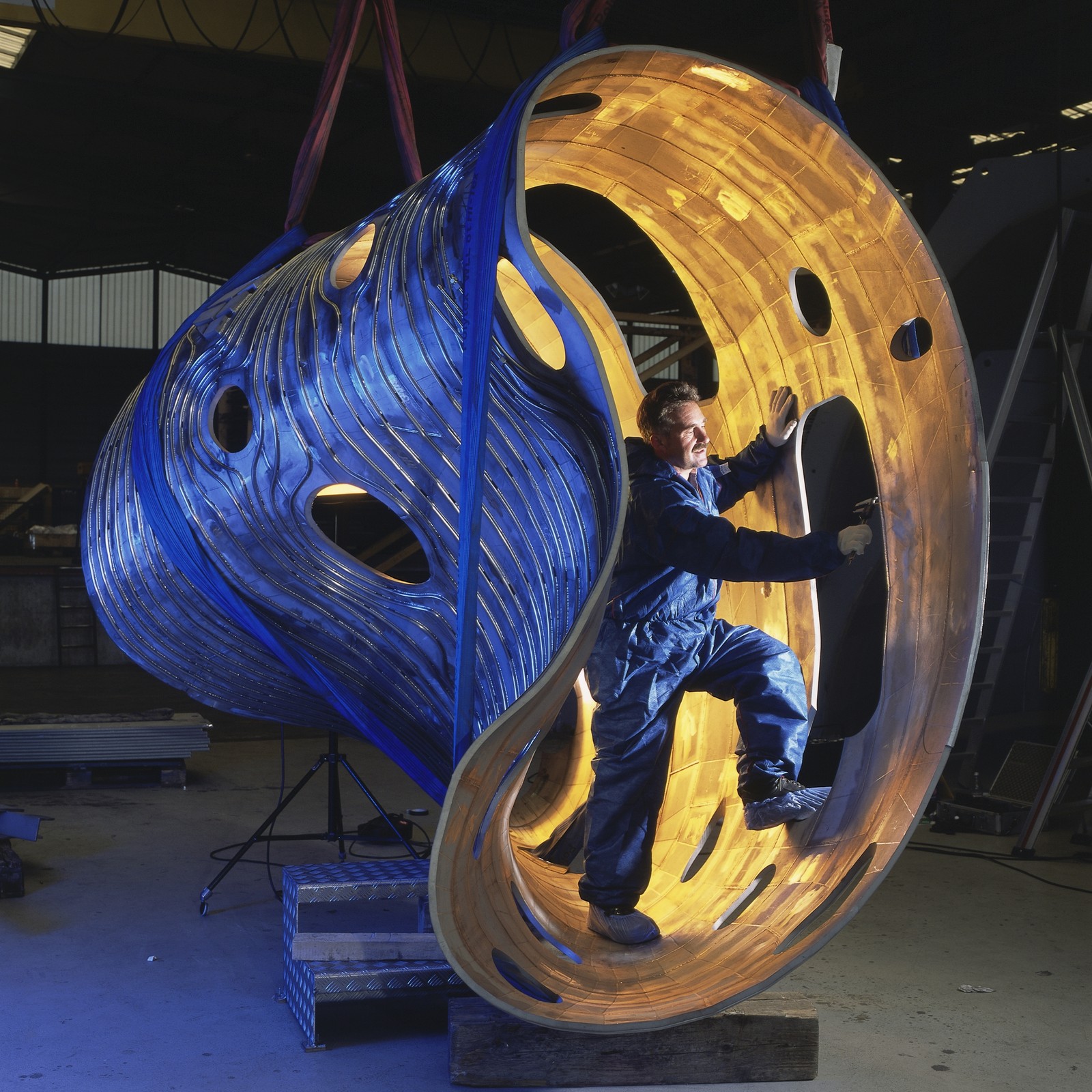
For industry, coil-manufacturing accuracy, assembly, quality assurance, refrigeration, maintenance access and cost all matter. Calculating a good magnetic field and repeatedly building and maintaining a machine that reproduces it are separate tasks.
The appeal of the stellarator is that it incorporates the magnetic twist into external engineering, opening a route toward long-duration operation. Assessing it requires looking together at confinement performance, duration, heat exhaust, manufacturing, maintenance and the energy balance of the whole plant. Once the reason for the complex shape becomes clear, the coils in photographs are no longer merely difficult curves: they are engineering choices intended to control plasma behavior.
Official information from related companies and research institutions
Check each organization’s announcements for development progress and technical documentation.
- IPP | Stellarator
- DOE Explains | Stellarators
- IPP | Magnetic confinement
- NIFS | LHD project and heliotron configuration
- IPP | Tokamak
- IPP | HiPMiB microwave-heating development project
- IPP | W7-X optimization results, 2021
- IPP | Stellarator theory
- IPP | Divertor
- IPP | Bootstrap-current measurements
- NIFS | Completion of LHD plasma experiments
- IPP | Wendelstein 7-X overview
- IPP | W7-X long-pulse results, 2025
- Bannmann et al. | Physical Review E, 2026
- PPPL | Early stellarators and Project Matterhorn
- Helical Fusion | Official website
- Proxima Fusion | Official website
- Type One Energy | Official website
Checked:2026-11-03