FRC
- Official name
- Field-reversed configuration
- ENGLISH
- Field-Reversed Configuration
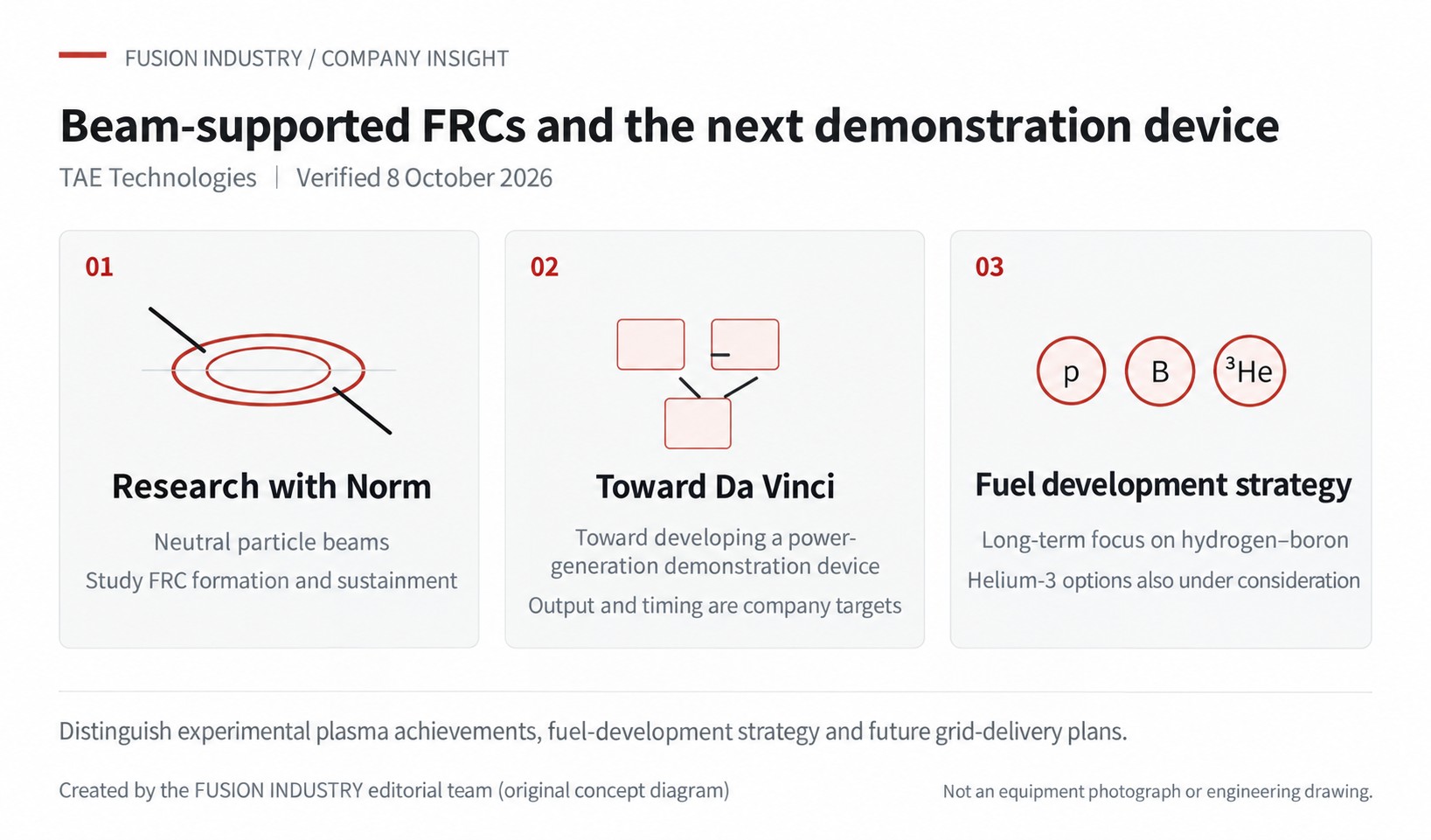
This approach uses a plasma structure called a field-reversed configuration. Helion's magnetic compression and TAE's beam-driven approach differ in operation and fuel strategy.
Read the Japanese original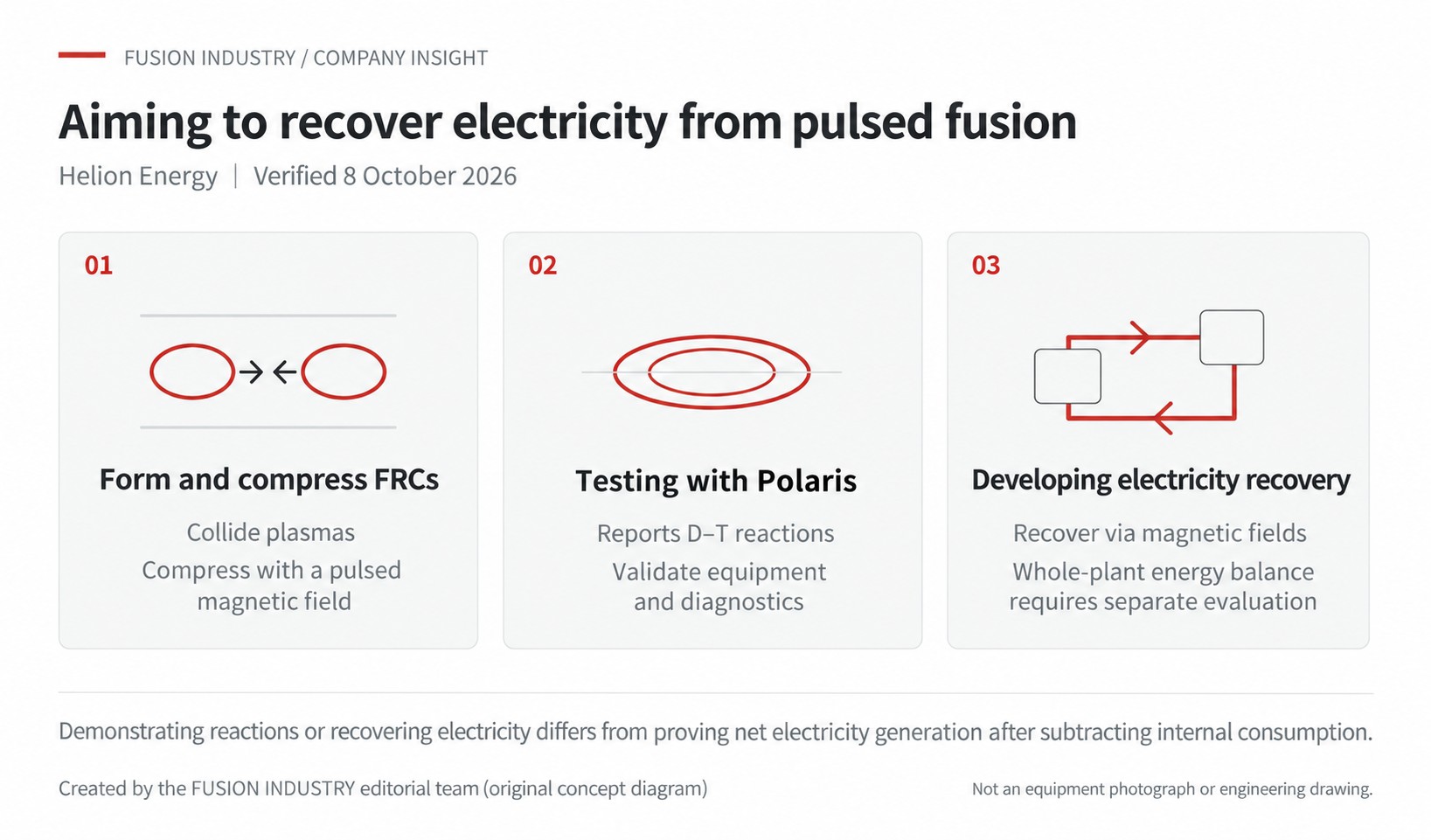
This approach uses a plasma structure called a field-reversed configuration. Helion's magnetic compression and TAE's beam-driven approach differ in operation and fuel strategy.
Business considerations
Consider manufacturing repeatability, maintenance, quality assurance and supply availability alongside individual performance. Check the reactor's overall objectives and the scope demonstrated for each component.
Understanding the organizations and companies
FRC is a plasma configuration, not a single power-generation method shared by companies. Helion develops FRC collision and magnetic compression with direct electricity recovery through electromagnetic induction, and identifies deuterium–helium-3 as its commercial fuel. TAE develops an FRC supported by neutral particle beams and pursues hydrogen–boron fuel for the future. Numerical comparisons must account for differences in fuel, heating, repetition and energy recovery.
Official information from related companies and research institutions
Check each organization’s announcements for development progress and technical documentation.
Checked:2026-10-08