Tandem mirror: combining magnetic confinement with potential barriers
- Official name
- Tandem mirror
- ENGLISH
- Tandem mirror
A tandem mirror connects a central plasma region to end plugs. Their electrostatic potential helps reduce particle escape. Learn how this differs from a simple mirror and why WHAM is not a complete tandem device.
Read the Japanese original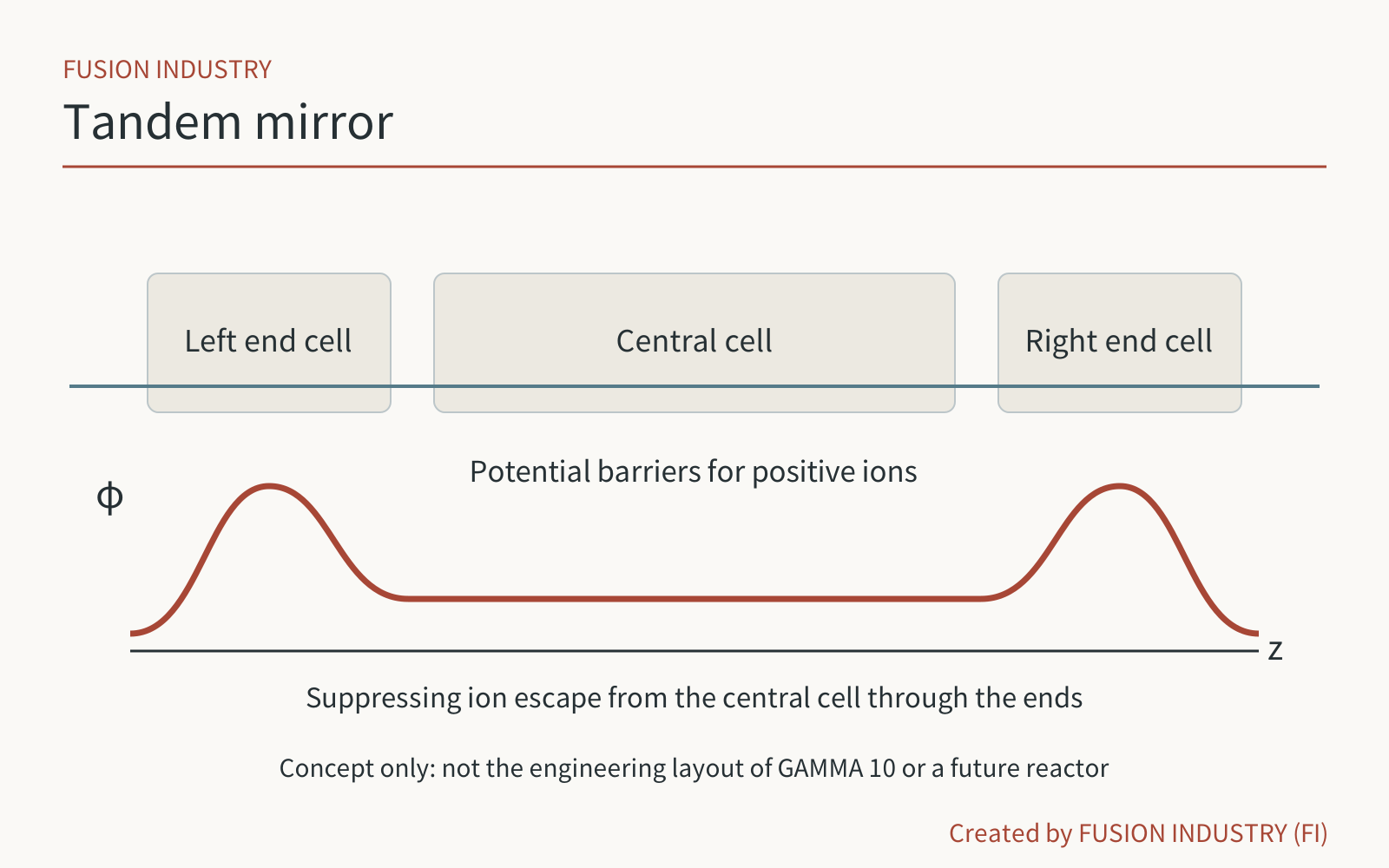
Adding an electric potential to magnetic confinement
A tandem mirror combines a long central plasma region with mirror regions at both ends. “Tandem” refers to their in-line arrangement. In a simple magnetic mirror, some particles can escape along the magnetic field. Controlling the density and temperature of the end-plug plasmas creates an electrostatic potential difference relative to the central cell, reducing the escape of positively charged ions in particular.[1][3]
For an ion, the potential barrier resembles an uphill energy requirement. It is not a solid cap over an opening. Magnetic reflection and electrostatic confinement work together, while electrons and ions respond differently. A drawing of a potential hill describes the electrical state of the plasma, not the shape of the vacuum vessel.
Central cells, plugs and thermal barriers
The central cell is the main region intended to host fusion. The end plugs help confine it. The University of Tsukuba’s GAMMA10 also has anchor cells for overall stability and plug/barrier cells that form ion-confining and thermal-barrier potentials. Radio-frequency and neutral-beam heating create and sustain the plasma.[2]
A thermal barrier is a potential structure that reduces energy exchange between hot end-region electrons and central-cell electrons. It is not a piece of insulating material. Not every tandem mirror uses GAMMA10’s cell arrangement or a thermal barrier: classical and thermal-barrier tandem configurations must be distinguished.[1][3]
Keep experiments separate from proposed power plants
GAMMA10 has investigated potential formation and improved confinement. WHAM, supported by Realta, is a simple-mirror experiment, not a completed tandem system. Realta-associated studies predict tandem-mirror performance using technologies such as high-temperature superconducting magnets. Calculated fusion gain is neither measured WHAM gain nor net power-plant output. A correction was subsequently issued for the 2025 modelling paper.[2][3][4]
Commercial development requires an energy balance that includes power used to heat and sustain the end plugs, radial particle and heat losses, and plasma instabilities. Stronger end confinement alone is not enough: the energy needed to maintain the central plasma across the entire system matters.