About the data

Q and net electricity

Official name
Ratio of fusion power to external plasma heating
ENGLISH
Plasma energy gain

Plasma energy gain Q and net electricity after subtracting the entire plant's power consumption are different metrics. Check the measurement boundary before comparing numbers.

Published Updated Translation reviewed
Share this article
Read the Japanese original
A terminology guide explaining meaning and role.Checked: 2026-10-08。
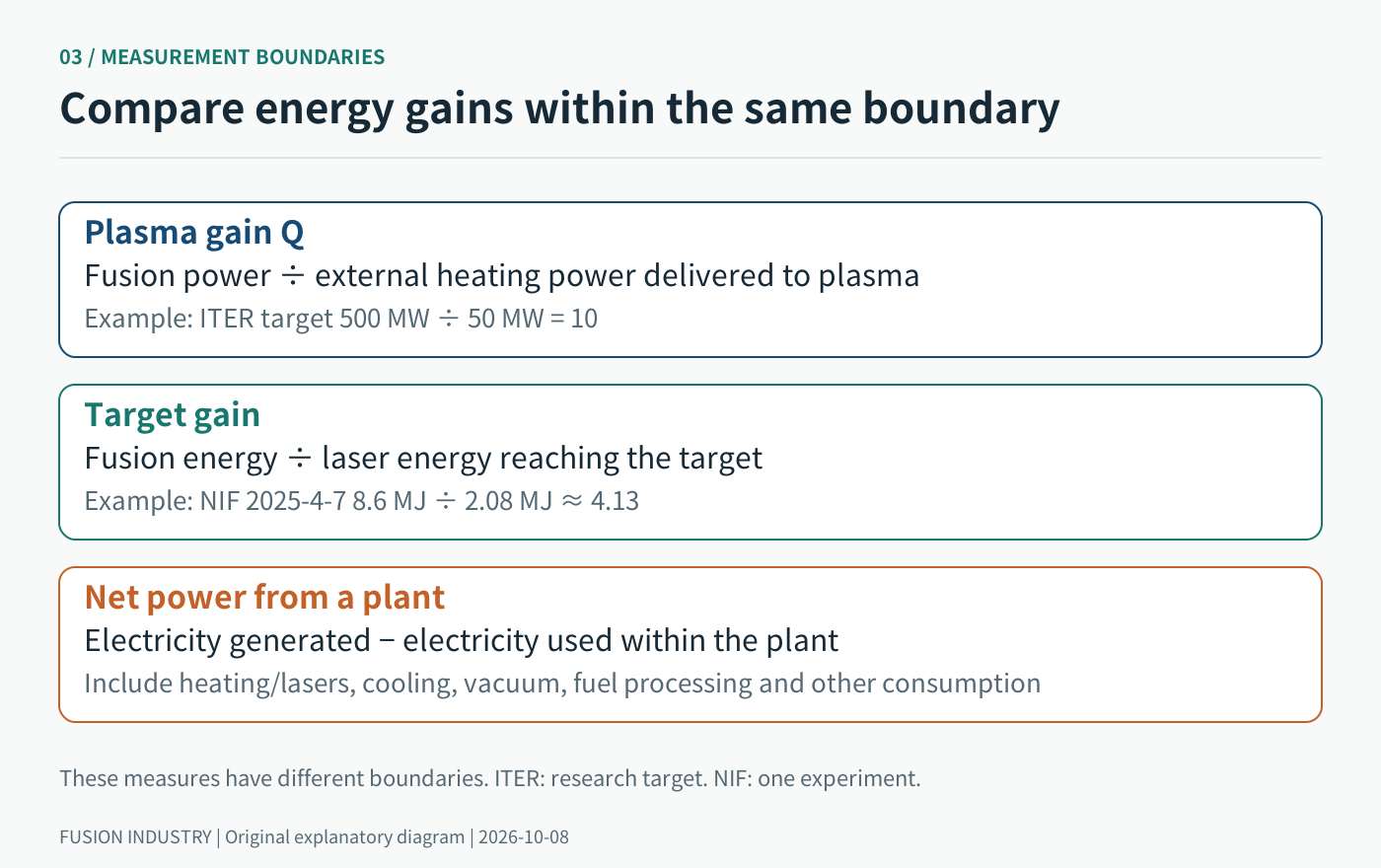
Three measurement boundaries: ITER’s plasma-gain target, NIF’s target gain in April 2025, and net electric power for a whole power plant.
Separate the measurement scopes of plasma gain, target gain and plant net electric power. Larger numbers do not rank different fusion approaches.FUSION INDUSTRY editorial team — original diagram

Plasma energy gain Q and net electricity after subtracting the entire plant's power consumption are different metrics. Check the measurement boundary before comparing numbers.

Business considerations

Consider manufacturing repeatability, maintenance, quality assurance and supply availability alongside individual performance. Check the reactor's overall objectives and the scope demonstrated for each component.
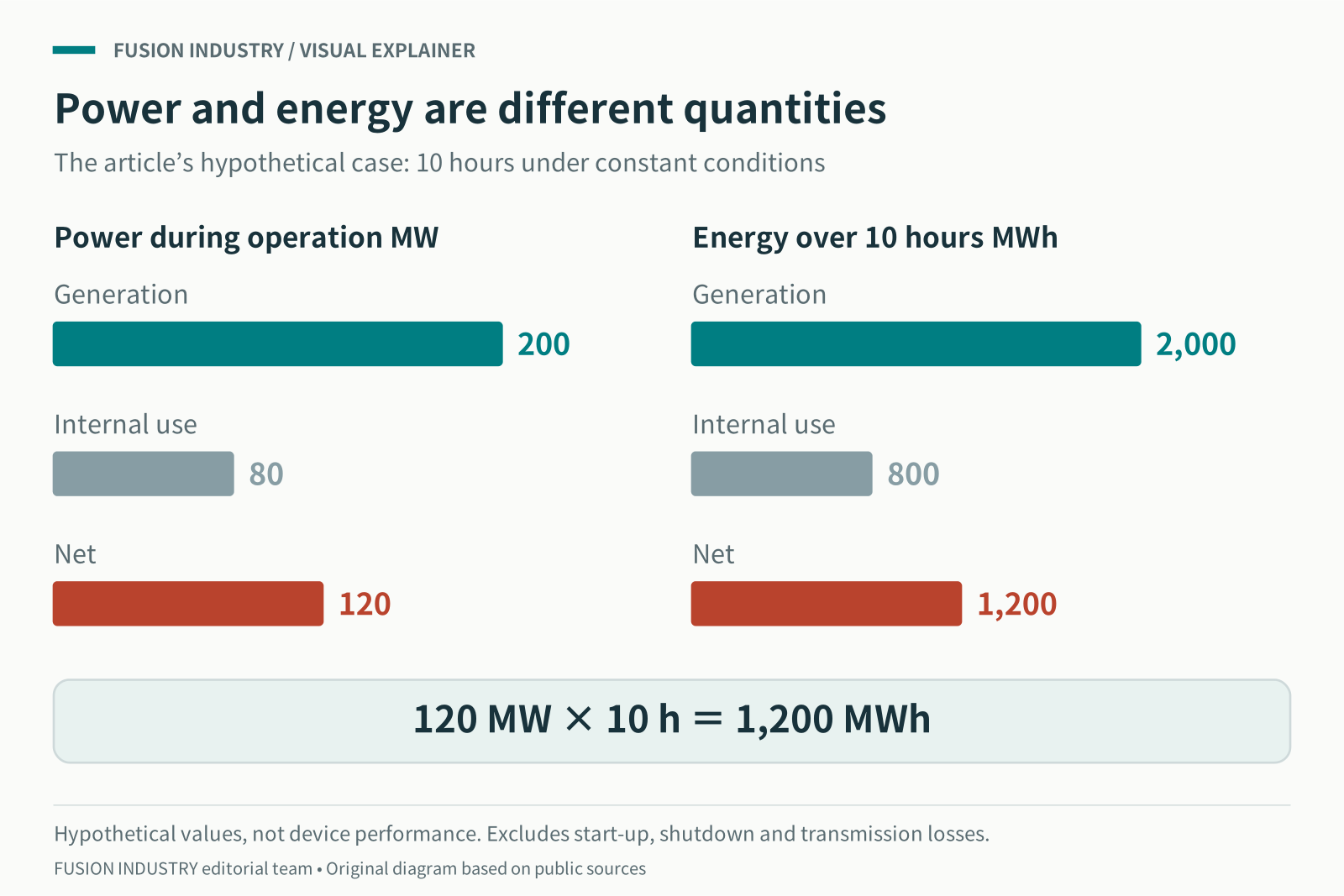
A hypothetical plant generates 200 MW and consumes 80 MW internally, leaving 120 MW. Over 10 hours at constant output, these become 2000 MWh, 800 MWh and 1200 MWh. Bars are proportional within each column; the columns use different units.
Power is the rate of energy conversion; electric energy accumulates over time. The article’s hypothetical 200−80=120 MW example is extended over 10 hours, excluding start-up, shutdown and transmission losses.FUSION INDUSTRY editorial team — original diagram

Understanding the organizations and companies

Even the same symbol Q changes meaning depending on which energy input forms the denominator. Distinguish ITER's plasma gain, NIF's target gain and the balance between a facility's electricity consumption and generation. A company's phrase 'net fusion energy' does not necessarily mean net electricity. Checking measurement locations, time intervals, auxiliary loads and whether values are measured or designed is the starting point for a fair comparison.

ITER Organization / LLNL/NIF / Commonwealth Fusion Systems / LLNL LIFT

Official information from related companies and research institutions

Check each organization’s announcements for development progress and technical documentation.

ITER Organization Explains plasma gain versus engineering breakeven. ITER does not generate electricity.LLNL/NIF Gain uses the optical energy reaching the target as its denominator. Values are reported by experiment date.Commonwealth Fusion Systems Company explanation of the goal of Q > 1 in SPARC. Do not confuse the outlook as of August 2026 with an achieved result.LLNL LIFT Reviews laser wall-plug efficiency and repetition requirements for future power generation.Tokamak Energy Official information from related companiesCommonwealth Fusion Systems Official information from related companiesEX-Fusion Official information from related companiesITER Official information on research devices and projectsQ-DEMO Official information on research devices and projectsSPARC Official information on research devices and projects
Share this article