Fuel cycle
- Official name
- Fusion fuel cycle
- ENGLISH
- Fusion fuel cycle
Fusion fuel does not simply pass through a reactor once. Understand the separate tasks of recovering unburned fuel from a D–T system’s exhaust, replacing consumed tritium, and preparing fuel for reuse.
Read the Japanese original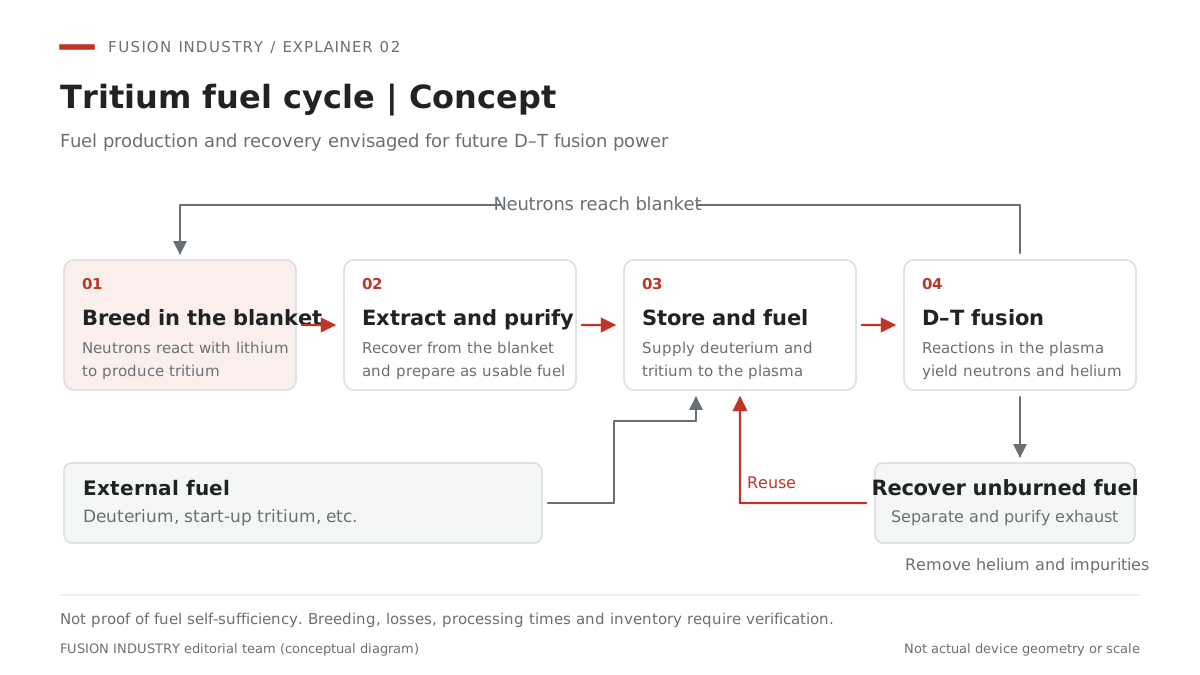
What is the fuel cycle?
The fuel cycle is the set of systems and operations that supplies fuel to a fusion device, recovers and purifies unburned fuel from its exhaust, and prepares it for resupply. This page focuses on systems using deuterium (D) and tritium (T). Other fuels or confinement approaches can require different delivery methods and equipment.
The first distinction is between recycling, which returns unburned fuel, and breeding, which produces new tritium. Recovering more fuel does not bring back fuel already consumed in a fusion reaction.
From exhaust to reusable fuel
ITER is designed to exhaust unburned fuel together with the reaction product helium and impurities, then process it for reuse in its Tritium Plant. Its main functions can be understood as follows:
- Exhaust processing and purification: separate hydrogen isotopes from other constituents.
- Isotope separation: adjust the deuterium and tritium composition of the purified hydrogen mixture as required.
- Storage and delivery: hold recovered and newly received fuel, then pass it to the supply system.
- Gas and water treatment: recover tritium that has entered streams outside the main fuel flow.
- Analysis: determine the composition at different stages to support processing and supply.
This is a functional overview, not a piping diagram common to every facility. ITER identifies six subsystems; those should not be counted as though they were identical to the equipment divisions used by another test facility.
Recovering fuel is not the same as producing it
Future D–T power plants envisage breeding tritium through reactions between fusion neutrons and lithium. The breeding blanket must be connected to processes that extract the produced fuel and transfer it to the fuel system. This is a different route from recovering unburned fuel leaving the reactor.
ITER’s Test Blanket Modules are planned to test breeding technologies in a fusion environment. A successful component-level test cannot be equated with fuel self-sufficiency for an entire power plant. Alongside the amount bred, it is necessary to distinguish how much can be extracted, how much remains in equipment, and when it can be returned for the next operation.
Source: ITER — Tritium breeding
H3AT: what will the facility test?
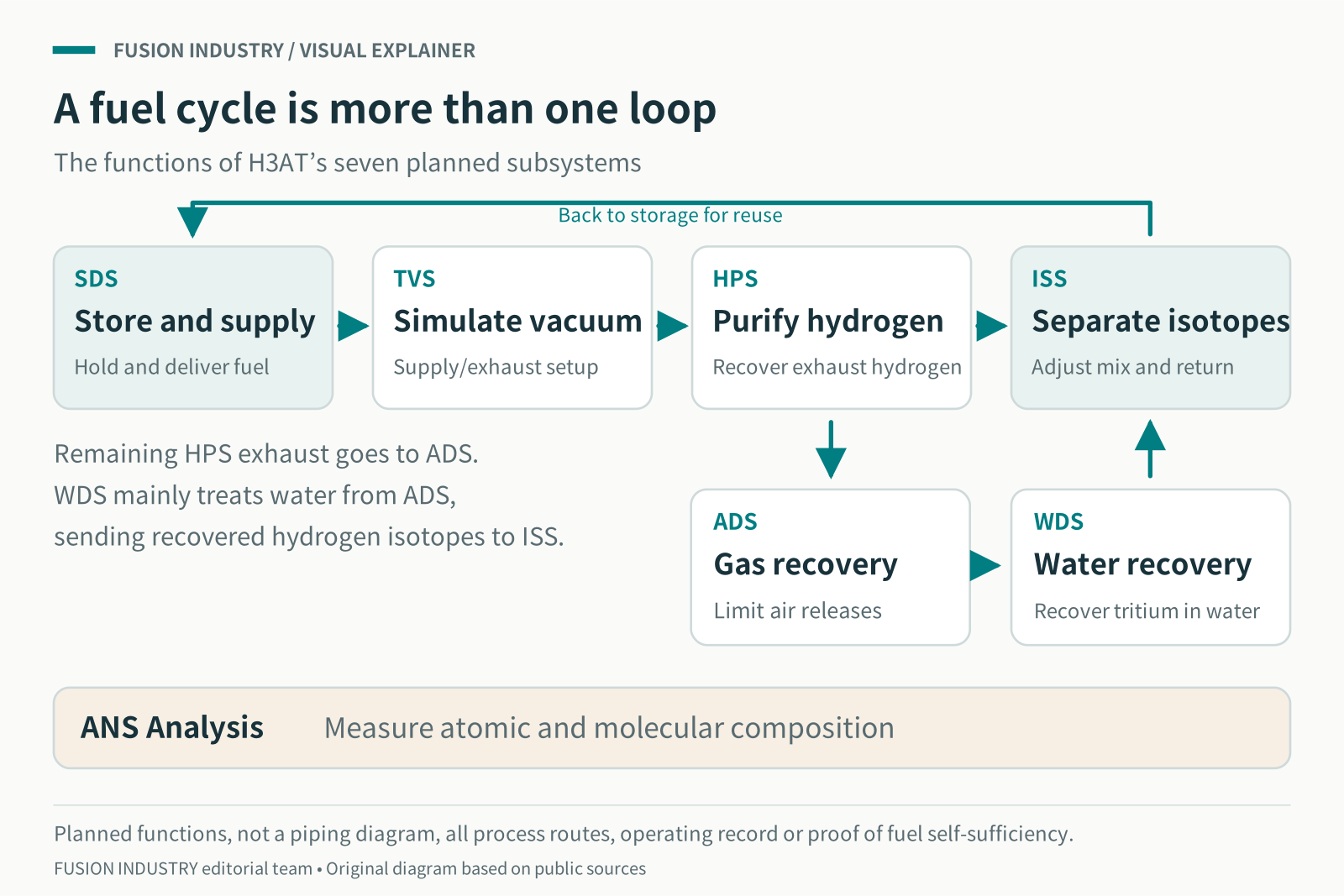
The H3AT Tritium Loop Facility, being developed by the UK Atomic Energy Authority and Eni, aims to demonstrate a continuous, closed-loop fuel cycle at pilot-power-plant scale. The published plan calls for completion in 2028 and full commissioning and operation by 2030. These are planned milestones, not an operating record.
Its seven published functions cover storage and distribution; simulation of a device’s feed and exhaust; hydrogen purification; isotope separation; recovery from gas; recovery from water; and analysis. A key distinction is that it simulates feed and exhaust conditions rather than operating a fusion reactor itself.
H3AT’s isotope-separation system includes distillation at 21–26 K. This is a condition of the separation process—not the plasma temperature or the temperature of the entire fuel system. Understanding a number requires identifying the process to which it applies.
Source: UKAEA — H3AT Tritium Loop Facility
Which measurements show progress?
An announcement that fuel has been recovered does not, on its own, show how close a system is to continuous operation. FI separates at least these questions:
- What was processed? Exhaust, gas or water? Was the test conducted with hydrogen or actual tritium?
- What was the processing capacity? How much was treated, for the specified flow rate and composition?
- Was it ready for resupply? Did the output meet the purity and composition required by the next process?
- What were the inventory and processing time? How much remained within the system, and how long before it could be used again?
- How far did integration extend? A single component, connected process tests, or operation coupled to a reactor?
These are editorial criteria for reading evidence, not equations for estimating unpublished performance. Recovery percentages alone should not be used to rank equipment tested under different conditions.
Related companies and further reading
Kyoto Fusioneering’s UNITY-2, developed with CNL, is one example of fuel-cycle development. Its announcement of 24 August 2026 distinguishes preliminary hydrogen tests in Japan from planned tritium operation in Canada by year-end. That announcement alone does not establish that the planned operation has taken place. The company profile explains the business and development organization; this page explains the roles of the equipment.
Source: Kyoto Fusioneering — 24 August 2026 announcement
- Kyoto Fusioneering’s business and technologies
- A worked explanation of recovery, breeding and the fuel balance
- Start with how fusion power works
Understanding the fuel cycle means looking beyond reactor performance to the systems outside the reactor that must work reliably for a power plant to keep operating.
Official information from related companies and research institutions
Check each organization’s announcements for development progress and technical documentation.