Direct energy conversion (DEC): from particle motion to electricity
- Official name
- Direct energy conversion
- ENGLISH
- Direct energy conversion
DEC recovers charged-particle kinetic energy without a heat engine. Learn why magnetic mirrors offer a suitable exhaust path and why WHAM’s demonstration is not net-electricity generation.
Read the Japanese original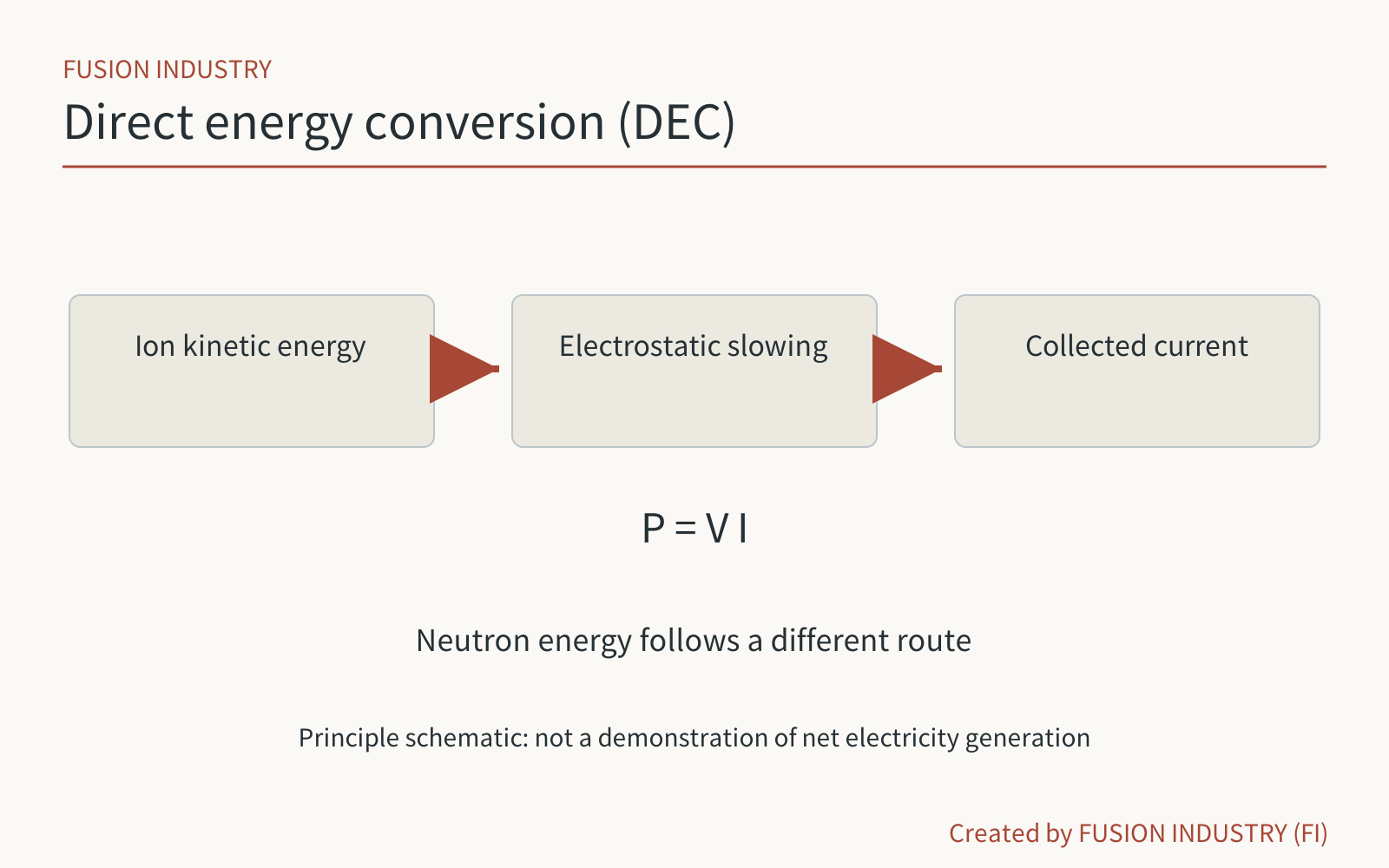
An alternative to making heat first
Direct energy conversion (DEC) turns charged-particle kinetic energy into electricity. In fusion research, one example slows ions escaping from a magnetic mirror and transfers their energy to an electrical circuit. “Direct” means bypassing the intermediate route of heat and a steam turbine or other heat engine. It does not mean creating energy from nothing.[2]
Particles in a mirror’s loss cone can stream out along field lines. This is a confinement loss, but the directed charged-particle exhaust also offers an opportunity for energy recovery. Improving confinement and recovering exhaust energy are different functions; neither eliminates all losses.[1][2]
Deceleration in an electric field
An electrostatic converter uses the fact that a positive ion loses kinetic energy as it moves to a higher electric potential. In an idealized description, a particle of charge q loses kinetic energy qΔV across a retarding potential difference ΔV. Electrical power is P=VI. Real converters must also contend with the particle energy distribution, electron rejection and electrode interception; simply raising voltage is not sufficient.
Realta’s reported initial WHAM converter uses a single stage with three fine grids: ground, electron repulsion and ion collection. The company reports an experiment on June 19, 2026, announced on June 30, producing several amperes at about 100 V. This is a company experimental report, not a guarantee of power-plant-scale performance.[2]
Where did the recovered energy come from?
Realta states that most recovered energy in this experiment came from externally supplied plasma heating and sustainment power. Extracting electrical power is different from producing more electricity than the entire facility consumes. The experiment also did not demonstrate large-scale conversion of fusion-born energy into electricity.[2]
In D–T fusion, roughly 80% of the released energy is carried by uncharged neutrons and 20% by charged alpha particles. Neutrons cannot be decelerated by an electrostatic field and are not directly collected by this DEC scheme. A future plant could recover neutron energy as heat in a blanket while also using charged-particle energy recovery. The relevant test is the whole-plant electricity balance, including heating, magnets and cooling—not DEC output alone.[2]
Checked:2026-11-03