Magnetic mirror: how a changing magnetic field reflects particles
- Official name
- Magnetic mirror
- ENGLISH
- Magnetic mirror
A magnetic mirror reflects some charged particles using a magnetic field that becomes stronger toward its ends. Learn the reflection condition, end losses and the WHAM example.
Read the Japanese original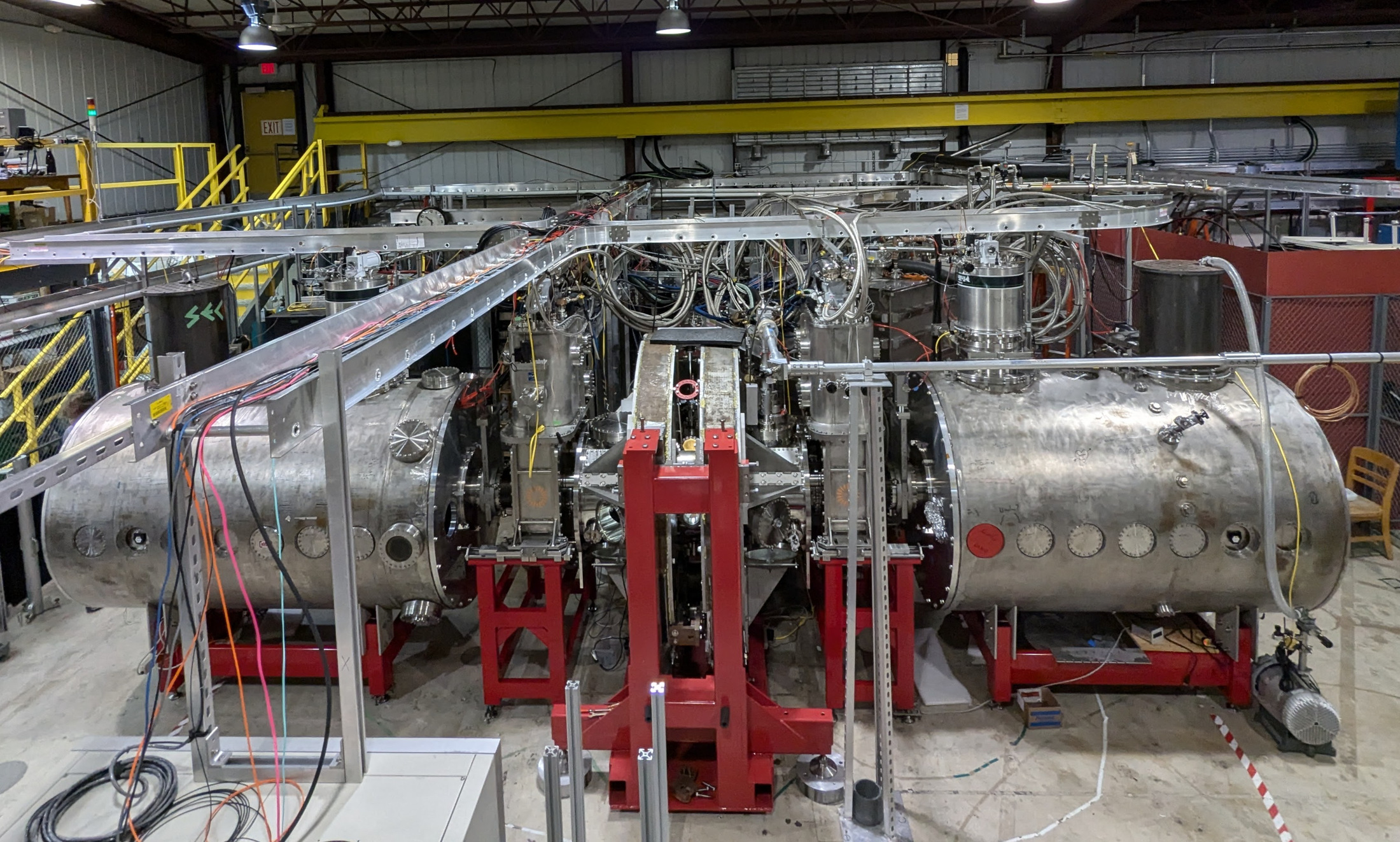
A magnetic “lid,” not a solid wall
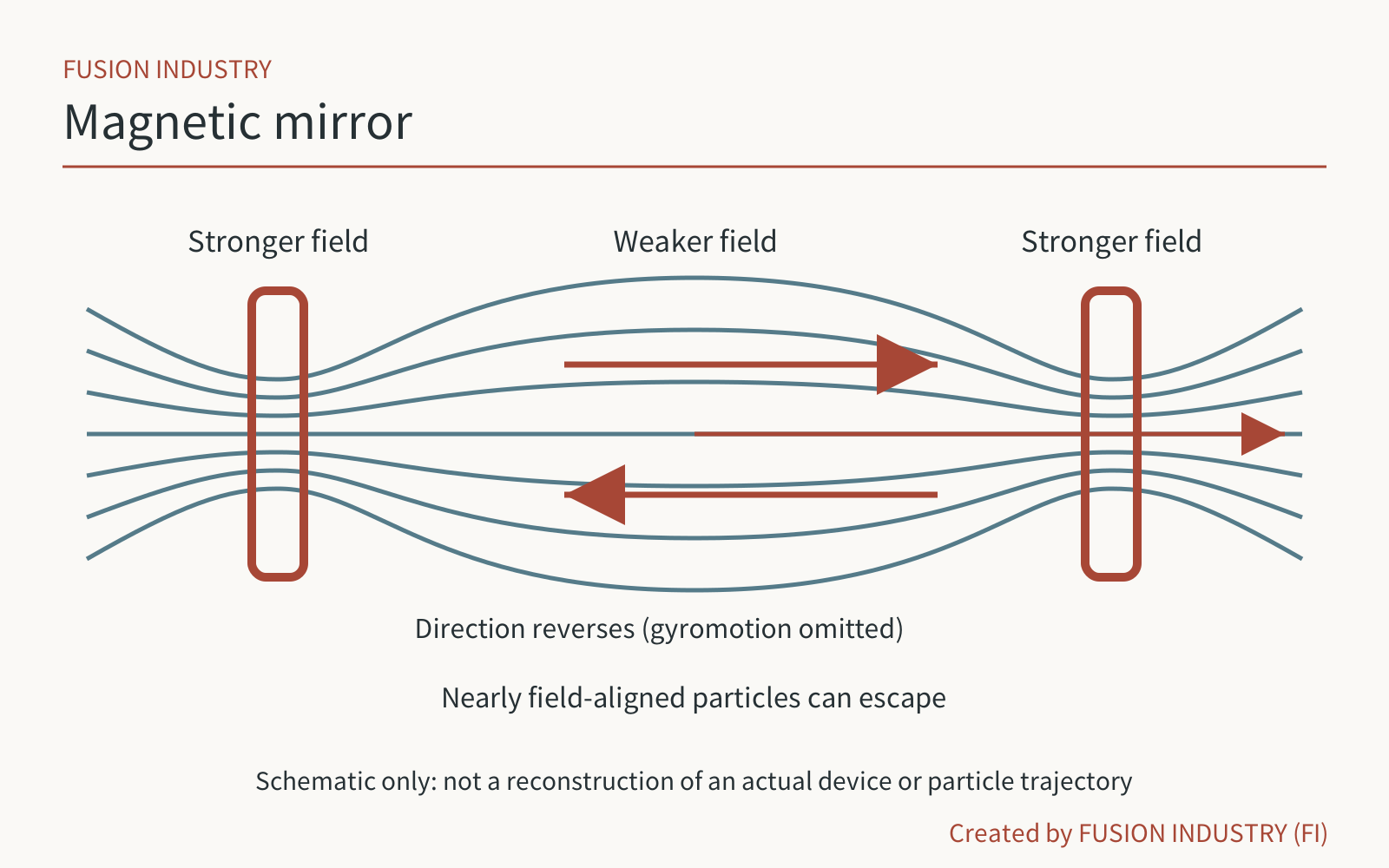
A magnetic mirror makes the field stronger at the ends than in the middle, causing some charged particles in a plasma to turn back. No reflective surface or solid wall is involved. A particle moving along a field line toward a stronger field can reverse its direction.
Unlike the toroidal arrangement of a tokamak, a basic mirror machine has a linear, open-ended geometry. Keeping particles in the central region and handling particles and heat that leave through the ends are therefore both important.
Why a particle turns around
Particle motion can be separated into a component along the field, v∥, and a perpendicular gyrating component, v⊥. If the field changes little during a gyration and the gyroradius is much smaller than the field-variation scale, the magnetic moment μ=m v⊥²/(2B) is approximately conserved. Here m is the particle mass and B is the magnetic-field magnitude.
Neglecting time-dependent electromagnetic fields and potential differences, the kinetic energy is also constant. As the particle enters a stronger field, its perpendicular energy rises and its parallel energy falls. It turns around where v∥ reaches zero. The static magnetic field is not adding energy to the particle.
Reflection does not mean perfect confinement
Particles travelling almost parallel to the field have little perpendicular motion and may escape rather than reflect. The corresponding range of velocity directions is the loss cone. Collisions can change the direction of an initially trapped particle and allow it to escape later. A single-particle reflection argument is therefore not proof of long-lived, stable confinement of an entire plasma.
A real example
WHAM at the University of Wisconsin–Madison is a magnetic-mirror experiment using high-temperature superconducting magnets. The university reports first plasma in July 2024 and research in partnership with Realta Fusion. An operating experiment and demonstrated commercial electricity generation are different development stages.
Next, explore the mirror ratio, which compares the end and central fields; the loss cone, which identifies escaping directions; and the tandem mirror, which also uses electrostatic confinement.
- Magnetic Mirrors — Richard Fitzpatrick, University of Texas at Austin
- Adiabatic Invariants — Richard Fitzpatrick, University of Texas at Austin
- WHAM — Wisconsin Ignites Fusion, UW–Madison
Checked:2026-11-03