Understanding Tokamaks: Connecting Experimental Experience and a Vast Supply Chain to Power Generation
Tokamaks have accumulated extensive fusion research and manufacturing experience. This guide connects magnetic-field principles with ITER, JT-60SA, high-temperature superconductors and opportunities for industrial participation.
Read the Japanese original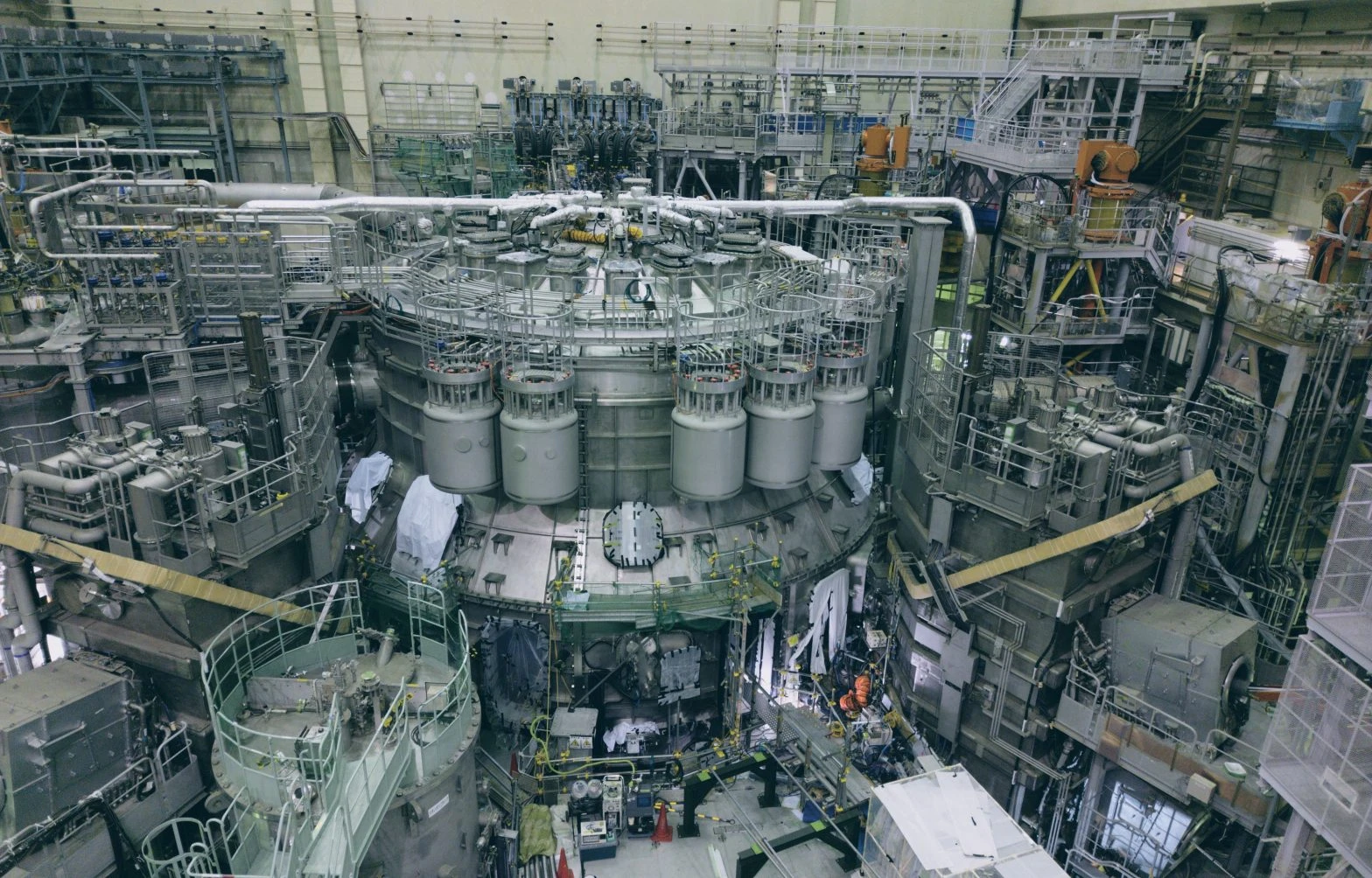
The tokamak combines a substantial body of fusion research with a supply chain that has actually manufactured large equipment. Concrete paths transfer knowledge from JET’s deuterium–tritium experiments to the Japanese-European JT-60SA, ITER under construction, and private high-field devices. It is a fundamental starting point for understanding fusion as an industry. However, experimental maturity and completion of a power plant supplying reliable electricity remain separate stages.
Two magnetic fields surround hot plasma
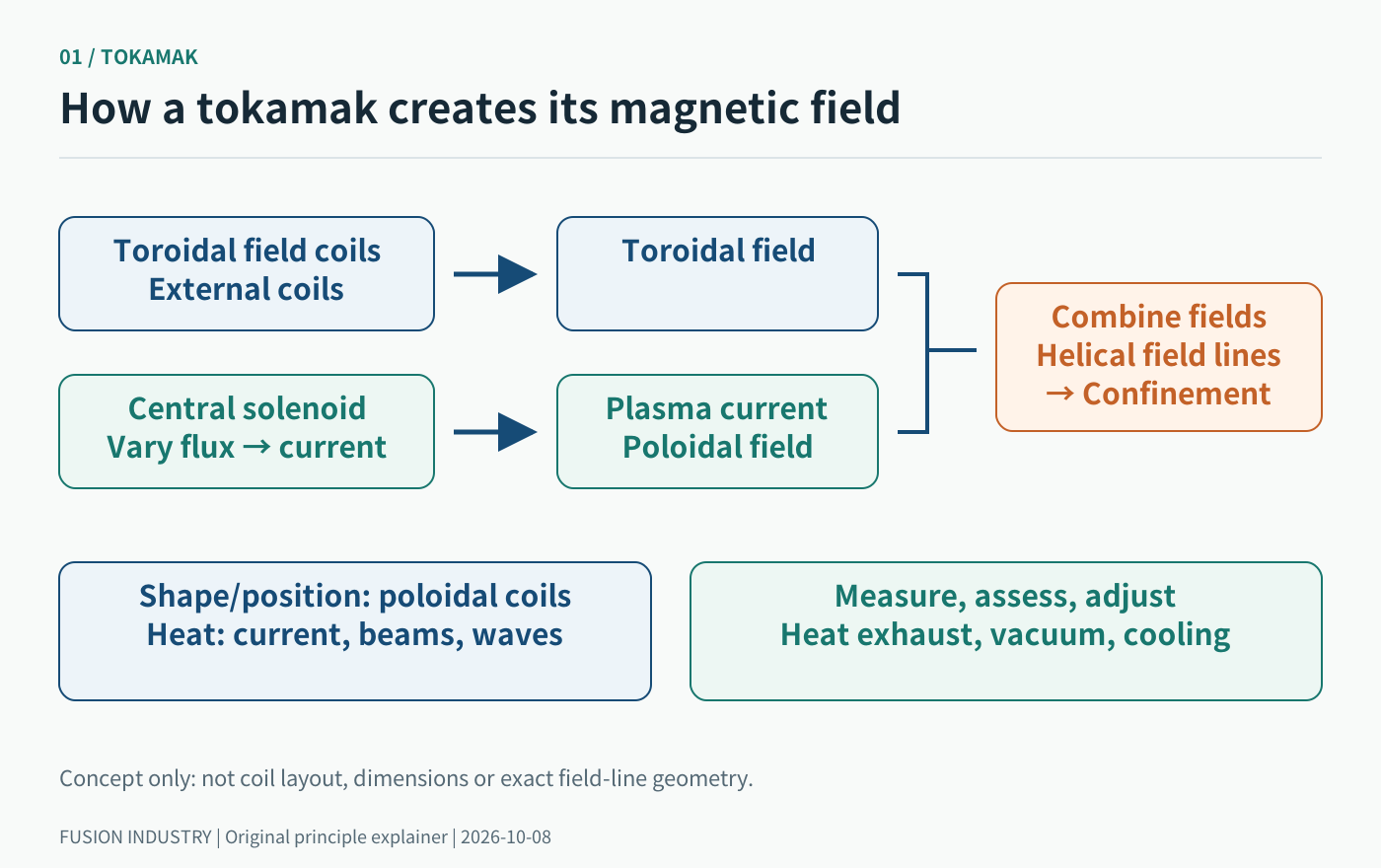
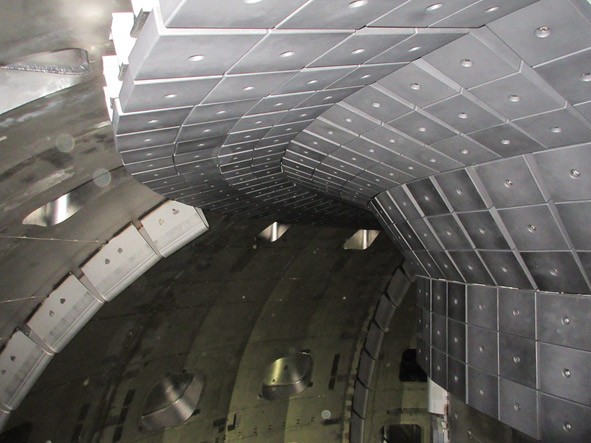
A tokamak has a doughnut-shaped vacuum vessel at its center. External toroidal-field coils generate a field along the ring, while plasma current flowing around the ring generates a field in another direction. Superimposing them makes the field lines helical and makes it harder for charged particles to escape toward the vessel wall. Poloidal-field coils also control plasma position and shape.
The central solenoid induces plasma current through changing magnetic flux. Heating uses resistive heating from current as well as neutral particle beams and high-frequency electromagnetic waves. Magnetic confinement, heating and measurement are separate tasks; only when synchronized do they operate as a machine. ITER’s explanation of the principles
A strength: connecting experiments with large-machine experience
In its final D–T experiments in 2023, the UK’s JET produced 69 MJ of fusion energy during about 5 seconds of high-power operation. The result was announced in February 2024. This was neither electricity sold nor a whole-facility energy surplus, but it represents important experience from large experiments using actual D–T fuel. UKAEA results announcement
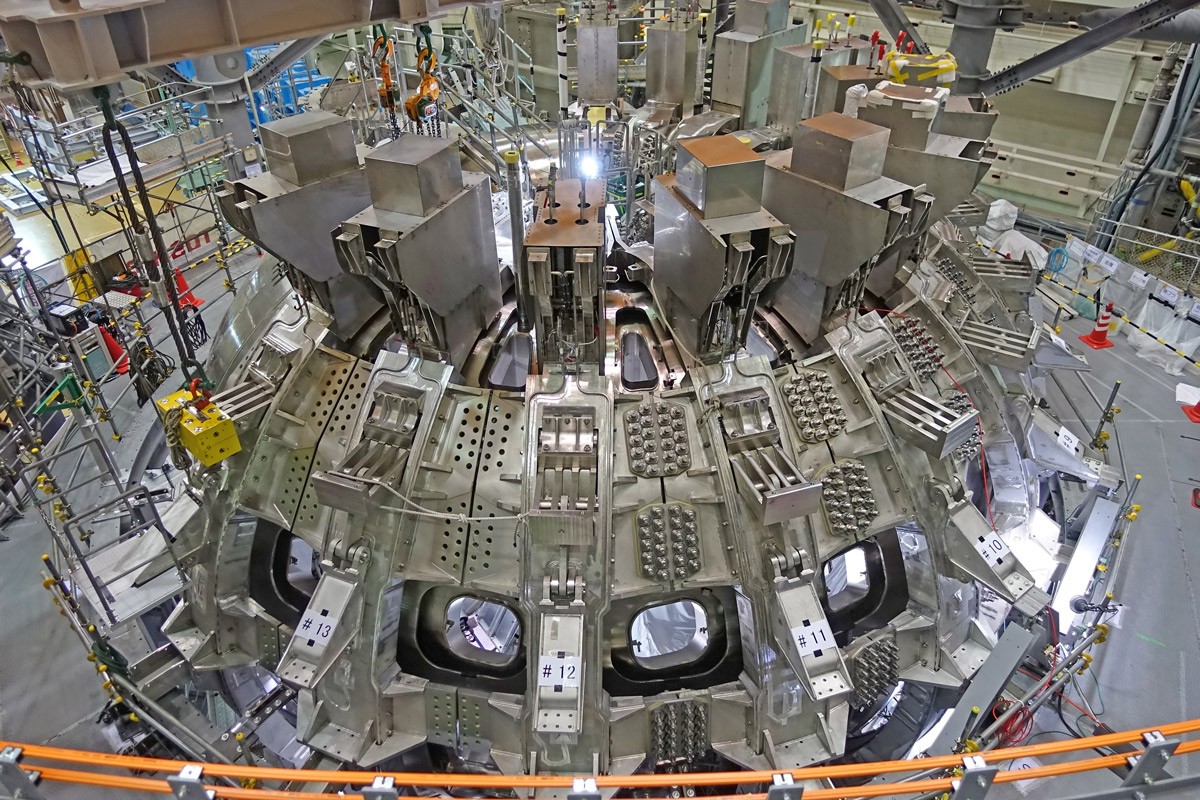
Japan’s JT-60SA supports ITER’s burning-plasma research and investigates knowledge needed for future high-performance operation. QST and F4E announced that integrated commissioning after upgrades began on 27 February 2026. Such staged verification builds experience in combining heating, control, vacuum and cooling. JT-60SA integrated commissioning
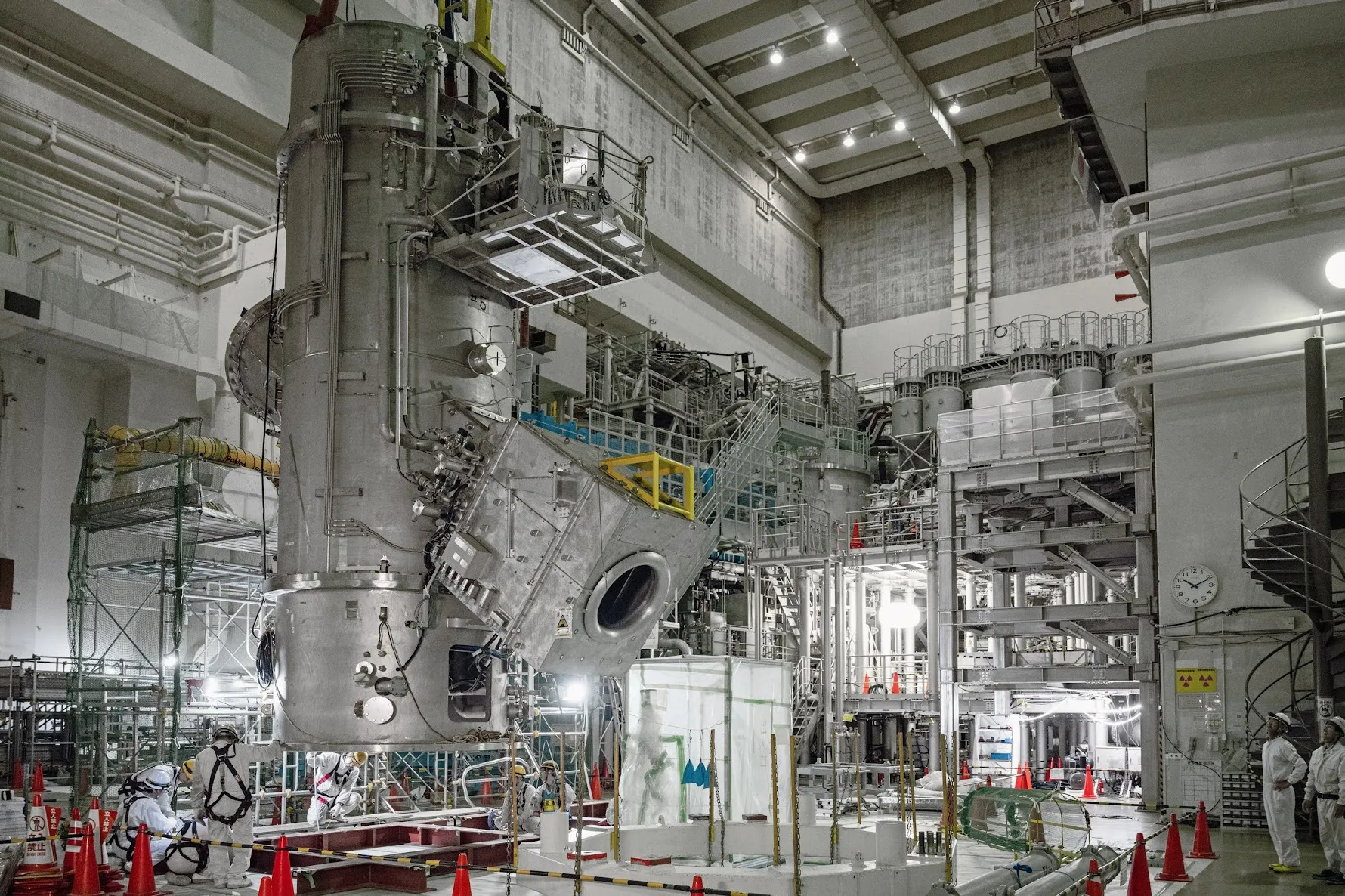
On 28 July 2026, ITER installed the sixth of its nine sector modules. Handling modules weighing about 1,100 tonnes combines immense scale with precision assembly. The achievement means “two-thirds of the sectors forming the tokamak core are in position,” not that the entire power plant is two-thirds complete. ITER installation report
Q = 10 does not mean ten times as much electricity
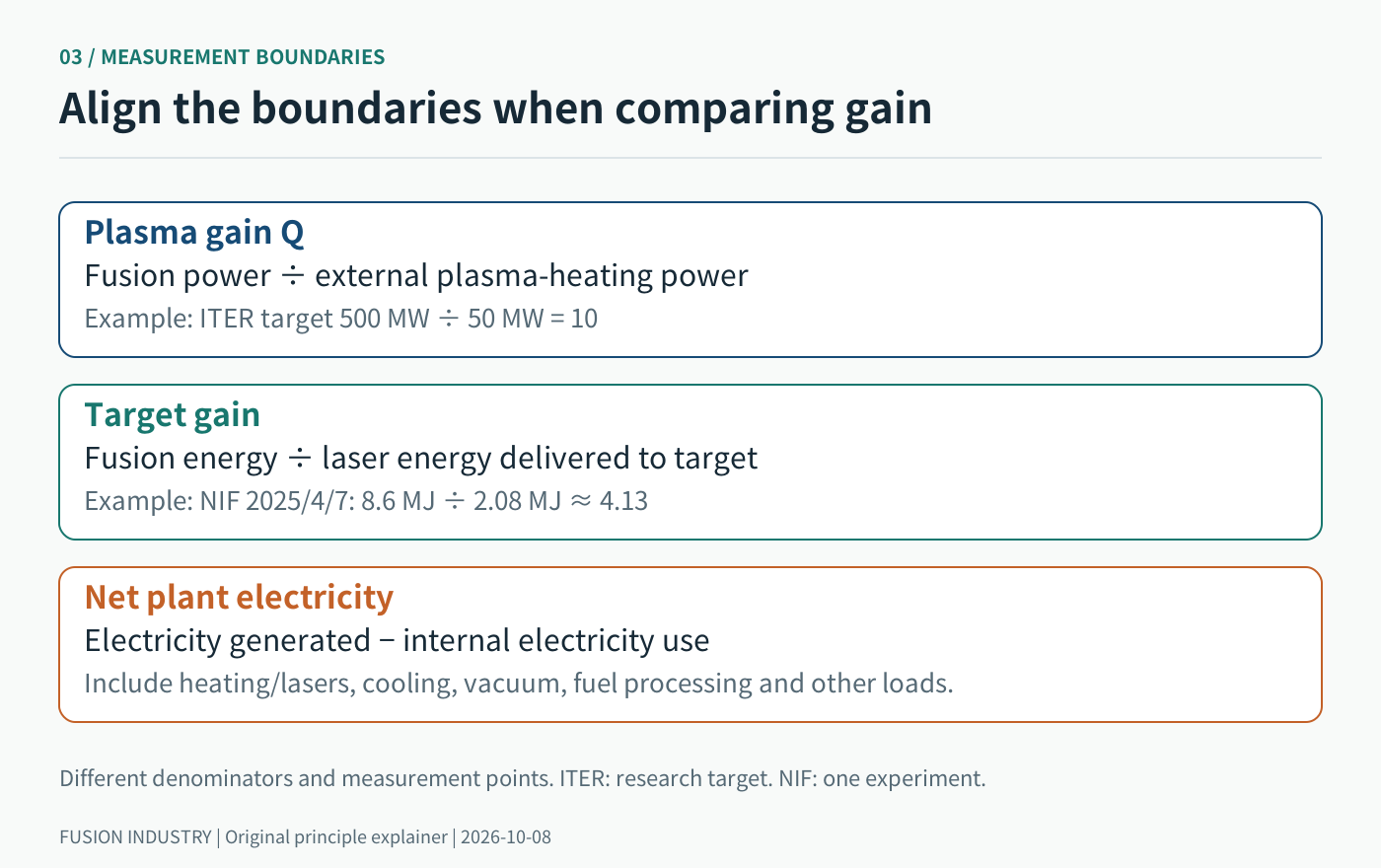
A representative ITER research target is 500 MW of fusion power from 50 MW of external heating delivered to the plasma. This ratio is plasma gain Q = 10. The denominator is not all electricity drawn by the facility, and the numerator is not electricity delivered to the grid. ITER has no role in generating or transmitting electricity. ITER research objectives
A power plant must account for losses in converting fusion heat to electricity and subtract the consumption of heaters, refrigerators, pumps and other systems. Sufficient Q, net electricity and annual availability must each be established separately. Simply checking where the “output” in a news report is measured greatly reduces misinterpretations of development plans. Plasma gain versus engineering energy balance
Business opportunities inside and outside the magnets
Magnet value lies not only in superconducting wire but also in conductor joints, winding, insulation, supporting structures and inspection. Magnets must withstand electromagnetic forces associated with strong fields and maintain their designed position and shape when cooled. Mitsubishi Heavy Industries has worked on ITER toroidal-field coils and the divertor, while U.S.-based General Atomics has manufactured the central solenoid. Mitsubishi Heavy Industries equipment development / General Atomics manufacturing record
Compact, high-field approaches using high-temperature superconductors are also progressing. Commonwealth Fusion Systems (CFS) is building SPARC, with the ARC power plant planned beyond it. In the company’s August 2026 explanation, Q>1 remains a future objective. Successful tests of wire or individual magnets cannot be substituted for achievement of fusion gain in SPARC. CFS development stage
Within Japan’s supply chain, collaboration connects high-temperature superconducting wire from Furukawa Electric and its group company SuperPower with Tokamak Energy’s magnet technology. Whole-reactor developers are not the only market participants. Opportunities exist throughout the process of turning components into large equipment: longer and more uniform wire, performance after winding, and inspection processes. Furukawa Electric collaboration announcement
Remaining challenges: operating longer, exhausting heat and replacing components
Tokamaks require important measures against disruptions involving abrupt changes in plasma current. Inductively driven operation has duration limits; longer operation requires designs incorporating external current drive and use of currents generated by the plasma itself. For power generation, electricity used for control also belongs in the energy balance.
Meanwhile, recycling tritium fuel, extracting neutron heat and replacing damaged equipment are challenges shared by many D–T approaches. Kyoto Fusioneering develops plasma heating, fuel-cycle, blanket and thermal-cycle technologies. Heat-recovery and fuel-processing results in test loops matter, but alone they do not demonstrate power generation by an entire fusion reactor. Kyoto Fusioneering development areas
Read schedules by what they verify, not just the year
ITER’s Baseline 2024 set out plans for the start of research operation in 2034 and D–T operation in 2039. The June 2026 Council also reviewed progress under that baseline. Target years are not guarantees; they depend on manufacturing quality, assembly, commissioning and licensing. Even when private projects set earlier targets, first plasma, gain achievement, heat recovery and net electricity delivery should be tracked separately. Published schedule information / 2026 Council report
Three perspectives for comparing approaches
Helical/stellarator designs have a strength in not relying on large plasma currents for confinement, while laser approaches have demonstrated ignition and gain at the fuel target. Comparison should not be a ranking of isolated records. Ask three questions: which conditions have been verified experimentally, what becomes difficult when scaling to a power plant, and how could your company’s technology address those challenges?
Tokamaks make it relatively easy to identify concrete customers, starting from experience in researching and manufacturing large machines. Companies seeking orders should examine procurement conditions including quality assurance, inspection records, maintainability and delivery schedules, not only required performance. Making this accumulated experience reusable in the next device is a step toward industrialization.
Related articles
Official information from related companies and research institutions
Check each organization’s announcements for development progress and technical documentation.
- ITER Organization | What is a tokamak?
- ITER Organization | What will ITER do?
- UKAEA | Results of JET’s final D–T experiments
- QST/F4E | Start of JT-60SA integrated commissioning
- ITER Organization | New baseline press conference summary, 3 July 2024
- ITER Organization | 38th ITER Council
- ITER Organization | Installation of the sixth sector module
- CFS | Explanation of the path to SPARC Q>1
- Mitsubishi Heavy Industries | Work for ITER
- General Atomics | Shipment of the first ITER central-solenoid module
- Furukawa Electric | Memorandum on a joint activity base with Tokamak Energy
- Kyoto Fusioneering | Core technologies and UNITY development plan
- ITER Organization | FAQ on gain and facility power
Information checked as of:2026-10-08
ITER’s 500 MW and Q = 10 are design objectives, not demonstrated net electricity generation or commercial-reactor availability.