Fusion Startup and Company Directory: 42 Companies by Country, Founding Year and Technology
From power plants to magnets, fuels, materials and neutron applications: compare 42 companies while distinguishing experimental results from future plans.
Read the Japanese original
Summary: The fusion industry includes not only power-plant developers, but also companies making magnets, fuels, materials, lasers and neutron-based services. This directory compares 42 companies by country, founding year, approach and business role. Even companies pursuing the same reactor family can be developing different products at different stages.
Reference date: October 30, 2026. This is a comparison based on public primary sources, not an investment recommendation or a census claiming to include every company worldwide.
Start with what the company intends to sell
A list of names alone does not explain an industry. One company designs a power plant; another produces the magnets it needs. Others use neutrons for testing or isotope production. All are connected to fusion, but their products, customers and required demonstrations differ.
“Approach” in this directory mainly means how plasma is confined or compressed, not the ultimate electricity-generator technology. Many concepts investigate heat-based power systems; some aim to recover charged-particle or magnetic energy directly as electricity. A confinement label alone does not establish efficiency, cost or delivery-date superiority.
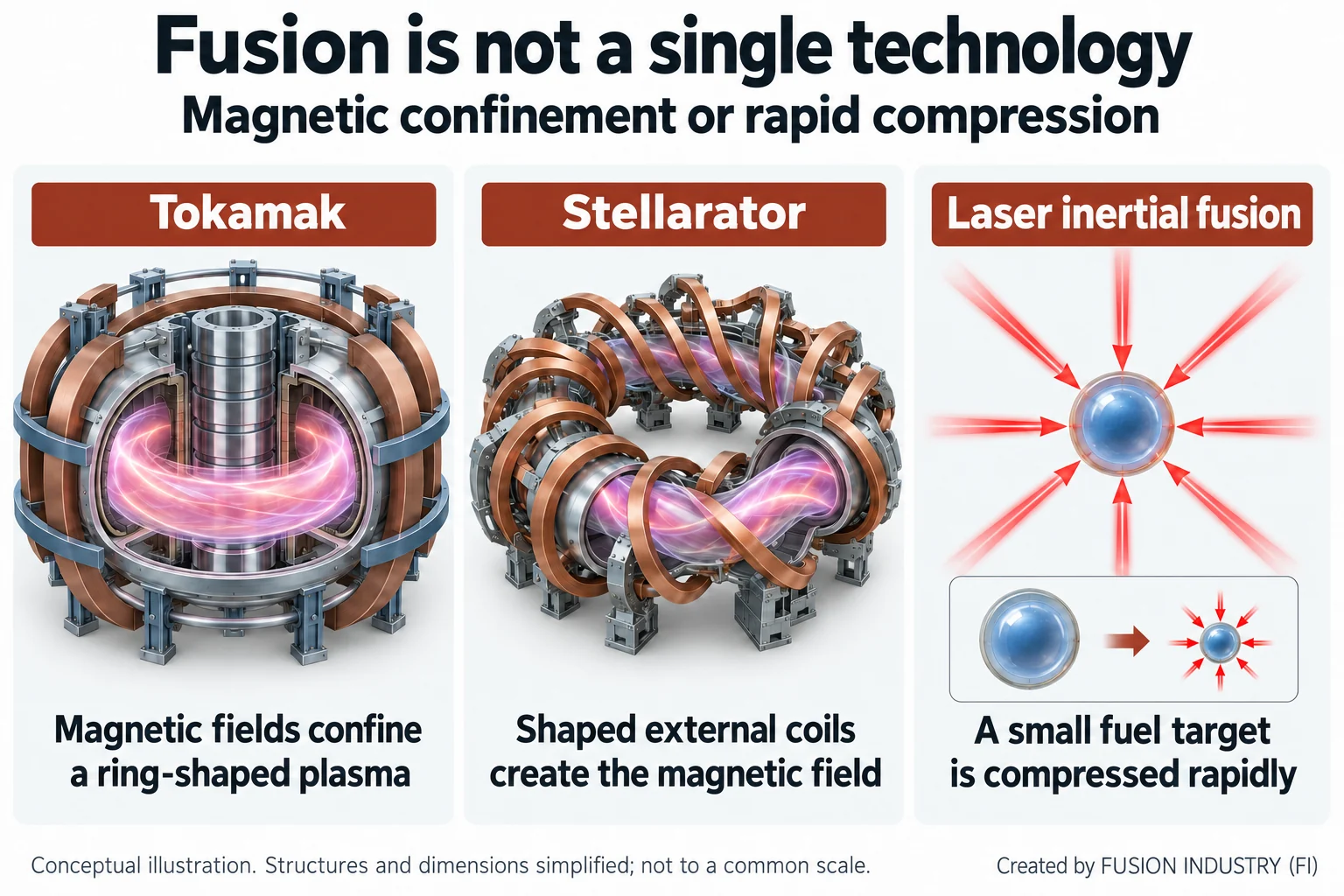
- Tokamaks: use magnetic fields to confine a toroidal plasma. Spherical tokamaks pursue a geometry with a relatively small central opening.
- Stellarators and helical devices: create twisted magnetic fields mainly with external coils. They combine potential advantages for continuous operation with demanding magnet and structural manufacturing.
- Laser inertial fusion: rapidly compresses and heats small fuel targets. Power generation also requires efficient lasers, mass-produced targets, repeated delivery and durable chamber walls.
- FRCs, mirrors and dipoles: include several magnetic geometries beyond conventional toroidal designs. Fuel, heating and energy-recovery choices differ between companies.
- Z-pinches, magnetized targets and pulsed power: use high currents, mechanical compression or related methods. The path from individual experiments to repetitive operation matters.
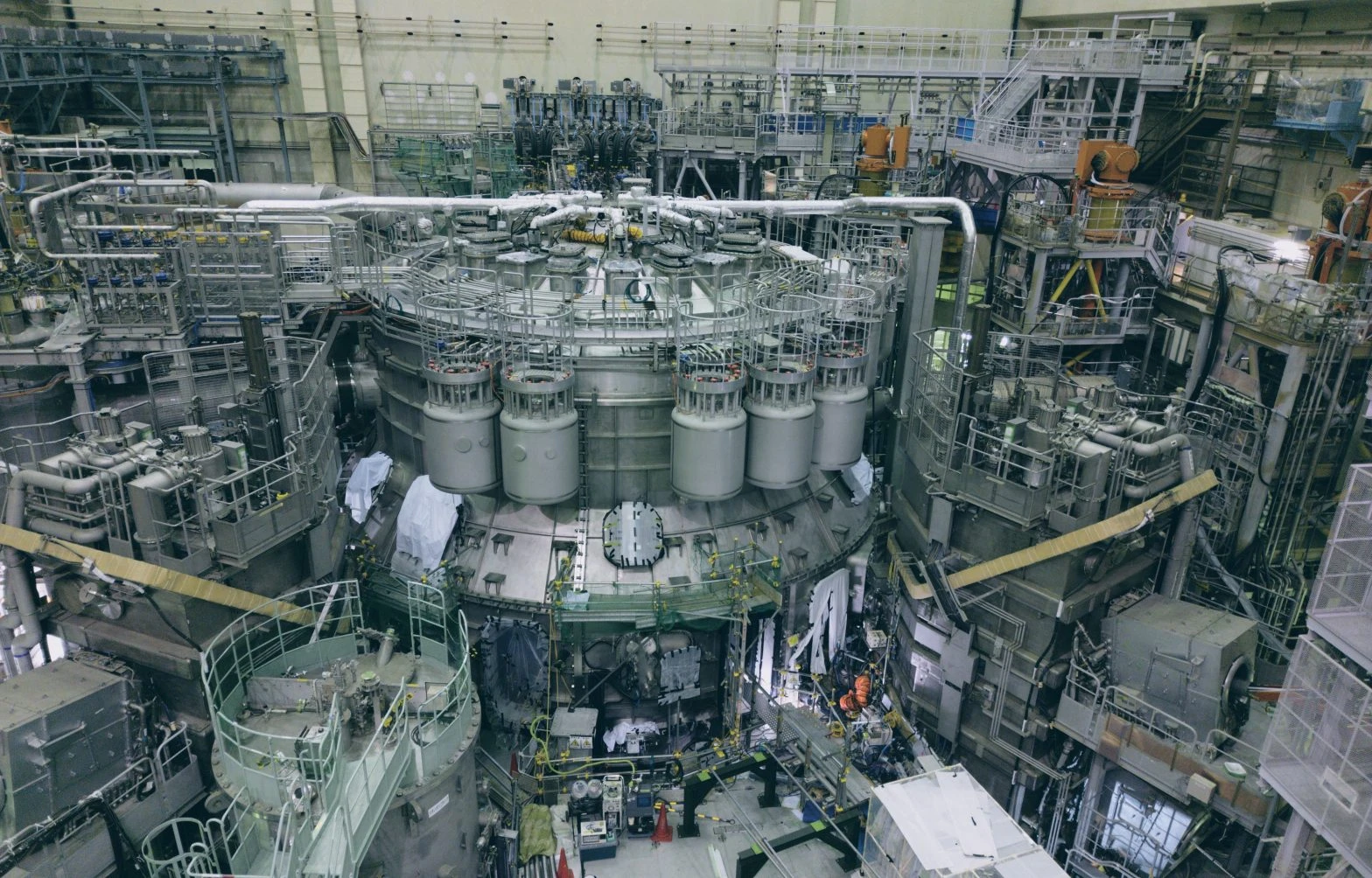
See a tokamak in practice: JT-60SA
Connecting a technology name to a real research machine makes the company table easier to read. JT-60SA, pictured here, is a superconducting tokamak developed jointly by Japan and Europe. It studies high-performance plasma operation, supports ITER and future-reactor research, and trains researchers and engineers. Controlling a toroidal plasma requires heating, diagnostics, vacuum and cooling systems as well as the central machine.
CFS and Tokamak Energy also work on tokamak technologies, but JT-60SA belongs to neither company. Shared principles do not make their geometries, magnets, fuels or operating objectives identical. QST’s research objectives · F4E’s photograph and explanation of auxiliary systems
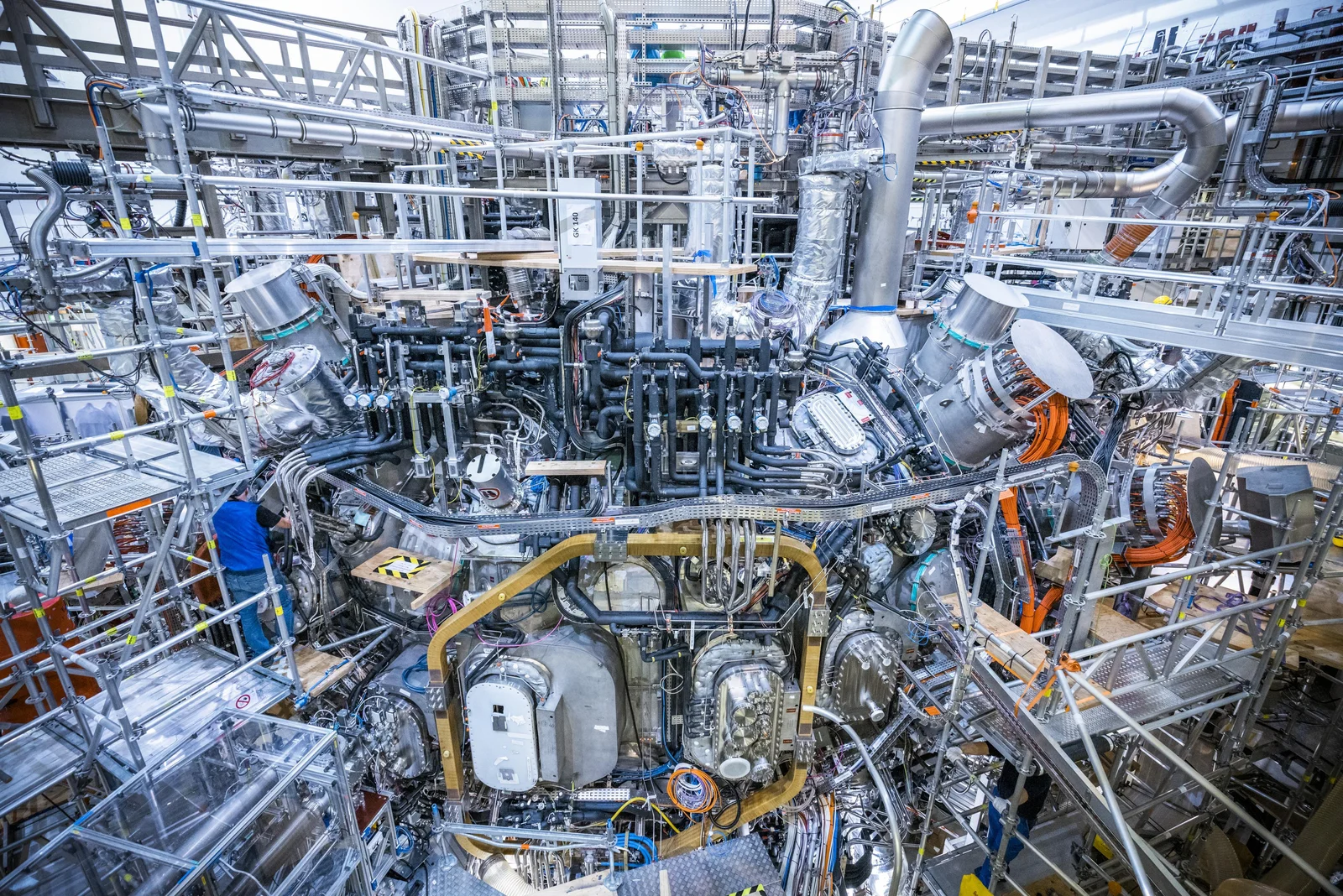
See a stellarator in practice: W7-X
Wendelstein 7-X (W7-X), pictured here, is a stellarator at Germany’s Max Planck Institute for Plasma Physics (IPP). It studies three-dimensional magnetic confinement produced by external coils and long-duration plasma operation. Its surrounding pipes and diagnostic equipment also show integration work that a simple reactor schematic cannot convey.
Proxima says it spun out of IPP in 2023 to build on W7-X research. W7-X is not a power plant built by Proxima. Turning research knowledge into a commercial plant still involves different magnet designs, manufacturing, maintenance and integration with generating equipment. IPP’s W7-X material · Proxima’s research lineage
Scope and how to read the tables
Companies are included where public sources identify development of fusion reactors or devices, or fusion-focused products and services. More mature companies and corporate-group ventures are included in separate categories so that the boundaries remain clear. Country refers to principal corporate or operating locations, not founders’ nationality or research partners’ locations. Multiple countries are shown where relevant.
Founding year generally means the company’s formation, not the year its researchers began studying fusion. Unverified dates are not filled in by inference. Where sources differ—as with GenF’s business formation and formal launch, or Xcimer’s founding-year descriptions—the distinction is retained.
The FIA’s 2026 industry survey received responses from 56 companies. That is not the total number of companies in the world: membership, participation and classification affect coverage. This directory likewise states its public-information boundaries. FIA’s explanation of its 2026 survey
Japanese reactor and commercialization developers
Comparison table (scroll horizontally)
| Company | Country / principal location | Founded | Technology / approach | Business role and development stage |
|---|---|---|---|---|
| Helical Fusion | Japan / Tokyo | 2021 | Helical magnetic confinement | Develops superconducting magnets and blankets together. Helix HARUKA is a demonstrator; KANATA is a future power project. Source 1 · Source 2 |
| EX-Fusion | Japan / Osaka | 2021 | Laser inertial confinement | Focuses on target delivery, tracking and control for repeated laser shots. Its laser-processing business is distinct from power-plant research. Source 1 · Source 2 |
| LINEA Innovations | Japan / Tokyo | 2023 | Advanced-fuel fusion | Develops advanced-fuel reactors and associated technologies. The company was established on September 29, 2023; this is not the start date of the underlying research. Source 1 · Source 2 |
| Starlight Engine | Japan / Tokyo | 2025 | HTS tokamak / FAST | Leads FAST, a program to integrate burning plasma, power conversion and fuel systems. Kyoto Fusioneering has a separate role as an industrial partner. Source 1 · Source 2 |
Reactor and fusion-device developers around the world
Comparison table (scroll horizontally)
| Company | Country / principal location | Founded | Technology / approach | Business role and development stage |
|---|---|---|---|---|
| Commonwealth Fusion Systems (Japanese) | United States / Devens | 2018 | High-temperature-superconducting tokamak | SPARC aims for plasma energy gain; ARC is a future power-plant program. Magnet production and electricity generation are different milestones. Source 1 · Source 2 |
| Helion Energy (Japanese) | United States | 2013 | Pulsed FRC / direct energy recovery | Compresses field-reversed-configuration plasmas and pursues a D–He3 fuel cycle with direct electricity recovery. A power-purchase agreement is not a record of delivered power. Source 1 · Source 2 |
| TAE Technologies (Japanese) | United States | 1998 | Beam-driven FRC / hydrogen–boron | Proton–boron fuel is a long-term objective. Accelerator, control and power-conversion capabilities are distinct from demonstrated fusion electricity. Source 1 |
| Zap Energy | United States | 2017 | Sheared-flow-stabilized Z-pinch | Develops pulsed fusion alongside fission and hybrid applications. Not every activity in the company is a pure-fusion project. Source 1 · Source 2 |
| Type One Energy | United States | 2019 | Stellarator | Supplies fusion-plant technology to prospective power operators. Infinity Two is a development program, not an operating power station. Source 1 · Source 2 · Source 3 |
| Thea Energy | United States | 2022 | Planar-coil stellarator | Uses arrays of planar coils and magnetic-field control. Eos is intended as a neutron source, while Helios is a power-plant program. Source 1 · Source 2 |
| Realta Fusion | United States / Madison | 2022 | Magnetic mirror | Uses stronger end fields to confine plasma. Targets modular industrial heat and electricity applications. Source 1 · Source 2 Company profile |
| Xcimer Energy | United States / Denver | November 2021 (FAQ: 2022) | High-energy excimer laser | Combines KrF laser development with a liquid-blanket reactor design. Its founders’ letter and current media page date founding to 2021; its FAQ says 2022. Source 1 · Source 2 · Source 3 |
| Pacific Fusion | United States | 2023 | Pulsed-power compression | Develops a pulsed-power driver and demonstration system. Net facility energy gain remains an objective, not an achievement implied by this listing. Source 1 · Source 2 |
| Avalanche Energy | United States / Seattle | 2018 | Compact electrostatic confinement / Orbitron | Develops neutron applications on a path toward power systems. Selling high-voltage feedthroughs is not selling fusion electricity. Source 1 · Source 2 |
| General Fusion | Canada | 2002 | Magnetized target fusion / mechanical compression | Combines liquid metal and compression. LM26 electron-temperature results are neither an ion-temperature measurement nor a demonstration of electricity generation. Source 1 · Source 2 |
| Proxima Fusion | Germany / Munich | 2023 | Quasi-isodynamic HTS stellarator | Spun out of IPP. Develops the Alpha demonstrator and Stellaris power-plant concept, emphasizing complex-magnet manufacturing and integration. Source 1 · Source 2 |
| Marvel Fusion | Germany / United States | 2019 | Laser inertial fusion | Develops lasers, targets, fuel-cycle and plant integration. Industrial laser and neutron applications should be separated from future power generation. Source 1 |
| Focused Energy | Germany / United States | 2021 | Direct-drive laser fusion | Develops high-repetition lasers and targets. Dates for Biblis and later plants are company objectives, not guaranteed commissioning dates. Source 1 |
| Renaissance Fusion | France | 2020 | Stellarator / liquid-metal wall | Combines patterned HTS films and liquid-metal walls to simplify magnet and reactor-wall engineering. Its website carries an updating notice. Source 1 · Source 2 |
| Novatron Fusion | Sweden | 2019 | Magnetic mirror / cusp | Combines mirror and cusp magnetic structures. Development using KTH’s research environment should not be described as completed power generation. Source 1 |
| OpenStar Technologies | New Zealand / Wellington | 2021 | Levitated dipole | Confines plasma around a levitated magnet, pursuing a magnetic-confinement geometry different from a tokamak. Source 1 |
| HB11 Energy | Australia / Sydney | 2017 | Proton fast ignition / hydrogen–boron | Uses different laser-pulse durations in a fuel-compression and ignition concept. A low-neutron fuel objective does not mean zero radiation. Source 1 · Source 2 |
| nT-Tao | Israel | Not verified | Compact stellarator / pulsed magnetic confinement | Develops compact systems for on-site power. The stated 20 MWe is a design objective, not current electrical output. Source 1 |
| Energy Singularity | China / Shanghai | 2021 | All-HTS tokamak | Following HH70 operation and magnet development, plans HH170. Operating HH70 is not a demonstration of net electricity generation. Source 1 |
| Startorus Fusion | China / Shanghai and Xi’an | Not verified | Repetitive-reconnection spherical tokamak | Operates SUNIST-2 with Tsinghua University and also supplies diagnostic, power and superconducting-related equipment. Source 1 |
| Pranos Fusion | India | 2024 | Low-aspect-ratio tokamak | Integrates the PRAGYA testbed, JENGA design-and-control software and MAGGA high-temperature-superconducting magnets. Source 1 Company profile |
| NearStar Fusion | United States / Chantilly | Not verified | Magnetized target impact fusion | Proposes railgun-driven compression and D–D fuel. Driver speed and repetition-rate specifications are not electricity-generation results. Source 1 · Source 2 |
| Longview Fusion Energy Systems | United States / Livermore | Not verified | Laser inertial fusion | Applies NIF experience to power-plant engineering. NIF target gain is not a result achieved by an operating Longview power plant. Source 1 · Source 2 |
| Inertia Enterprises | United States | Not verified | Indirect-drive laser fusion | Emphasizes scalable laser manufacturing, affordable targets and plant integration. Semiconductor-laser partnerships are development activities. Source 1 |
| Stellarex Energy | Canada | 2022 (company profile) | Stellarator | Connects Princeton-derived technology with Canadian nuclear and tritium capabilities. Its US origins and current Canadian focus should be distinguished. Source 1 · Source 2 |
| MIFTI Fusion | United States | 2008 | Staged Z-pinch | Compresses fuel with a gas liner. Neutron-producing experiments are distinct from its proposed net-energy system. Source 1 · Source 2 |
| LPPFusion | United States | 2003 | Dense plasma focus | Pursues hydrogen–boron fuel and direct energy conversion. Its small pulsed experimental systems should be distinguished from commercial power sources. Source 1 · Source 2 · Source 3 |
Materials, equipment, fuels and neutron applications
Comparison table (scroll horizontally)
| Company | Country / principal location | Founded | Technology / approach | Business role and development stage |
|---|---|---|---|---|
| Kyoto Fusioneering | Japan / Tokyo | 2019 | Fusion engineering and equipment | Works on heating, blankets, fuel cycles and heat extraction. It should not be classified simply as a power producer pursuing one reactor configuration. Source 1 · Source 2 |
| Tokamak Energy | United Kingdom / Oxfordshire | 2009 | Spherical tokamak / high-temperature superconductors | Operates across TE Magnetics, manufacturing equipment and fusion technology. ST40 supports experiments and technology testing; the company also supplies external programs. Source 1 |
| First Light Fusion | United Kingdom | 2011 | Fuel systems for inertial fusion | Now emphasizes the two-stage FLARE fuel system for integration by partners. This differs from older descriptions centered on its own power-plant concept. Source 1 |
| Astral Systems | United Kingdom | 2021 | Compact fusion / neutron applications | Develops irradiation, isotope, research and training applications. Commercial neutron use and commercial net electricity are separate achievements. Source 1 Company profile |
| Blue Laser Fusion | United States / Santa Barbara and Japan | 2022 | Optical-enhancement-cavity laser technology | Develops efficient pulsed lasers for fusion and other applications. Its current business is not exclusively fusion. Source 1 |
| Fuse | United States | Not verified | MagLIF / pulsed power | Uses a staged path from radiation testing toward fusion energy. TITAN’s pulse-power rating is not commercial electrical output. Source 1 |
| MiRESSO | Japan / Misawa | 2023 | Blanket materials / beryllium | Builds on QST research to develop beryllium refining and stable supply. Its role is materials infrastructure rather than competition between reactor concepts. Source 1 · Source 2 |
| SHINE Technologies | United States / Janesville | 2010 | Neutrons / isotopes / fuel recycling | Applies fusion-related technologies to testing and medical markets. Isotope operations and future fuel-recycling plans are not net fusion-power generation. Source 1 · Source 2 FAQ |
Corporate ventures and space propulsion
Comparison table (scroll horizontally)
| Company | Country / principal location | Founded | Technology / approach | Business role and development stage |
|---|---|---|---|---|
| GenF | France / Le Barp | 2024 venture / 2025 formal launch | Laser inertial fusion | A Thales-group company developing lasers, targets and reactor engineering with research institutions through TARANIS. Listed separately from independent startups. Source 1 · Source 2 |
| Helicity Space | United States | 2018 | Fusion space propulsion | Develops the Helicity Drive for spacecraft. It should not be compared directly with grid-electricity developers. Source 1 · Source 2 |
Not all milestones mean the same thing
The essential comparison is between like-for-like achievements. Energizing a magnet, producing plasma, generating fusion reactions, producing neutrons, achieving plasma or target energy gain, demonstrating net electricity at facility level, and supplying electricity over extended periods are different milestones.
For example, designing a laser power plant using NIF’s target-gain results does not mean the company’s own plant has delivered electricity. Producing neutrons and supplying testing services likewise does not establish the energy balance required for a power station. Power-purchase agreements and development partnerships can be important commercial preparations, but they are not proof that future delivery has occurred.
When reading “the 2030s,” “20 MW” or a number of shots per second, ask whether the number is a measurement, an equipment specification or a design objective. Electron and ion temperatures differ, as do instantaneous power and sustained energy production. This directory does not turn company plans into independently verified achievements.
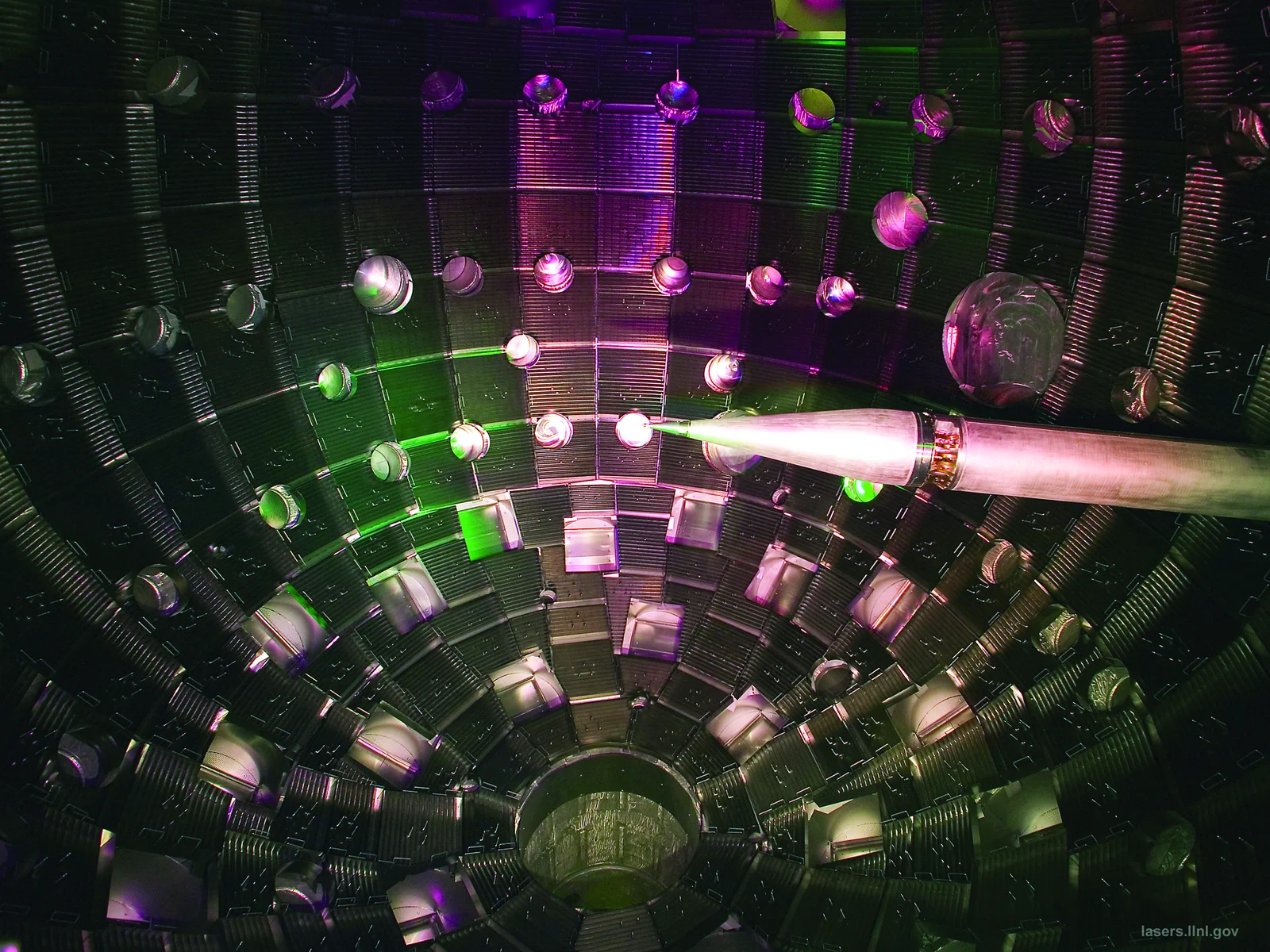
The spherical vessel in the photograph is the target chamber at LLNL’s NIF research facility, not a power plant owned by a company in this directory. NIF experiments compare fusion yield with laser energy delivered to the target. Longview describes drawing on its team’s experience designing, building and operating NIF. This is a concrete example of why a research facility’s accumulated knowledge must be distinguished from a company’s future generating plant. LLNL on ignition · Longview’s company description
What stands out for Japan’s industrial ecosystem
Japan is not pursuing only one reactor family. Helical, laser, advanced-fuel and HTS tokamak development sits alongside fusion engineering and materials supply. Separating reactor developers from equipment and materials providers helps explain why the same supplier can appear in projects in several countries.
For manufacturers considering participation, today’s demonstrator requirements can be more concrete than a predicted date for a completed power plant. Magnets involve conductors, winding, joints, cryogenics and inspection; laser systems involve optics, power supplies, targets and positioning; blankets involve materials, fluids, corrosion and fuel recovery. This is an editorial decomposition of technical work, not confirmation that a particular company is currently procuring those items externally.
What to check next
To understand a company in depth: distinguish its experimental device from its future power plant; read papers as well as company announcements; examine the fuel, heat, maintenance and regulatory systems outside the plasma; and distinguish deliveries from planned collaborations.
A young company does not necessarily have a young research base. Many bring decades of university and national-laboratory work into a business. Conversely, a long history or a large financing round does not prove net electricity or commercial economics. Start by asking who is trying to deliver what, and at which stage. This directory is an entry point for making that comparison.
Official information from related companies and research institutions
Check each organization’s announcements for development progress and technical documentation.
- Helical Fusion|Official source
- EX-Fusion|Official source
- LINEA Innovations|Official source
- Kyoto Fusioneering|Official source
- Commonwealth Fusion Systems|Official source
- Helion Energy|Official source
- TAE Technologies|Official source
- Zap Energy|Official source
- Type One Energy|Official source
- Thea Energy|Official source
- Realta Fusion|Official source
- Xcimer Energy|Official source
- Pacific Fusion|Official source
- Avalanche Energy|Official source
- General Fusion|Official source
- Tokamak Energy|Official source
- First Light Fusion|Official source
- Astral Systems|Official source
- Proxima Fusion|Official source
- Marvel Fusion|Official source
- Focused Energy|Official source
- Renaissance Fusion|Official source
- Novatron Fusion|Official source
- OpenStar Technologies|Official source
- HB11 Energy|Official source
- nT-Tao|Official source
- Energy Singularity|Official source
- Startorus Fusion|Official source
- Pranos Fusion|Official source
- NearStar Fusion|Official source
- Longview Fusion Energy Systems|Official source
- Inertia Enterprises|Official source
- Blue Laser Fusion|Official source
- Stellarex Energy|Official source
- Fuse|Official source
- MIFTI Fusion|Official source
- GenF|Official source
- Helicity Space|Official source
- Starlight Engine|Official source
- MiRESSO|Official source
- SHINE Technologies|Official source
- LPPFusion|Official source
Information checked as of:2026-10-30