ITER test blankets face checks beyond the weld
Sound welds do not guarantee the required strength after heat treatment. EUROFER97 research, full-size mock-ups and historical contracts show what fusion component manufacturing demands from suppliers.
Read the Japanese original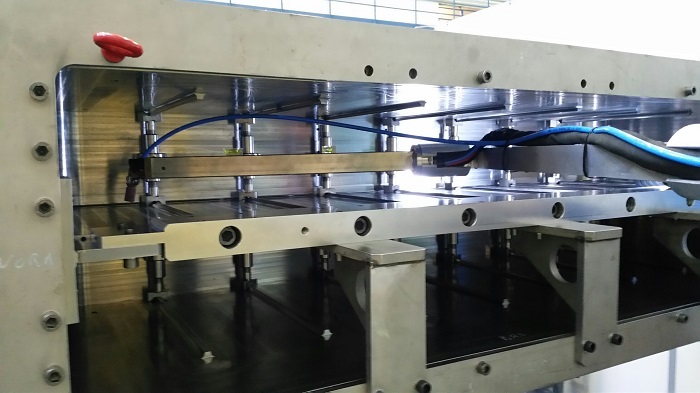
Even when a weld has no detected defects, heat treatment can leave the steel below a code's strength requirements. Research on EUROFER97, a material being developed for ITER test blanket modules, illustrates the problem. Choosing a weldable material and operating a robot do not complete the manufacturing preparation. How much of the process must be demonstrated?
A fuel-breeding test module also needs cooling passages
Test blanket modules, or TBMs, will test technologies that use fusion neutrons and lithium to produce the fuel tritium. ITER plans to test several concepts. Results from small test modules cannot by themselves establish fuel self-sufficiency for an entire power plant. ITER's TBM program
The box contains structures for removing heat as well as breeding materials. In manufacturing development described by Europe's domestic agency Fusion for Energy (F4E) in 2017, engineers tested a welding procedure on a full-size box mock-up measuring 1.7 × 0.5 × 0.7 metres. Before plasma experiments, they needed an experiment in assembling the metal enclosure.
A robot can reach the joint, but the box must keep its shape
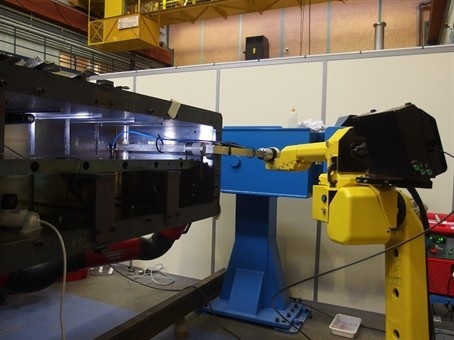
The trial used a TIG welding robot. Its task was to work in the confined space inside the box. F4E also described purpose-built clamps to manage distortion while protecting the surface and internal channels.
Tool access, how the joint is held, and whether passages remain intact cannot be judged from a material catalogue alone. The case shows why component geometry and manufacturing equipment have to be considered together. This is a record of preliminary procedure development in 2017. It does not establish that today's TBMs are finished, or that this particular mock-up was made from EUROFER97. F4E's manufacturing account
Heat treatment changes both strength and toughness
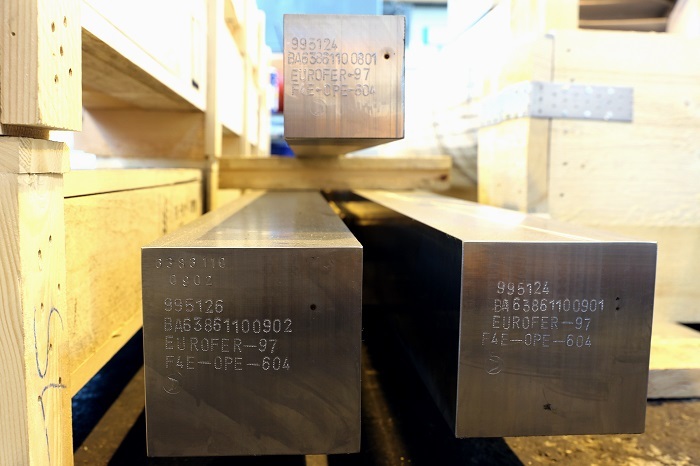
EUROFER97 is a reduced-activation ferritic-martensitic steel being developed as a structural material for European TBMs. A 2026 manufacturing study covers TIG, electron-beam and laser welding, together with hot isostatic pressing (HIP), which joins material at high temperature and pressure.
According to the public abstract, the joints examined had no macro- or micro-defects. However, standard post-weld heat treatment softened the base material and sometimes reduced tensile properties below the limits in the RCC-MRx design and construction code. The researchers also assessed repeated heat treatments, reporting declining strength and improving toughness—the material's resistance to fracture.
Producing a sound joint and meeting the required mechanical properties therefore need separate verification. The study recommends measures including optimizing heat-treatment parameters; it does not declare qualification complete for every manufacturing condition. These findings are limited to what the public abstract reports. Public research abstract
Contracts have covered more than finished components
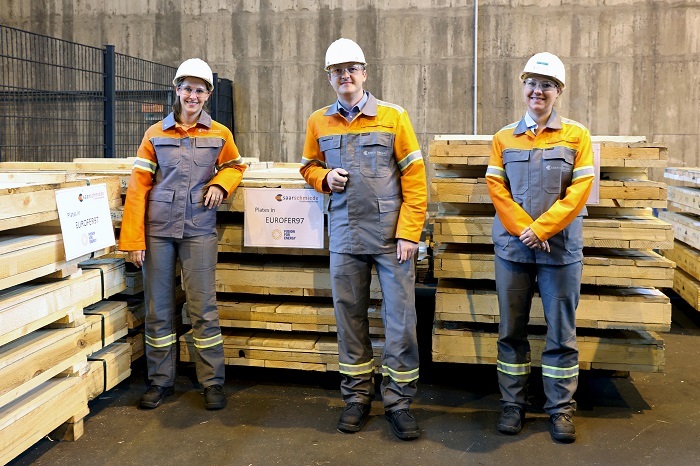
Manufacturing procedures themselves have been purchased. In 2012, F4E announced two contracts for detailed, standardized fabrication procedures and feasibility mock-ups for TBM subcomponents, including cooling plates, stiffening plates and the box. Together they were worth about EUR 5.2 million: roughly EUR 4 million for Atmostat and EUR 1.2 million for KIT.
These are historical contract values, not current TBM prices or a new procurement notice. Their significance is that making mock-ups, documenting procedures and validating them were contracted before the complete device existed. F4E's 2012 contract announcement
Suppliers must account for performance across the process
FI's industrial reading is that owning machining equipment is only part of the capability. A supplier also needs to explain the process conditions under which performance can be assured. Tool access in confined spaces, distortion-control fixtures and material tests after heat treatment must connect into a manufacturing route.
A company considering this field should distinguish what coupons can establish, what requires a full-size mock-up, and which later operations can alter material properties. This is analysis based on the cited records, not evidence of new orders or a definitive list of entry requirements. In fusion manufacturing, demonstrating a weld is followed by the work of turning the whole process into a usable component.
Sources
- F4E — Validating the best welding techniques to deliver ITER Test Blanket Modules (26 July 2017)
- Zmitko et al. — Progress and future perspectives in the European test blanket modules (TBM) manufacturing (2026, public abstract)
- F4E — Contracts for TBM EUROFER subcomponent manufacturing procedures (26 June 2012)
- ITER — Tritium breeding
- F4E — Validating the best welding techniques to deliver ITER Test Blanket Modules (26 July 2017)
- Zmitko et al. — Progress and future perspectives in the European test blanket modules (TBM) manufacturing (2026, public abstract)
- F4E — Contracts for TBM EUROFER subcomponent manufacturing procedures (26 June 2012)
- ITER — Tritium breeding
Information checked as of:2026-11-20
Primary-source industrial analysis. Distinguishes 2012 contracts, 2017 mock-up trials and a 2026 public research abstract; does not claim completed qualification, current tenders or commercial fuel self-sufficiency.