ITER divertor: Walter Tosto’s first series-produced cassette body passes hydraulic test
Manufacturing of ITER’s divertor cassette bodies has advanced. Italy’s Walter Tosto has passed the hydraulic test on its first series-produced unit and will proceed to leak testing.
Read the Japanese originalAnnouncement date:2026-11-26
Components destined for the inside of a fusion reactor cannot be delivered on the strength of precision manufacturing alone. Their welds must also withstand pressure and prevent water leakage. On 26 November, Fusion for Energy (F4E), the European Domestic Agency for ITER, announced that the first series-produced divertor cassette body manufactured by Italy’s Walter Tosto had passed its hydraulic test.
A step toward manufacturing 54 units
The divertor at the bottom of the ITER vacuum vessel receives heat and particles leaving the plasma. It consists of 54 cassettes, each carrying 3 plasma-facing components on a stainless-steel support structure. The test concerned the cassette body forming that support. Under 2 contracts with F4E, Walter Tosto will manufacture 54 units at its plant in Chieti, Italy.
Helium leak testing follows the hydraulic test
To meet stringent dimensional tolerances and leak-tightness requirements, the two organisations developed dedicated welding techniques, with inspectors monitoring the manufacturing process. The factory acceptance test used pressurised water to check pressure resistance and water leakage. Drying, hot helium leak testing, functional testing and dimensional inspection are planned next. Walter Tosto has also invested in equipment for conducting hot helium leak testing in-house.
F4E has separately reported manufacturing and inspection progress on cassette bodies from another supplier, SIMIC. This milestone concerns Walter Tosto’s production line; it is not completion of all acceptance tests or delivery. Alongside precision machining and welding, equipment that demonstrates product quality is an important part of the fusion supply chain.
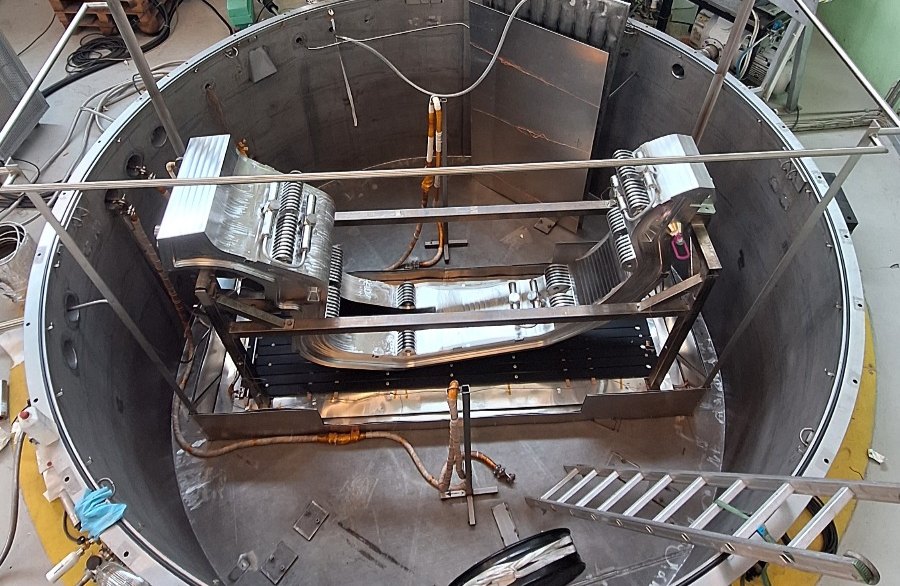
The photograph is a reference image published by F4E in 2025 showing a SIMIC-CNIM cassette body prepared for hot helium leak testing, not the Walter Tosto unit reported here.
Official information from related companies and research institutions
Check each organization’s announcements for development progress and technical documentation.
- F4E: F4E and Walter Tosto pass a key test for the first cassette body
- ITER: Divertor
- F4E: ITER cassette bodies — hot helium leak tests
Information checked as of:2026-11-26
Walter Tosto’s first cassette body passed the hydraulic test. Remaining acceptance tests and delivery are still ahead.