ITER’s First Production Cryopump Reaches Target Vacuum
ITER reports that its first production cryopump reached 10⁻⁶ Pa in cold tests. Helium pumping capacity was nearly 50% higher than for the pre-production unit tested in 2025. Installation and plasma operation remain future milestones.
Read the Japanese originalAnnouncement date:2026-11-16
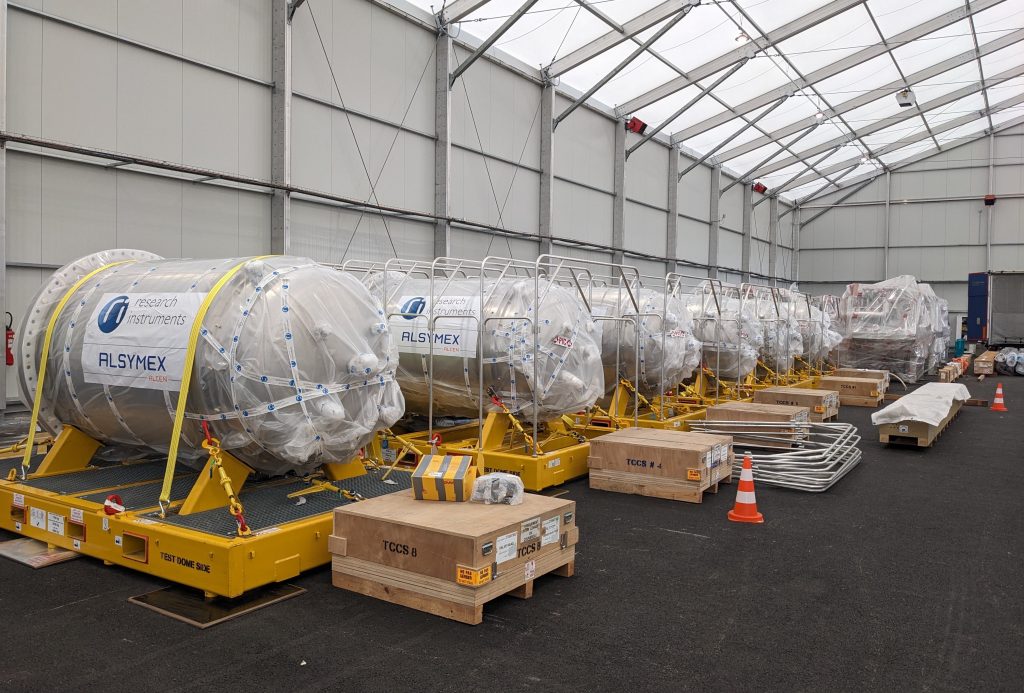
ITER’s first production cryopump has reached its target vacuum in a cryogenic test. In a report published on 16 November, the ITER Organization said its helium pumping capacity was nearly 50% higher than that of the pre-production unit tested in 2025. Equipment designed to evacuate the massive vacuum vessel and eventually remove exhaust gases has moved beyond factory acceptance to performance testing before installation.
Cooled to 4.5 K
From 21 to 27 October, ITER tested the production pump in a 15-cubic-metre tank at its test facility. Procured by Europe’s Fusion for Energy (F4E) and manufactured by Germany’s Research Instruments, the unit was cooled to 4.5 kelvin (about −269°C). ITER reports that tests using helium and a mixture containing hydrogen and neon achieved the target pressure of 10⁻⁶ pascal.
Testing the controls as well as the pump
ITER plans to use six cryopumps for the vacuum vessel and two for the cryostat surrounding its superconducting magnets. Along with pumping performance, the campaign examined inlet-valve modulation, isolation procedures for releasing trapped gas during regeneration, residual-gas analysis and control software. Our earlier explanation of cryopump regeneration covered the operating principle; this is a distinct result from testing a production unit.
Hydrogen test planned for 2027
ITER plans to test another production pump’s hydrogen pumping performance in 2027 and begin installing the eight pumps in 2029. The reported vacuum was achieved in a 15-cubic-metre test tank, not during operation inside ITER’s vacuum vessel or with fusion plasma.
For suppliers and system integrators, delivery is not the finish line. Vacuum performance, valves, instruments, controls and regeneration procedures must work together before commissioning.
- ITER Organization: Into thin air (16 November 2026)
- Fusion for Energy: Eight European cryopumps delivered (31 March 2025)
Information checked as of:2026-11-23
Results from a 15 m³ tank test on 21–27 October 2026. A second pump's hydrogen test in 2027 and installation starting in 2029 remain plans.