Fusion Research Institutes and National Projects: A Directory Covering Japan and 20 Other Countries
A 29-entry guide across 21 countries and international frameworks, from Japan’s QST and NIFS to global public research centres. Distinguish research, construction and design, and find the problem each organisation addresses.
Read the Japanese original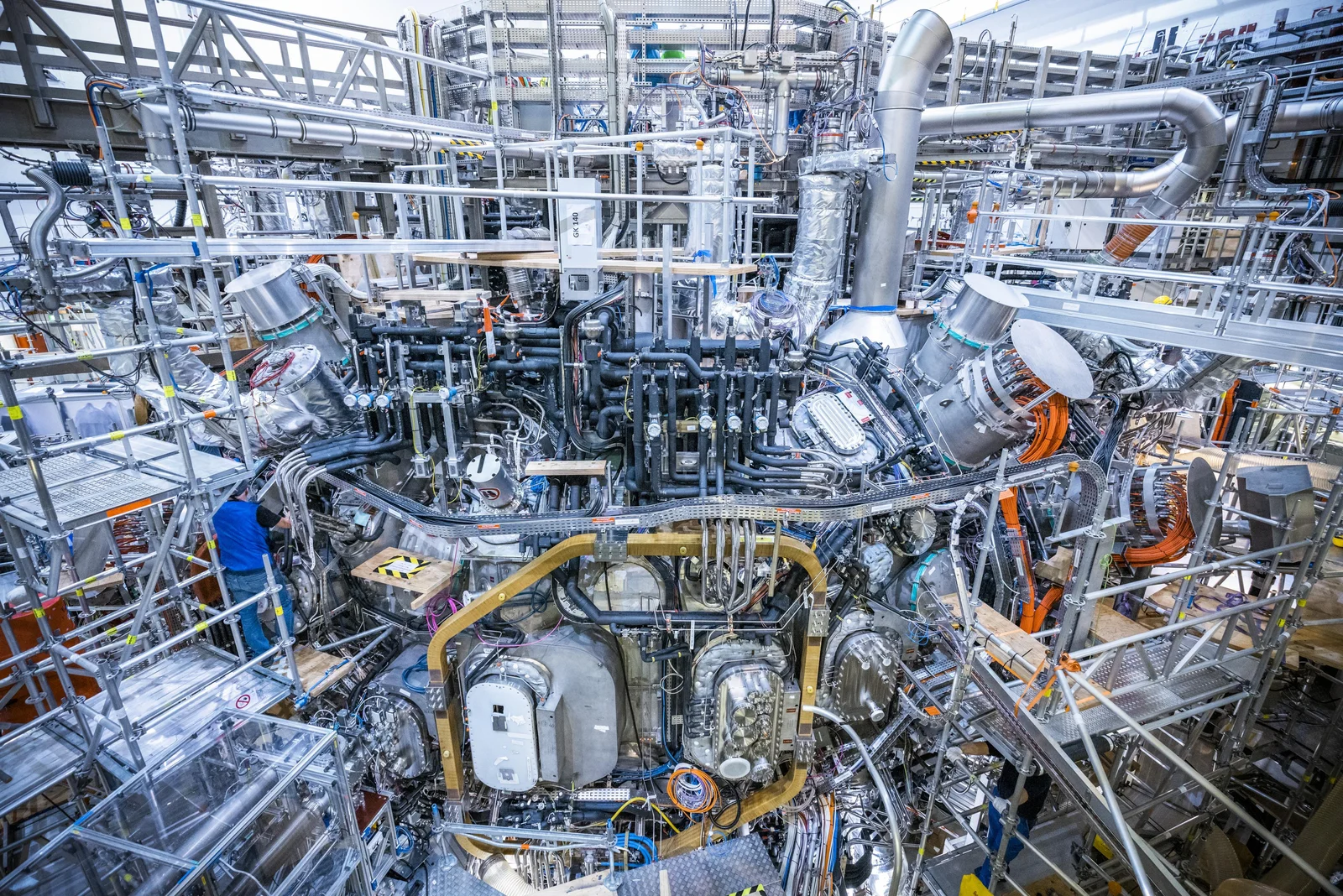
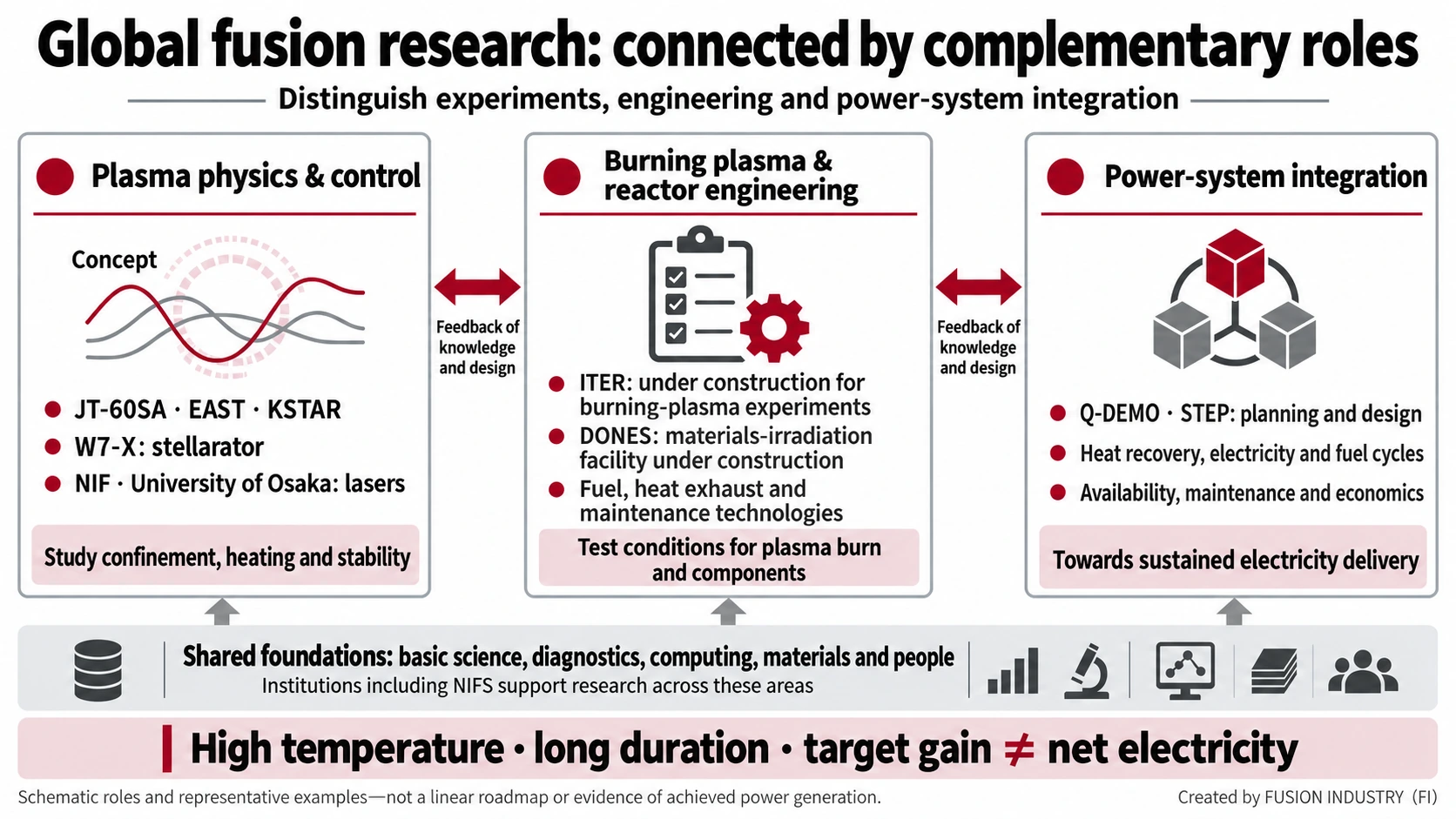
Fusion headlines mix research institutes, experimental machines, international organisations and proposed power plants. They are not all competing to demonstrate the same thing. Confining plasma, qualifying heat-resistant materials, processing fuel and integrating a power plant solve different problems.
This guide covers 29 entries across 21 countries and international frameworks, starting with Japan’s QST and NIFS. It distinguishes national laboratories, public-university centres, state-linked institutes and programme-delivery bodies. It is not a census of every organisation worldwide. Based on official material read on 30 October 2026, it explains roles and the development stages that the evidence supports.
Start with what a facility is meant to demonstrate
- Plasma research: tokamaks and stellarators investigate confinement, heating and control. High temperature or long duration alone does not mean electricity generation.
- Enabling engineering: materials, heat exhaust, fuel cycles, diagnostics and remote maintenance. Facilities that generate no electricity can still provide essential reactor knowledge.
- Burning-plasma and prototype stages: experiments address self-heating by fusion reactions or integrated systems including electricity, fuel and maintenance. Construction, design and targets are not operating achievements.
An “approach” usually describes how plasma is produced and confined, not a complete electricity-generation system. A materials source or funding programme does not have a reactor concept in that sense.
International frameworks: ITER is not a French-only project
ITER is hosted in France but is an international collaboration. Its seven members are China, Euratom, India, Japan, Korea, Russia and the United States. The UK maintains domestic fusion research but should not be described as a current ITER member. Swiss participation is through the European framework, not an additional membership.
International frameworks
Comparison table (scroll horizontally)
| Country / organisation | Main facility or field | Role and development stage |
|---|---|---|
| International; hosted in France/ITER Organization | ITER / tokamak | International burning-plasma and reactor-engineering experiment under construction, not a grid power station. Seven members participate; Europe is represented by Euratom. 1 2 |
| European framework/Euratom / EUROfusion / Fusion for Energy | Research coordination / ITER procurement | EUROfusion coordinates collaborative research within the Euratom framework; F4E delivers European ITER contributions. These roles differ from those of national laboratories. 2 3 |
Japan, Asia and Russia
Comparison table (scroll horizontally)
| Country / organisation | Main facility or field | Role and development stage |
|---|---|---|
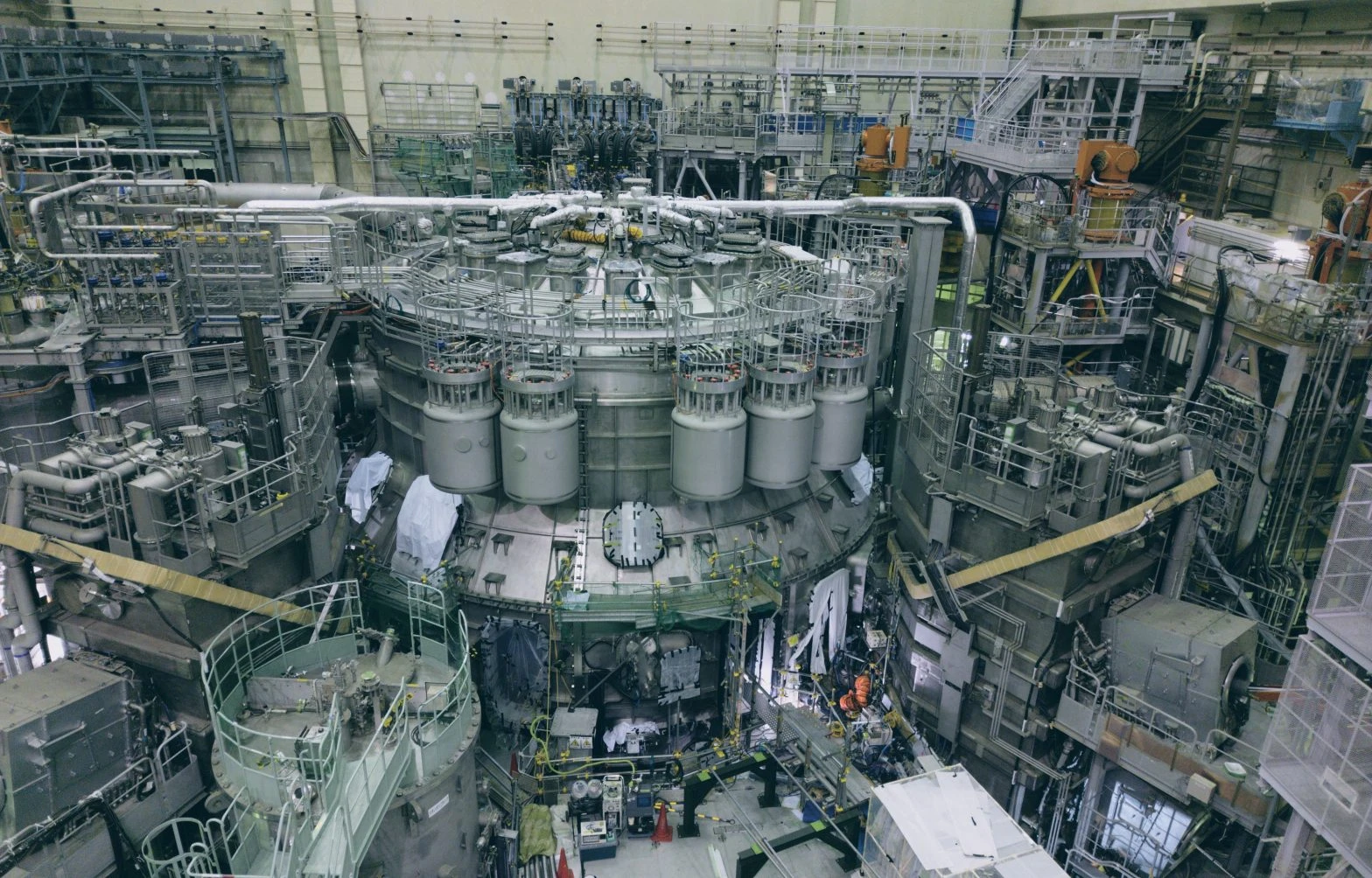
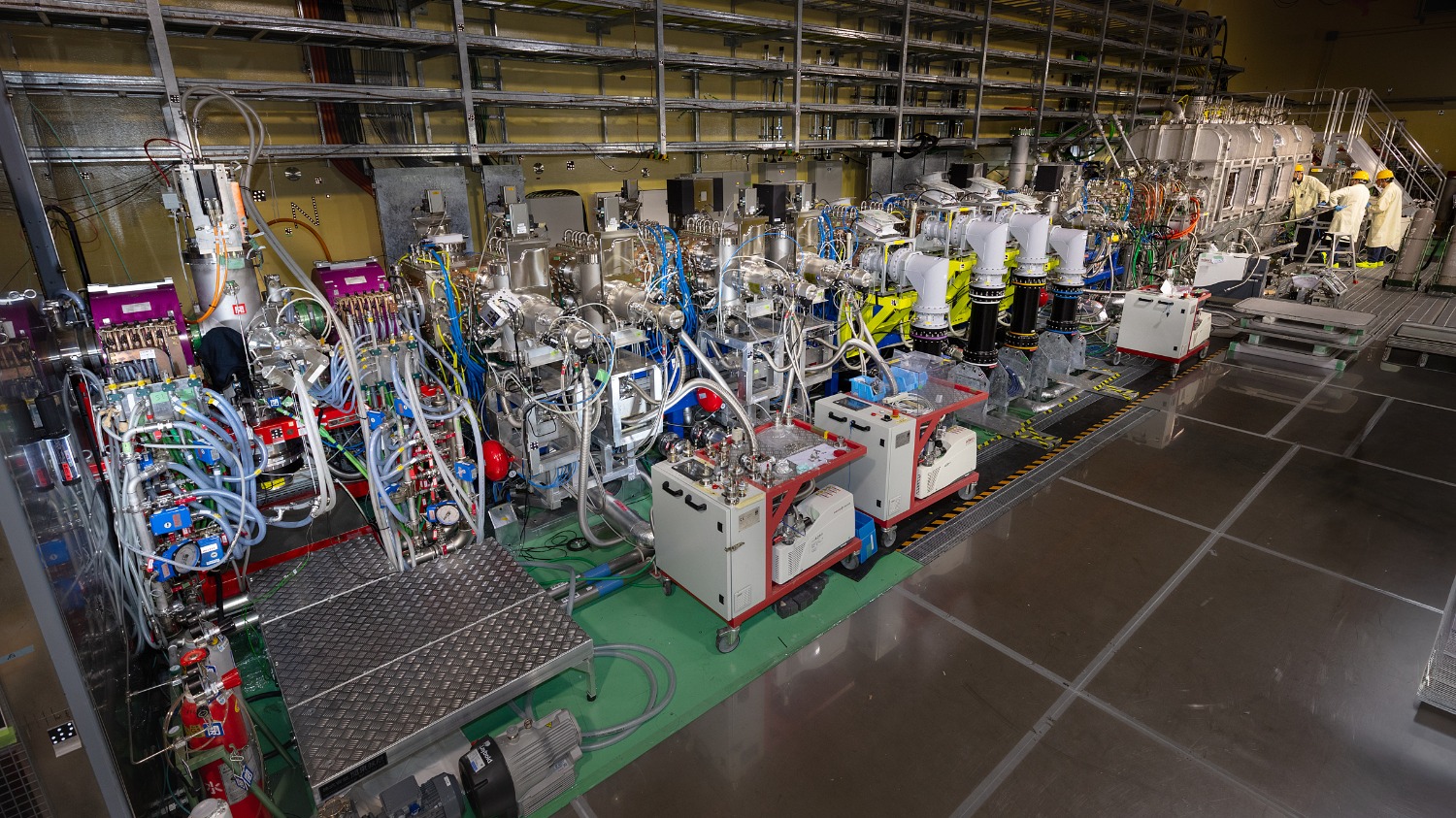
| Japan/QST | JT-60SA / ITER / LIPAc / Q-DEMO | Japan–Europe JT-60SA studies advanced plasma operation; QST also delivers Japan’s ITER contributions. Rokkasho develops accelerator and reactor-engineering capabilities. Q-DEMO is a design programme with staged electricity, fuel-breeding and steady-operation goals. 4 |
| Japan/NIFS | LHD legacy / plasma science / computation | Inter-university research institute supporting helical-plasma science, computation and collaboration. LHD experiments ended on 25 December 2025; data research and post-LHD work are not continued LHD operation. 5 6 |
| Japan/The University of Osaka — ILE | GEKKO-XII / LFEX; laser fusion | National-university centre studying fast ignition: laser compression followed by intense additional heating. Experiments and simulations investigate how to deliver energy efficiently to compressed fuel. 7 |
| China/CAS — ASIPP / HFIPS | EAST / CRAFT / BEST | EAST addresses plasma experiments, CRAFT engineering infrastructure, and BEST a burning-plasma facility under development. BEST’s intended electricity demonstration is a target, not achieved generation. 8 9 |
| China/CNNC — Southwestern Institute of Physics (SWIP) | HL-3; tokamak | Research institute within the state-owned CNNC group, advancing HL-3 experiments and international collaboration. It is distinct from CAS’s ASIPP and from private startups. 10 |
| South Korea/Korea Institute of Fusion Energy (KFE) | KSTAR; superconducting tokamak | Studies sustained high-performance plasmas in KSTAR and develops Korea’s ITER contributions. Current collaborative work addresses magnetic diagnostics and plasma-equilibrium reconstruction. 33 11 |
| India/Institute for Plasma Research (IPR) | ADITYA-U / SST-1; tokamaks | ADITYA-U supports plasma-control and diagnostic research; SST-1 develops superconducting-tokamak capabilities. “Steady state” in a name is not proof of indefinite operation or electricity generation. 12 |
| Russia/NRC Kurchatov Institute | T-15MD; tokamak | Tokamak designed for ITER-complementary plasma research. Do not confuse T-15MD with its predecessor T-15. Its role is documented; the latest operating status was not established in this review. 13 |
| Kazakhstan/National Nuclear Center of Kazakhstan | KTM; materials-testing tokamak | KTM is designed around materials and divertor testing, including exchangeable samples and adjustable plasma-loading geometry to investigate component behaviour in demanding conditions. 31 |
| Thailand/Thailand Institute of Nuclear Technology (TINT) | Thailand Tokamak-1 (TT-1) | TT-1 supports plasma research, training and international cooperation. A national-roadmap draft was discussed in March 2026; this is not a commitment that a power plant is built or commercialised. 32 |
European laboratories and programmes
Comparison table (scroll horizontally)
| Country / organisation | Main facility or field | Role and development stage |
|---|---|---|
| Germany/Max Planck Institute for Plasma Physics (IPP) | ASDEX Upgrade / Wendelstein 7-X | Investigates tokamaks with ASDEX Upgrade and stellarators with W7-X, pursuing complementary confinement configurations alongside plasma–wall and heat-exhaust research. 17 |
| France/CEA — IRFM | WEST; tokamak | WEST investigates tungsten plasma-facing components and long pulses. Its 2026 C13 campaign reported H-mode progress while studying erosion, heat loads and radio-frequency heating. 18 |
| United Kingdom/UK Atomic Energy Authority (UKAEA) | MAST Upgrade / JET decommissioning / enabling facilities | National laboratory combining MAST Upgrade spherical-tokamak research with materials, fuel and robotics. JET is in decommissioning and repurposing, not experimental operation. 19 |
| United Kingdom/UK Fusion Energy (UKFE) | STEP; spherical-tokamak prototype programme | Leads the STEP prototype-plant programme at West Burton. Its October 2026 report describes movement toward preliminary design and technology demonstrations, not an operating power station. 20 |
| Italy/ENEA / DTT consortium | Divertor Tokamak Test (DTT) | Superconducting tokamak under construction at Frascati. Water-cooled tungsten components and strong external heating will test heat-exhaust solutions relevant to ITER and DEMO. 21 |
| Spain / international/IFMIF-DONES España / international DONES programme | Accelerator-driven neutron source | Materials-irradiation facility under construction near Granada. Deuteron beams striking liquid lithium produce neutrons for qualification of reactor materials, complementing plasma-confinement experiments. 22 |
| Switzerland/EPFL — Swiss Plasma Center | TCV; variable-configuration tokamak | Public-university research centre hosting TCV. Switzerland participates in ITER through the European framework; it is not an eighth ITER member. 23 1 |
| Czech Republic/Institute of Plasma Physics, Czech Academy of Sciences | COMPASS-U; tokamak project | COMPASS-U is designed to investigate high-field, high-heat-flux plasmas, closed divertors, hot walls and liquid-metal exhaust concepts relevant to ITER and DEMO. 24 |
| Netherlands/Dutch Institute for Fundamental Energy Research (DIFFER) | Magnum-PSI; linear plasma generator | Magnum-PSI exposes wall and divertor materials to dense plasma. In-situ and post-exposure diagnostics evaluate surface evolution and durability in a shared user facility. 25 |
| Hungary/HUN-REN Centre for Energy Research | Diagnostics / shattered-pellet injection / DONES engineering | Develops plasma diagnostics, ITER shattered-pellet injection and DONES engineering. It illustrates participation through specialist systems rather than a domestic power-reactor project. 26 |
| Poland/Institute of Plasma Physics and Laser Microfusion (IPPLM) | Magnetic / laser plasma research; national coordination | Public research institute coordinating national fusion research and participation in EUROfusion, with magnetic-confinement, laser-plasma and diagnostic work. 27 |
North and South America
Comparison table (scroll horizontally)
| Country / organisation | Main facility or field | Role and development stage |
|---|---|---|
| United States/US Department of Energy — Fusion Energy Sciences (FES) | Funding and research programme | A funding and research programme rather than a machine, spanning foundational science, materials and fuel cycles. Public funding does not make every participating operator a state-owned company. 14 |
| United States/Princeton Plasma Physics Laboratory (PPPL) | NSTX-U; spherical tokamak | National laboratory pursuing spherical-tokamak research with NSTX-U. Facility purpose and latest operating status are separate; this entry does not certify completion of its restart. 15 |
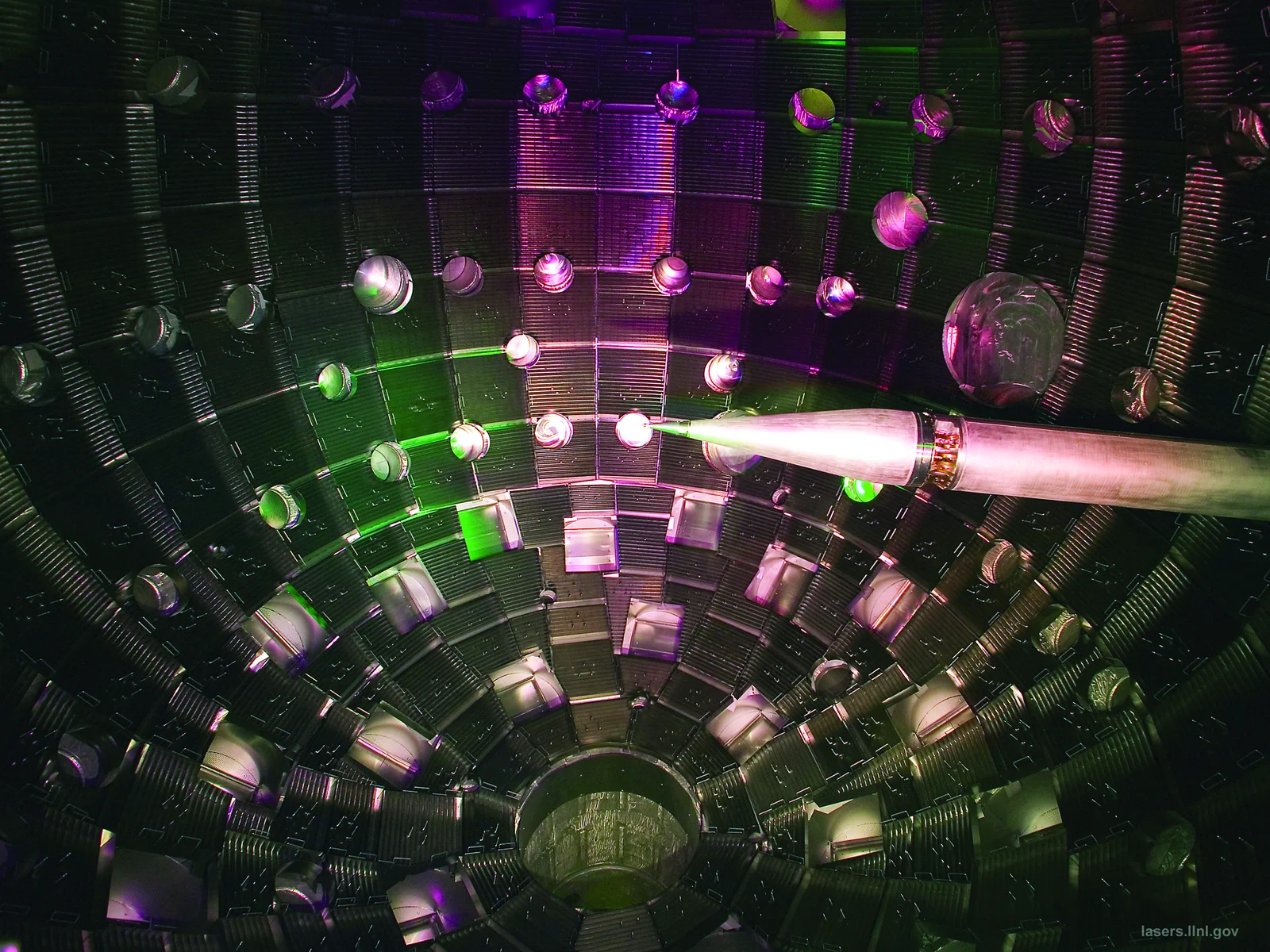
| United States/Lawrence Livermore National Laboratory (LLNL) | NIF; laser inertial confinement | National laboratory studying laser inertial confinement. NIF ignition compares fusion output with laser energy delivered to the target, not net facility electricity. Stockpile stewardship is also central to its mission. 16 |
| Canada/Canadian Nuclear Laboratories (CNL) | Tritium / fuel-cycle engineering | Collaboration with UKAEA addresses tritium separation and processing, fuel cycles and decontamination, applying nuclear-technology expertise to future fusion fuel handling. 28 |
| Brazil/INPE / CNEN | ETE; spherical tokamak / national coordination | ETE investigates low-aspect-ratio plasmas and diagnostics. INPE describes a gradual transfer of activities to CNEN; the future Iperó research centre should not be presented as completed. 30 |
Oceania
Comparison table (scroll horizontally)
| Country / organisation | Main facility or field | Role and development stage |
|---|---|---|
| Australia/Australian Nuclear Science and Technology Organisation (ANSTO) | Fusion materials / plasma diagnostics | Works with universities on ITER-related plasma-facing materials and diagnostic imaging, applying irradiation and characterisation capabilities to components for extreme environments. 29 1 |
How to use this directory for learning and business
Start with a question, not machine size. Magnetic-confinement questions lead toward facilities such as JT-60SA, W7-X and KSTAR; laser questions toward Osaka or NIF; materials and exhaust toward DONES or Magnum-PSI. This is not a ranking.
For manufacturers and engineers, the research operator is not always the procurement body. ITER divides responsibilities among the international organisation, domestic agencies and suppliers. A machine’s name alone does not identify an open tender or a market-entry route; consult the actual procurement and collaboration arrangements.
Public research is not the opposite of startups. Testing, diagnostics, fuel technology and training can provide capabilities that a single company cannot readily reproduce. However, collaboration with a public institution does not validate a company’s future power-plant performance or economics.
Three checks that prevent misleading comparisons
- Check the boundary of the metric. Plasma records, target energy gain and facility-wide electricity balance are different measures.
- Check the verb. Designing, constructing, experimenting and generating electricity are different milestones. Facilities such as LHD and JET retain research value after experiments end.
- Check the organisational type. International frameworks, funding bodies, universities, laboratories, state-owned companies and private firms should not be counted as one category.
Countries not listed here also conduct research. The directory does not include every small device, university group or specialist materials, computing and diagnostic team. Where current material could not be retrieved, limitations are explicit rather than replaced with assumed operating status or commercialisation dates.
The world’s fusion effort is more than its hottest machine
Fusion energy requires plasma performance to be connected with materials, fuel, heat exhaust, maintenance and system design. Instead of memorising countries and device names, ask which problem each organisation addresses and what stage has actually been demonstrated. That makes both the science and the industrial landscape easier to understand.
Sources
Checked on 30 October 2026. Numbered table links refer to the official sources below.
- ITER Members — 2026-01-01
- European Commission — Fusion energy and ITER
- Fusion for Energy
- QST 核融合エネルギー部門
- NIFS — Completion of the LHD Experiment — 2025-12-25
- NIFS — Research and collaborative platforms
- The University of Osaka ILE — Laser-produced-high-Field sciences
- HFIPS — ASIPP progress report — 2026-10-09
- CAS — BEST construction — 2025-10-10
- CNNC — Fusion engineering cooperation — 2026-09-28
- IPP CAS — KFE delegation and KSTAR collaboration — 2026-10-12
- IPR — Tokamak Plasma Experiments
- ITER — T-15MD comes on line in Russia — 2021-06-15
- US DOE — Fusion Energy Sciences
- PPPL — Virtual tour of NSTX-U
- LLNL — Achieving Fusion Ignition
- IPP — Historic and current fusion devices
- CEA IRFM — WEST C13 campaign — 2026-08-03
- UKAEA — Research and facilities
- UK Fusion Energy — STEP programme progress — 2026-10-13
- DTT — Overview of diagnostic systems — 2026-10-20
- IFMIF-DONES — About the facility
- EPFL — Swiss Plasma Center
- IPP CAS — COMPASS-U mission
- DIFFER — Magnum-PSI
- HUN-REN EK — Fusion Plasma Physics Department
- IPPLM — Institute and research scope
- UKAEA and CNL — Tritium collaboration — 2024-02-14
- ANSTO — Nuclear Materials Research and Technology
- INPE — Fusão Nuclear — 2025-08-26
- NNC Kazakhstan — Tokamak KTM
- NXPO and TINT — Fusion Technology Roadmap consultation — 2026-03-16
- NST — Korea Institute of Fusion Energy
Official information from related companies and research institutions
Check each organization’s announcements for development progress and technical documentation.
- ITER Members
- European Commission — Fusion energy and ITER
- Fusion for Energy
- QST 核融合エネルギー部門
- NIFS — Completion of the LHD Experiment
- NIFS — Research and collaborative platforms
- The University of Osaka ILE — Laser-produced-high-Field sciences
- HFIPS — ASIPP progress report
- CAS — BEST construction
- CNNC — Fusion engineering cooperation
- IPP CAS — KFE delegation and KSTAR collaboration
- IPR — Tokamak Plasma Experiments
- ITER — T-15MD comes on line in Russia
- US DOE — Fusion Energy Sciences
- PPPL — Virtual tour of NSTX-U
- LLNL — Achieving Fusion Ignition
- IPP — Historic and current fusion devices
- CEA IRFM — WEST C13 campaign
- UKAEA — Research and facilities
- UK Fusion Energy — STEP programme progress
- DTT — Overview of diagnostic systems
- IFMIF-DONES — About the facility
- EPFL — Swiss Plasma Center
- IPP CAS — COMPASS-U mission
- DIFFER — Magnum-PSI
- HUN-REN EK — Fusion Plasma Physics Department
- IPPLM — Institute and research scope
- UKAEA and CNL — Tritium collaboration
- ANSTO — Nuclear Materials Research and Technology
- INPE — Fusão Nuclear
- NNC Kazakhstan — Tokamak KTM
- NXPO and TINT — Fusion Technology Roadmap consultation
- NST — Korea Institute of Fusion Energy
Information checked as of:2026-10-30