The zero-resistance magnets that take 40 megawatts to cool
CERN’s Large Hadron Collider uses superconducting magnets kept at 1.9 kelvin. Its refrigeration system needs 40 megawatts of electrical power to keep them cold.
Read the Japanese original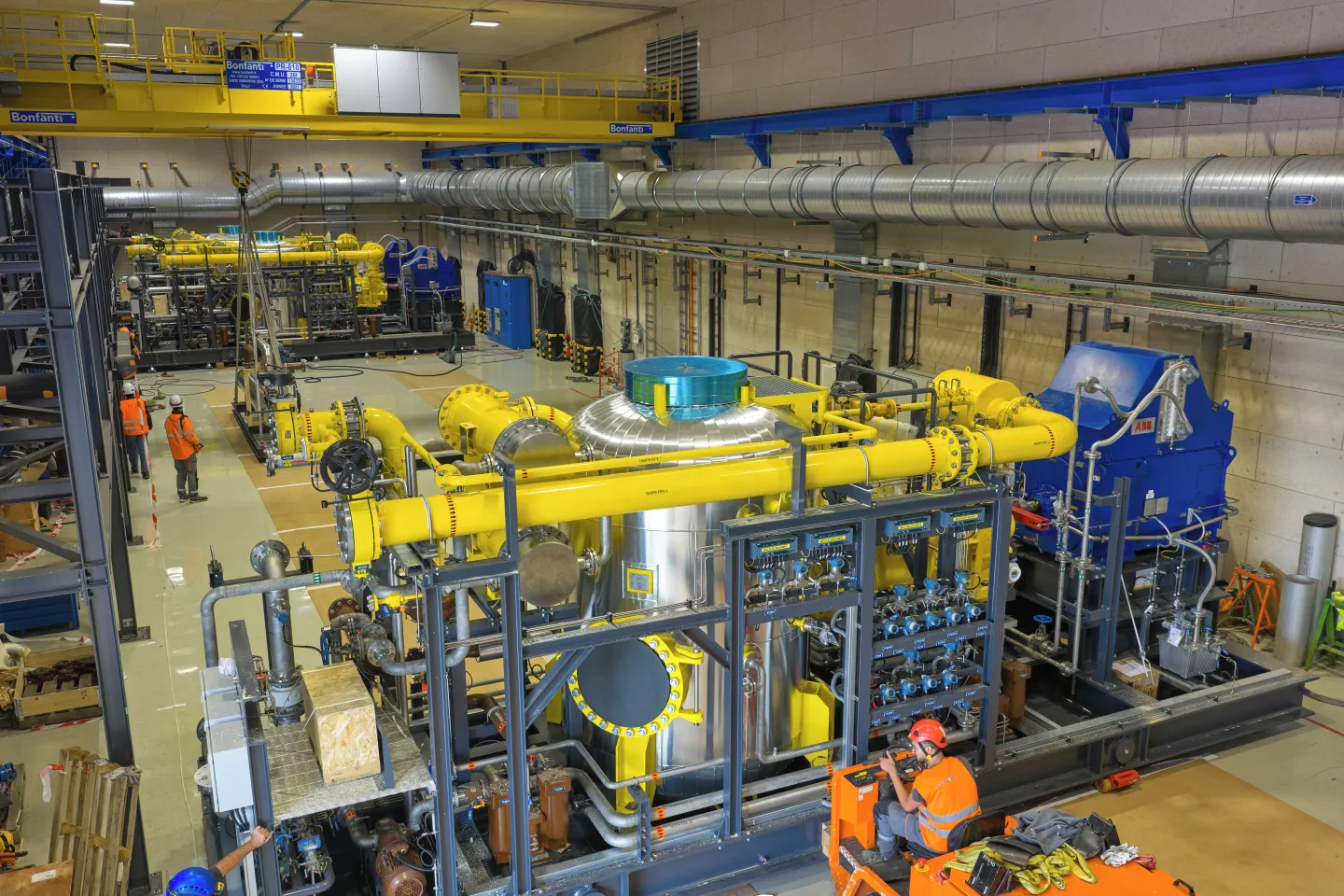
The coils in Europe’s Large Hadron Collider conduct electricity without resistance, yet keeping its magnets cold takes 40 megawatts of electrical power. The magnets operate just 1.9 degrees above absolute zero. The coils avoid resistive heating, but keeping about 23 kilometres of the 27-kilometre ring that cold calls for an industrial refrigeration system on the surface. Where does that electricity go?
Cooling a 27-kilometre ring
A particle travels straight unless a force bends its path. At CERN’s LHC, 1,232 main bending magnets, each 15 metres long, guide particles around the ring. Strong magnetic fields require large currents. By cooling niobium–titanium wire into its superconducting state, CERN can carry those currents without resistive heating in the coils and keep the magnets compact. CERN estimates that conventional magnets would require a ring about 120 kilometres long to reach the same particle energy.
Cooling the magnets once is only the start. Heat seeps in through supports and pipes. Refrigerators have to move that heat from the cold magnets to warmer surroundings, and the larger the temperature difference, the more work that takes.

Industrial refrigeration on the surface
A household fridge has a compressor. At the LHC, the machinery occupies buildings. After passing through surface compressors, helium is cooled in a cold box containing heat exchangers and expansion turbines. It is cooled further before carrying heat away from the magnets in a closed circuit. CERN’s 40-megawatt figure is electrical power for the cryogenic system. The accelerator’s total demand and the heat removed from the magnets are different quantities. A bill would also depend on the load, operating hours and price of electricity.
When CERN reported on the High-Luminosity LHC upgrade in December 2025, two new refrigerators were being added to the eight already in use, in part to serve stronger focusing magnets. The cold boxes delivered for the upgrade were 16 metres long. Even an upgrade to the cooling system calls for manufacturing and transporting equipment on that scale.

What fusion projects need to count
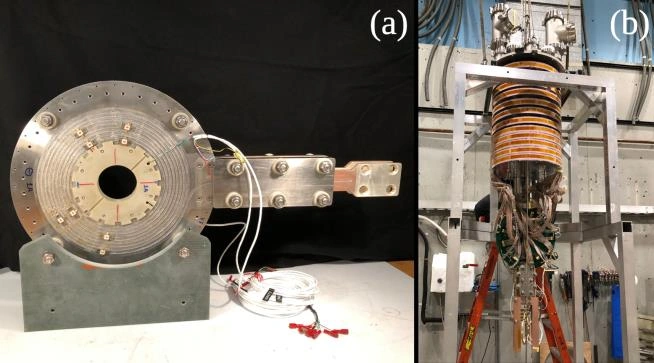
Fusion experiments also depend on more than the superconducting wire. A paper from the SPARC magnet team shows a test coil set up for evaluation at 15 kelvin. The choice of temperature depends on the material, field and current. The LHC’s 40-megawatt figure belongs to its own installation.
What matters to a future power station is the power it produces and how much it feeds back to run its own equipment, refrigeration included. Even when a coil loses no energy to resistance, heat still has to be carried away to keep the magnet at its operating temperature.
- CERN: LHC cryogenics
- CERN: LHC superconducting electromagnets
- CERN: Cold boxes for the High-Luminosity LHC
- Hartwig et al.: SPARC magnet demonstration programme, figure 3
Information checked as of:2026-11-17
CERN gives 40 MW as the electrical demand of the LHC cryogenic system in operation. The HL-LHC equipment was being delivered and installed as of December 2025. The SPARC photograph shows a test setup.