310 Tonnes, Millimetres of Precision: Toshiba Builds Fusion Hardware
From JT-60SA's vacuum vessel to ITER's giant superconducting coils, Toshiba has a tangible record in fusion. We trace its manufacturing and assembly work and explain what the minus-269°C, 10,000-ampere test announced in 2026 established.
Read the Japanese original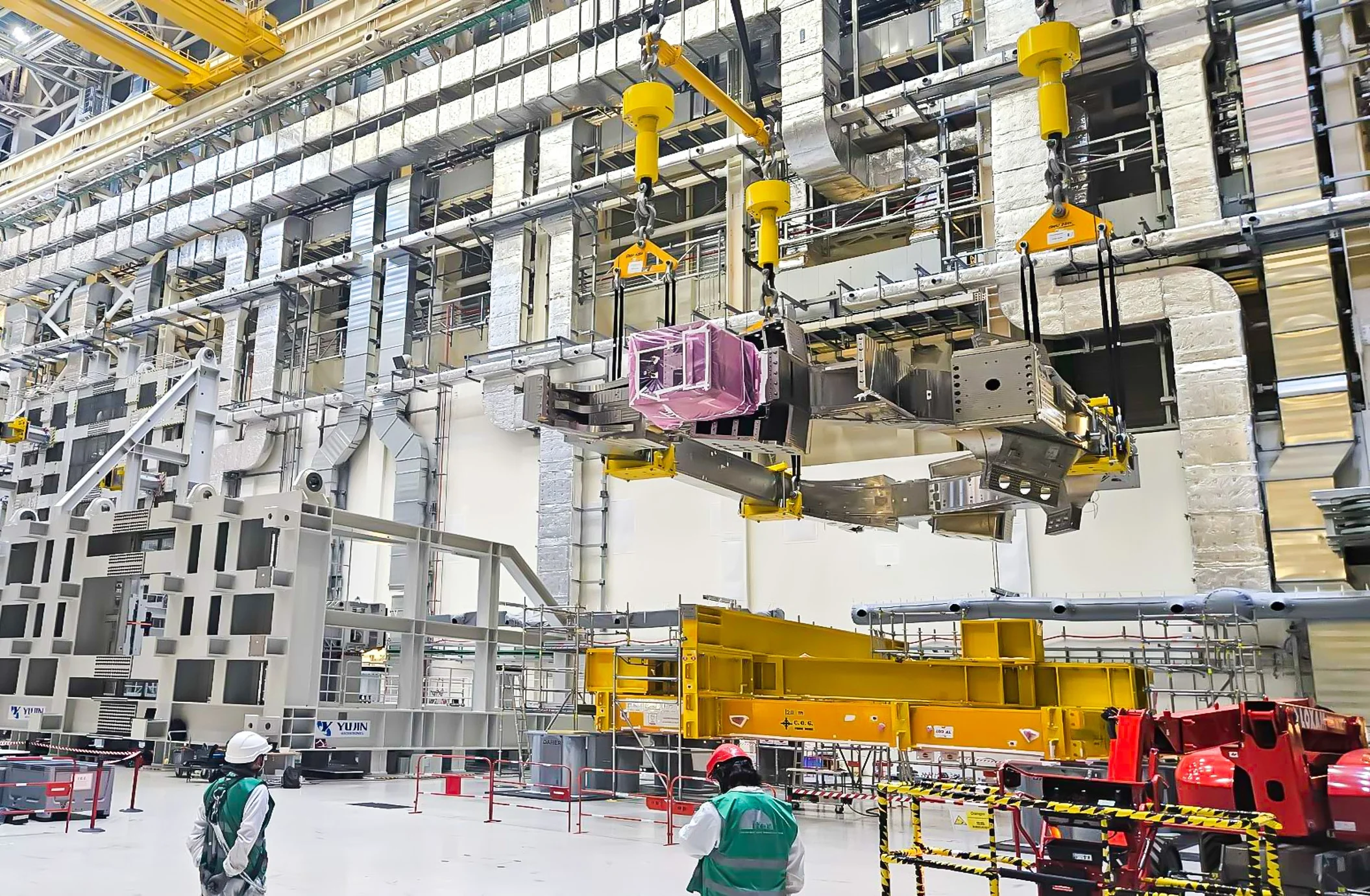
Startups creating plasma are not the only protagonists in fusion. Companies that manufacture enormous machines, move them across borders and verify that they perform as required are equally essential. Toshiba is a concrete example.
Tracing its work changes how we see the fusion industry. The important question is not simply when someone promises to generate electricity, but who has completed what, and under which conditions its performance has been tested. This company and technology feature connects Toshiba's manufacturing and assembly record with the coil testing announced in 2026. It does not present older announcements as breaking news.
Two ways Toshiba helps build fusion
Toshiba says it has worked on fusion technology since the 1970s and participated in projects including JT-60, JT-60SA and ITER. That is the company's history of involvement; it does not mean that fusion research worldwide began in the 1970s.
The distinction between JT-60SA's vacuum vessel and ITER's toroidal field (TF) coils illustrates the breadth of that work. The vessel provides a vacuum environment for plasma experiments. The coils are large electromagnets used to confine plasma with magnetic fields. Vessel and magnets perform different functions, but must work together as an experimental machine. Toshiba's technology overview
This work is easy to overlook when a fusion machine is viewed as a single invention. Separating manufacturing, which turns a design into a component; assembly, which places components together; and testing under actual operating conditions makes a company's contribution more tangible.
A 310-tonne coil, with tolerances of just millimetres
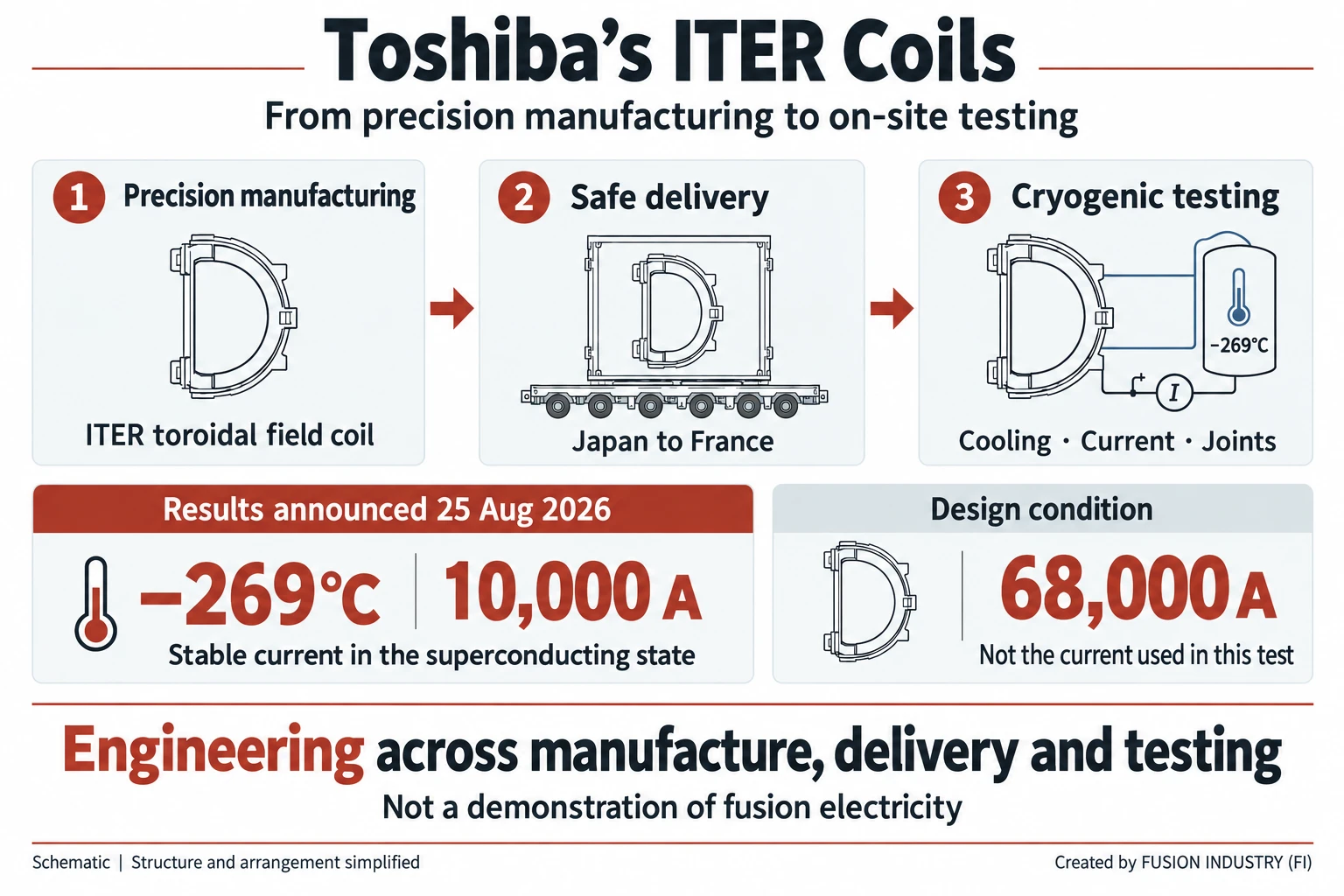
On 21 February 2023, QST and Toshiba Energy Systems & Solutions announced completion of Toshiba's fourth ITER TF coil. Despite standing 16.5 metres tall and weighing 310 tonnes, the component was subject to a tolerance of only a few millimetres for its current centre line—the reference position of the current flowing through it.
Why does such a large coil demand such fine precision? The magnetic field is produced by the current inside, not by the external shape alone. Controlling the position of the current centre line contributes to the required magnetic-field accuracy. This is not simply a matter of completing an enormous steel structure. QST and Toshiba's completion announcement
On 6 March that year, the ITER Organization also reported completion of Toshiba's fourth coil and the eight regular coils procured by Japan. ITER will incorporate 18 TF coils, with a spare counted separately. Toshiba's four coils, Japan's share and the total number in the machine are different quantities. ITER's manufacturing report
From a Japanese factory to an experimental machine in France
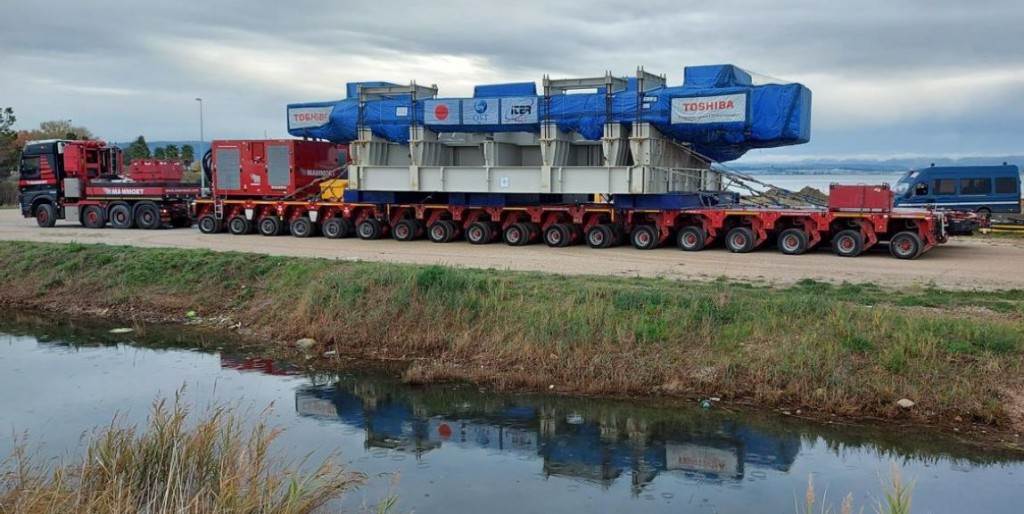
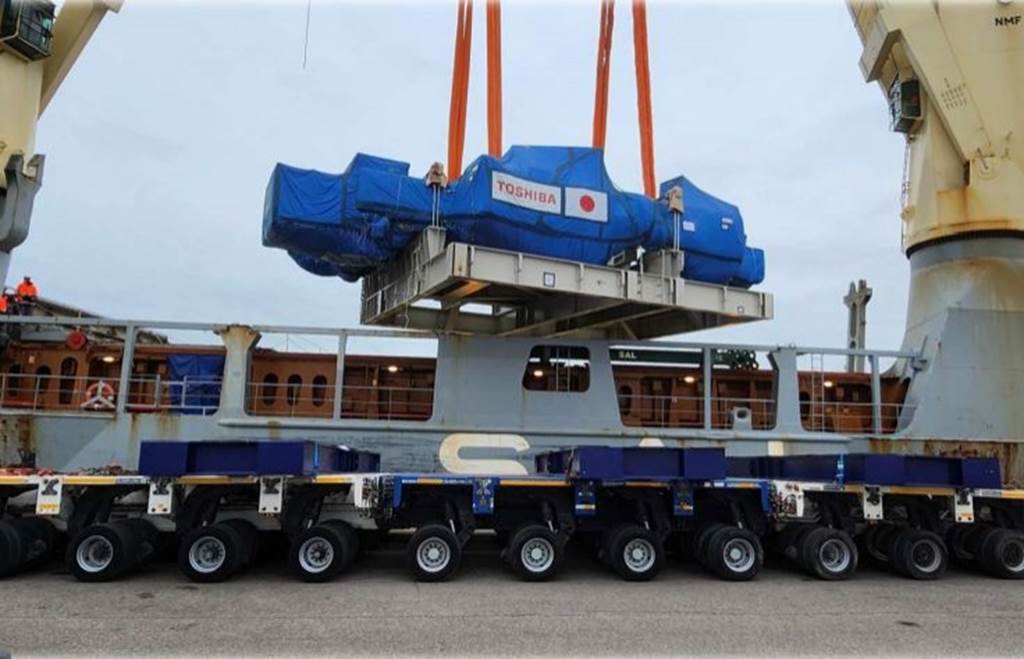
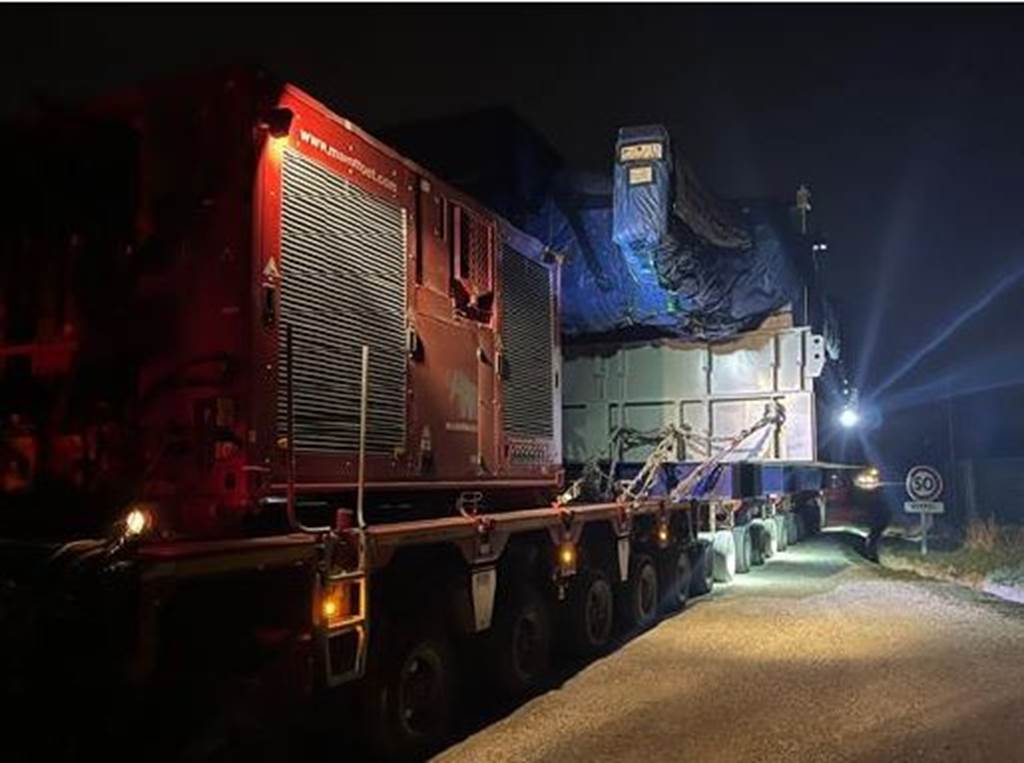
Manufacturing achievements are not documented only in factory announcements. ITER's official transport record follows Toshiba-made TF10, TF16 and TF15 across the sea and towards the construction site. TF15, for example, was unloaded at France's Fos-sur-Mer port in December 2022.
The transport photographs in this feature show real coils in protective packaging and their movement. They do not show the internal winding structure or the 2026 energization test itself. They document the stage at which manufactured equipment reaches the site of an international project. ITER's official transport record
When examining an industry, it is important to distinguish completion, shipment, arrival, installation and testing. Arrival does not necessarily mean a component is ready to operate, and a successful test does not mean a power plant has been completed. Each stage nevertheless represents a distinct achievement, with specific technical requirements and responsibilities.
At JT-60SA, the work included the vessel and overall assembly
Toshiba's role extends beyond superconducting coils. QST's JT-60SA construction record explicitly recognizes Toshiba Energy Systems & Solutions and Toshiba Plant Systems & Services for their contributions to manufacturing the vacuum vessel and assembling the machine as a whole. The research institution's own record therefore also identifies their scope of work. QST's construction record
The challenge is that making individual components and making the whole machine work are separate tasks. Even components that individually meet their accuracy requirements cannot support an experiment unless they fit together on site, leave the necessary working space and can be assembled without interference from other equipment. Knowledge that connects manufacturing with assembly is itself an important fusion technology.
Minus 269°C and 10,000 amperes: what did the test establish?
On 25 August 2026, QST and Toshiba announced a successful cryogenic energization test of a TF coil at the ITER construction site. It was cooled to minus 269°C and carried a stable current of 10,000 amperes in the superconducting state. According to the announcement, the team also examined heat generation at joints and coolant-flow characteristics, with no coolant leaks or similar problems.
The achievement was to test a manufactured component together with power and cooling equipment under conditions approaching its operating environment. However, the 10,000-ampere test and the TF coil's 68,000-ampere design current are different. This was not a demonstration of electricity generation from fusion, or of the performance of an entire commercial reactor. QST and Toshiba's test announcement
There is no need either to dismiss the achievement because it has not generated electricity or to leap to the claim that fusion power has been demonstrated. Reading exactly which operating conditions have been verified makes the next stages of validation clearer.
Judge companies by their equipment and achievements, not declarations alone
Toshiba's example shows that participation in the fusion industry is not limited to developing an original reactor from scratch. Manufacturing large components, assembling them precisely and verifying their performance on site are also industrial roles.
Three questions make company comparisons clearer: what did the company supply or undertake; how far has it progressed through manufacture, delivery and testing; and whose primary records substantiate that progress? This is FI's editorial framework, not a forecast of future orders or earnings.
Toshiba's documented strength is that its work is embodied in actual equipment for JT-60SA and ITER, rather than only in a future concept. Assessing that contribution requires looking at both completed hardware and the performance that still needs to be demonstrated.
Toshiba and fusion, at a glance
At JT-60SA: the vacuum vessel and machine assembly. At ITER: completion of Toshiba’s fourth TF coil was announced in February 2023. Cryogenic energization-test results were also announced in 2026. Manufacturing, transport and on-site testing are different milestones, and must be distinguished from demonstrating commercial fusion power.
- Toshiba: Fusion technology and contributions to JT-60SA
- QST and Toshiba ESS: Completion of the fourth ITER TF coil
- ITER: Japan completes last vertical coil
- ITER: Component Transport
- QST: JT-60SA construction
- QST and Toshiba: Successful cryogenic TF-coil energization test
Information checked as of:2026-10-27
Company and technology feature based on primary sources