Naka's open day is tomorrow: discover a research center connected to the world
Ahead of the October 17 open day, explore Naka's research machines, engineering for ITER and Japanese–European training. Check general admission versus reserved tours, access limits and the last free shuttle, and choose questions to investigate on site.
Read the Japanese originalAnnouncement date:2026-10-17
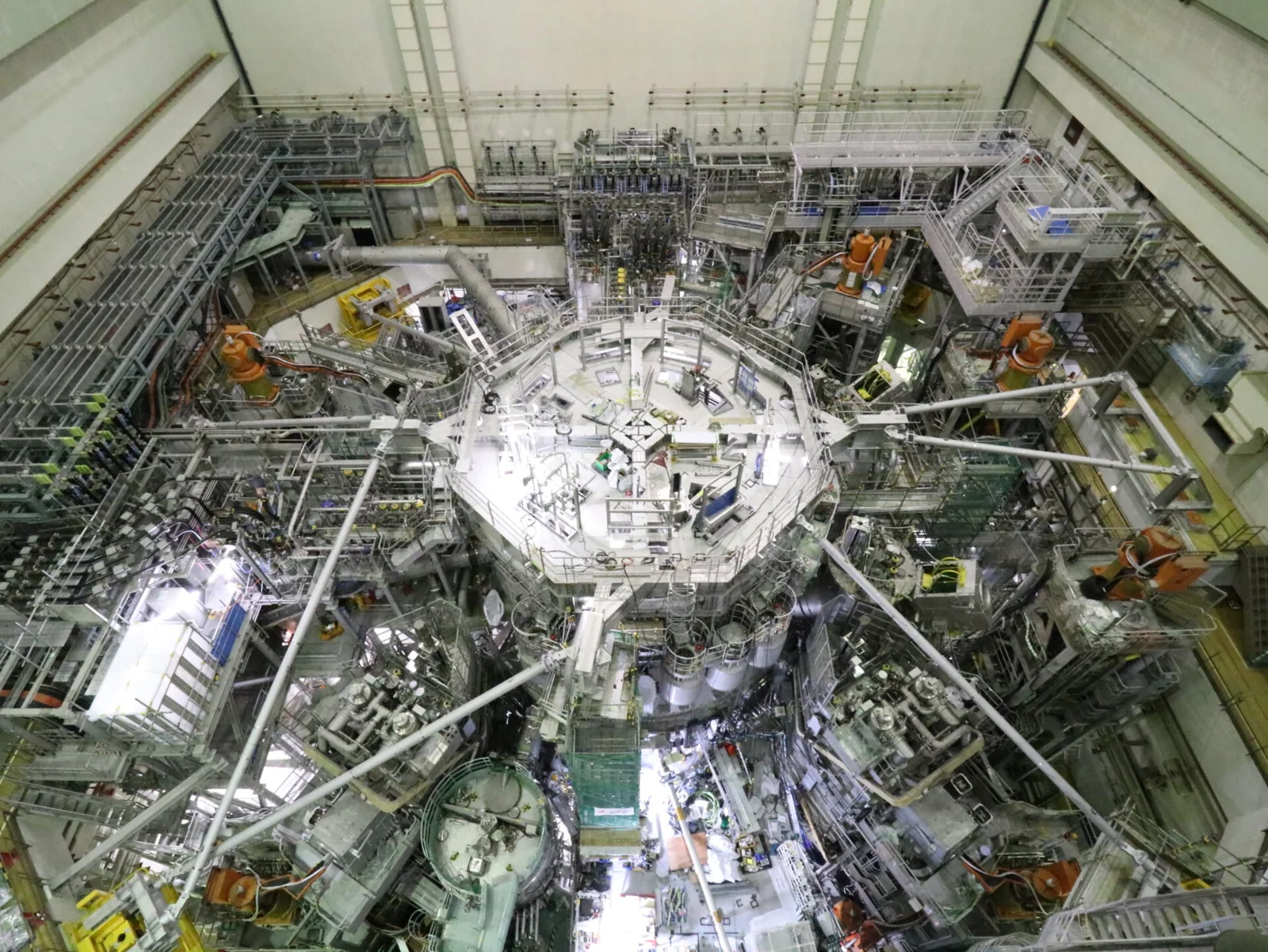
Naka's facility open day is finally tomorrow. On Saturday, October 17, 2026, the QST Naka Institute for Fusion Science and Technology welcomes the public. Whether enormous research machines excite you or fusion is entirely new, learning what has been built up here can make the visit much more rewarding.
Naka's significance goes beyond the size of its equipment. Research into high-temperature plasma, development of equipment sent around the world, and training the next generation who will operate it are connected at one site. Tomorrow offers a chance to explore that breadth of work. QST's official event information
From Naka to fusion research around the world
QST is the National Institutes for Quantum Science and Technology. Its Naka site houses JT-60SA, a joint Japanese–European project. This experimental machine uses a tokamak configuration, combining magnetic fields to confine high-temperature plasma. Plasma is a state in which electrons have separated from atoms and electrically charged particles move about.
The questions extend beyond how high the temperature can be raised: how can plasma be stabilized and measured, and knowledge carried into the next operating campaign? As Japan's domestic agency for ITER, the international experimental reactor under construction in France, Naka also develops and procures major components with industry. It connects domestic experiments with construction on a global scale. QST's research policy for Naka
Commercial fusion electricity generation has not already been achieved here. Even so, the work of moving future requirements from drawings to hardware, and from individual parts to working systems, is impressive in its own right.
Important equipment surrounds the giant machine
Look closely at photographs of JT-60SA and you will see layers of piping, cables, supports and auxiliary systems around it. Research involving high temperatures depends on cooling, removing air, delivering electricity and measuring conditions. Look at the central machine and the equipment that makes it work together.
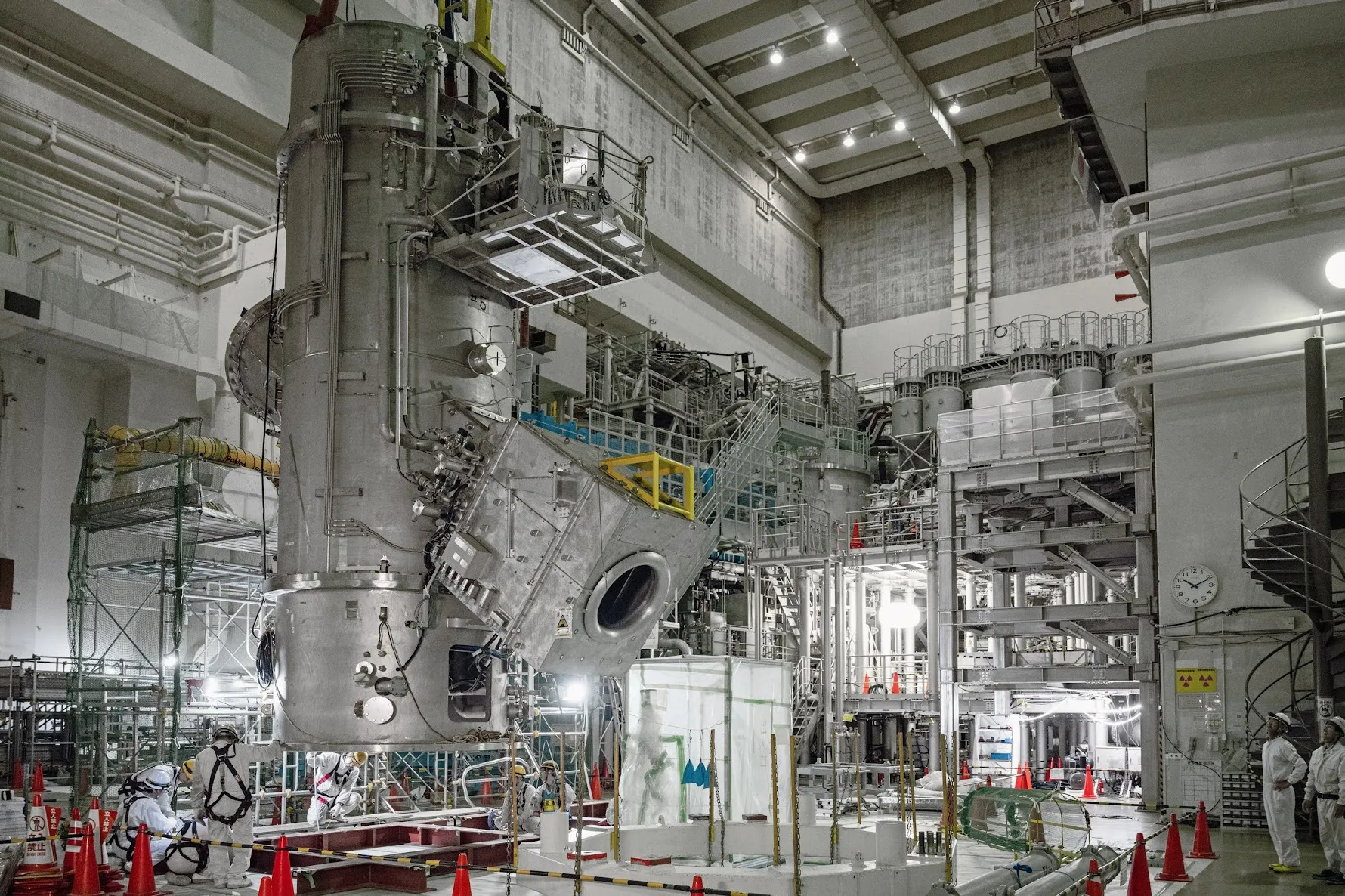
In the upgrade work described by F4E in January 2025, equipment from more than 70 suppliers in Japan and Europe was integrated, with additions to heating and diagnostic systems. The photograph of a neutral beam unit being lifted records work in December 2024. Moving a large component requires strength; placing it precisely requires accuracy. Both advance the research. F4E's upgrade report
Tomorrow's activities reflect this breadth. Plans include a behind-the-scenes tour of the central substation, superconductivity and vacuum experiments, NBI exhibits and robot arm operation. NBI heats plasma by delivering energy in a beam of electrically neutral particles. Asking what the main machine needs in order to operate makes each piece of equipment easier to understand.
Turning Japanese technology into working equipment
Naka's international cooperation is more than an exchange of information between researchers. Consider ITER's superconducting toroidal field coils: enormous magnets arranged around the ring-shaped machine to create the field that confines plasma. Japan was responsible for manufacturing nine coils.
On August 25, 2026, QST and Toshiba announced a successful test at the ITER construction site in which a Japanese-made coil was cooled to approximately −269°C and carried a stable current of 10,000 amperes. QST engineers also contributed to the test plan using their manufacturing experience. The 10,000-ampere result is a test achievement; it does not mean operation at the design current of 68,000 amperes or the start of operations for ITER as a whole. QST's official energization test announcement
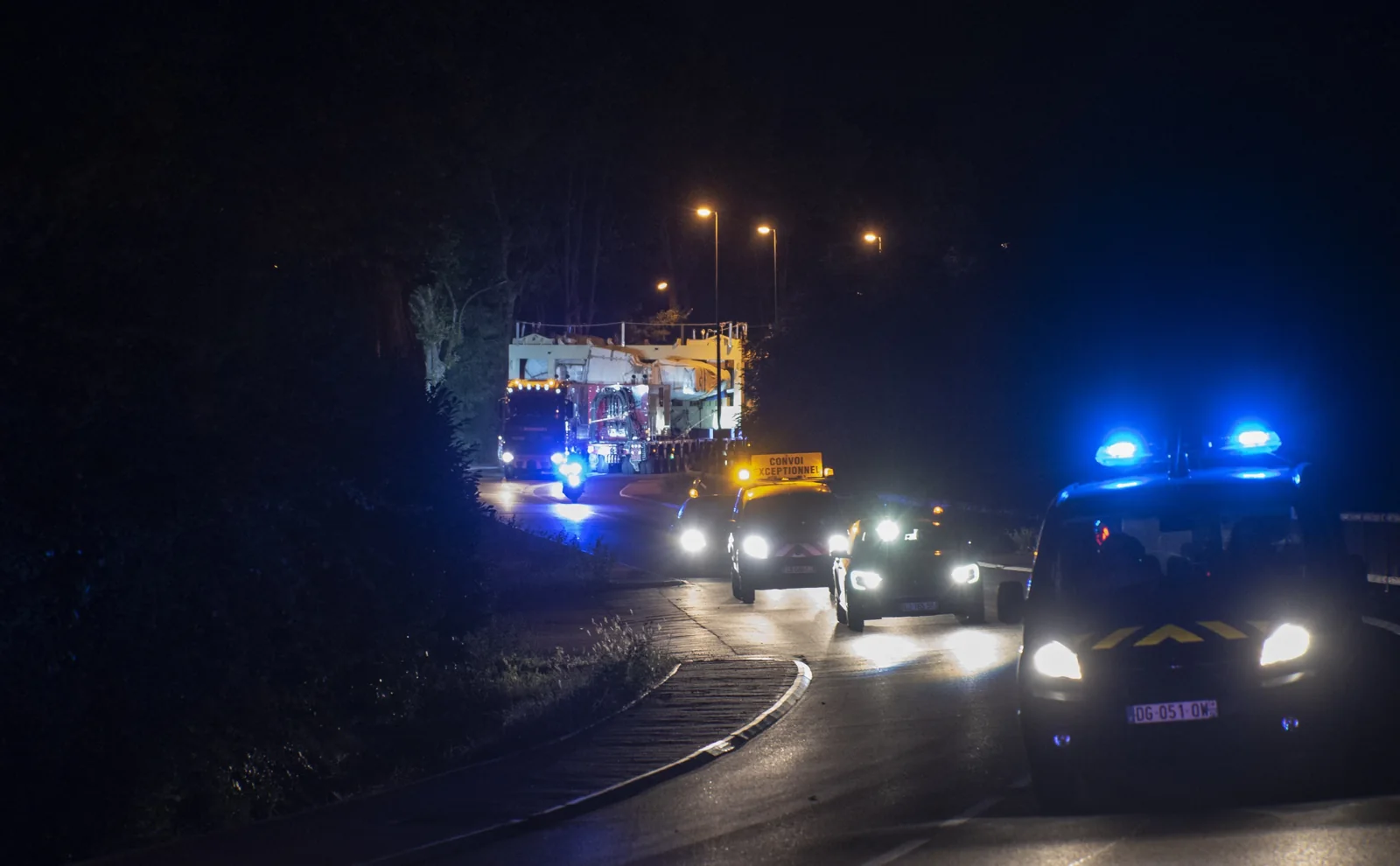
Completing a large component is not the end of the job. It must be transported, connected to cooling and power systems, and tested under the intended conditions. Another Japanese-procured coil, TF13, arrived at ITER on July 3, 2020. Delivering enormous components across borders also brings together many technologies. ITER's record of TF13's delivery
If you encounter an ITER exhibit tomorrow, consider how Japanese researchers and manufacturers support a huge project in another country. Naka is connected to the world through physical equipment and people's experience.
Research machines are also places to train people
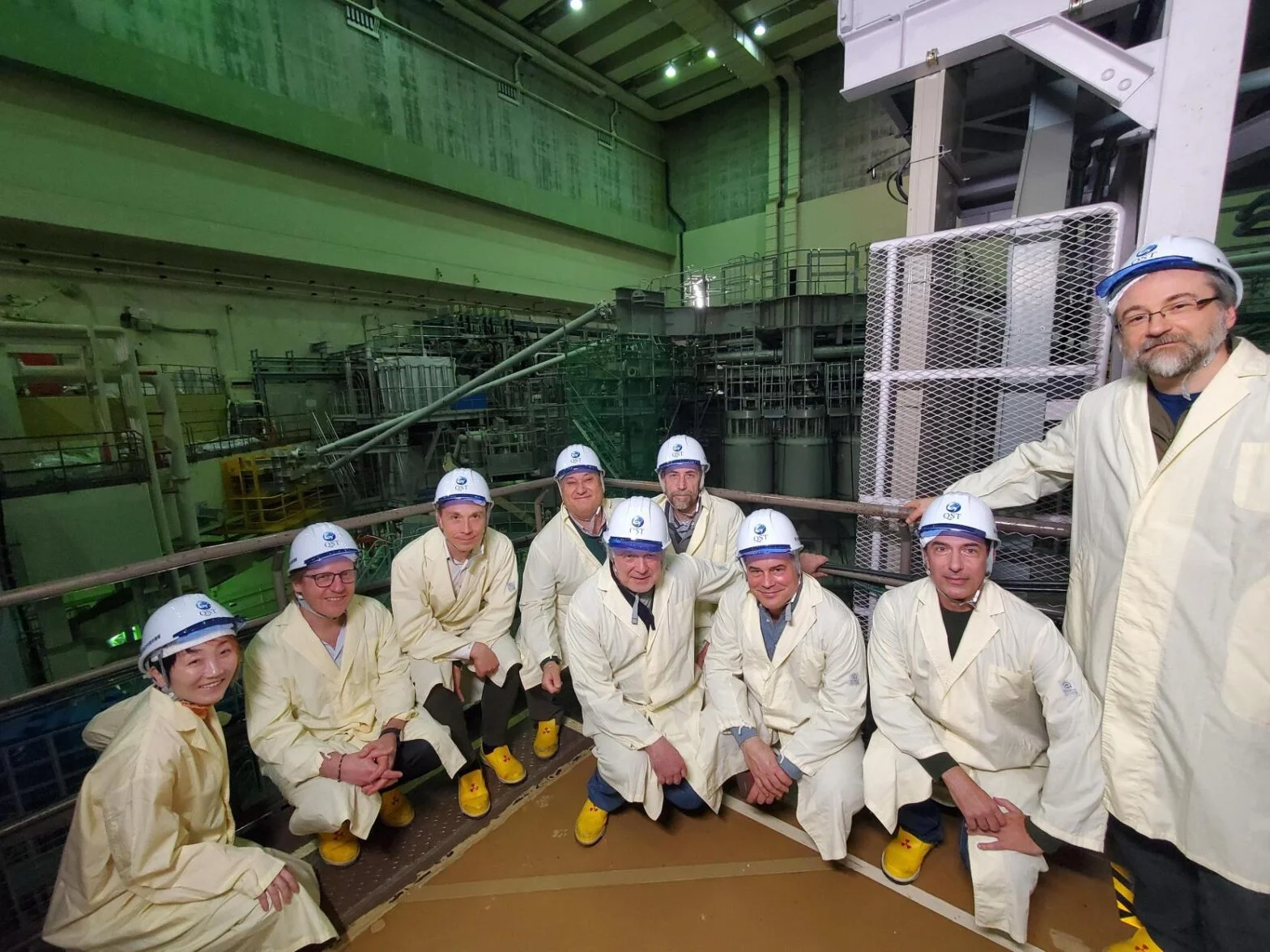
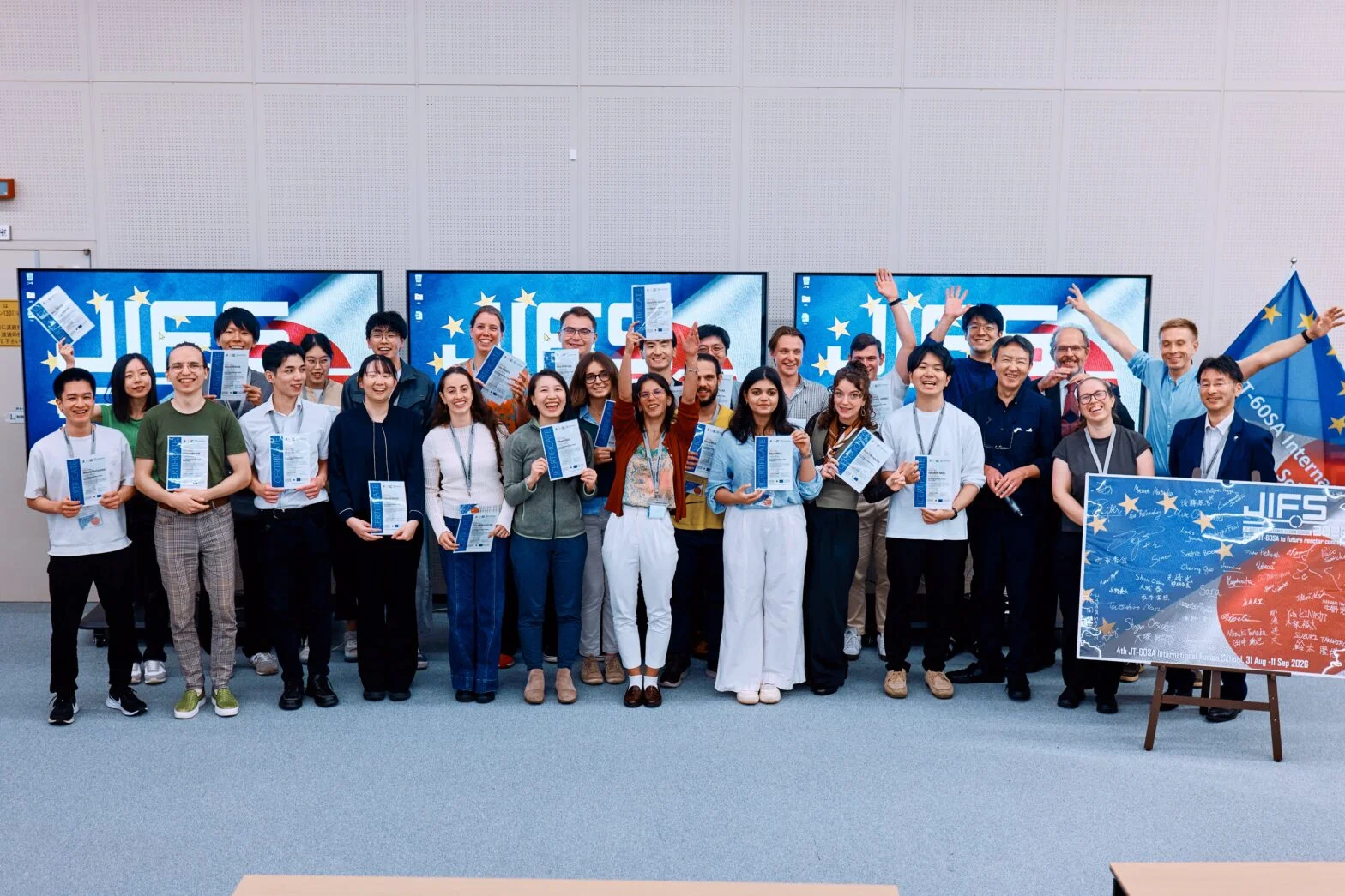
Another important role is passing knowledge to the next generation. The fourth JT-60SA International Fusion School in 2026 brought together 11 students from Japan and 11 from Europe. Over two weeks they studied machine design, technology, plasma physics and operations, and visited the tokamak hall and control room. The smiles in the graduation photograph represent another achievement of this research center. F4E's September 21, 2026 report
On August 31, European universities and research institutions were also announced as participants in the JT-60SA On-site Laboratory, where students and early-career researchers stay at Naka and take part in R&D. The aim is to develop internationally the connection between classroom learning and research using real equipment. QST's announcement on Japanese–European training
A machine becomes a research capability only when people know how to use it. During the open day, consider asking what a facility is used to verify and which kinds of work come together there. For anyone considering a career, this can connect school subjects with real jobs.
Choose tomorrow's highlights from your own questions
First-time visitors might begin with cooling or vacuum demonstrations. Those interested in machinery could choose actual NBI equipment or the robot arm, while visitors interested in electricity could explore the central substation. The leaflet describes its 275 kV equipment: a voltage of 275,000 volts. The scale of the electricity needed to run the institute can itself become a theme for a visit.
Advance registration for the JT-60SA tour has closed, but this is separate from general admission. The leaflet says on-the-day applications are accepted only if cancellations create places. Check availability and details at the general information desk in the control building lobby, and enjoy other activities without assuming a tour place. The robot arm activity uses limited numbered tickets distributed on the day. QST's official leaflet
Not every facility inside the institute is freely accessible. Stay within designated venues and tour routes and follow local instructions where photography is restricted. Respecting these rules matters when a research facility opens its doors.
Check times and transport before leaving
The event takes place on Saturday, October 17 from 10:00 to 16:00, with gates opening at 09:30 and closing at 16:30. The venue is 801-1 Mukoyama, Naka, Ibaraki. Admission is free, with entry and exit permitted freely. Drivers can use on-site parking. Visitors may not arrive before the opening time.
Rail travelers can use the free shuttle from the west exit of Tokai Station on the JR Joban Line. Mito HollyHock buses are also scheduled that day, so check that you are at the QST facility open day stop. The final return shuttle leaves Naka at 16:15 and arrives at Tokai Station at 16:30. Because it departs before the gates close, plan your return journey in advance. QST's official shuttle timetable
The event is planned to proceed in rain but be canceled in severe weather. A cancellation would be announced on the official page by 08:00 that morning. Check the latest information before setting out.
Tomorrow can bring fusion from the news into view through the scale of the equipment and the work of research: giant machines, the technologies around them and people tackling challenges with international partners. Bring your own questions and discover what makes Naka remarkable.
- QST | Facility open day 2026 (updated October 6, 2026; event scheduled October 17, 2026); checked October 16, 2026
- QST | Naka's research policy (updated January 16, 2026; standing information; outdated anniversary wording not used); checked October 16, 2026
- F4E | JT-60SA upgrade (announced January 28, 2025; photographs December 2024); checked October 16, 2026
- QST | Energization test of an ITER TF coil (announced August 25, 2026; 10,000 A test result); checked October 16, 2026
- ITER | TF13 delivery record (announced July 6, 2020; arrival July 3, 2020; different coil from the 2026 test); checked October 16, 2026
- F4E | Fourth International Fusion School (announced September 21, 2026; held August–September 2026); checked October 16, 2026
- QST | Strengthening the Japanese–European On-site Laboratory (announced August 31, 2026); checked October 16, 2026
- QST | Official leaflet (event scheduled October 17, 2026; participation conditions and activities); checked October 16, 2026
- QST | Free shuttle timetable (service scheduled October 17, 2026); checked October 16, 2026
- F4E | JT-60SA commissioning preparations (announced March 13, 2026; photographs February and March 2026); checked October 16, 2026
Information checked as of:2026-10-16
Official public primary sources checked October 16, 2026. Event scheduled for October 17, 2026. Coil energization was announced August 25, 2026; training announcements were August 31 and September 21, not new announcements on the article date. Does not imply commercial power generation, the start of ITER-wide operations or plasma operation during the open day. Photographs are research records from the dates in their captions, not photographs of the 2026 open day. Suggested visitor questions are editorial analysis.