Understanding Tokamak Energy: the fusion and superconducting-magnet strategy behind ST40 and Demo4
Britain’s Tokamak Energy combines spherical-tokamak research with the commercial development of high-temperature superconducting magnets. Its headlines about “100 million degrees”, strong magnetic fields and power-plant contracts describe different kinds of progress. Separating the roles of the ST40 plasma experiment and the Demo4 magnet test facility makes the company easier to understand.
Read the Japanese original
Why a fusion developer also builds a magnet business
Tokamak Energy was founded in 2009 as a spin-out from the UK Atomic Energy Authority. Its current company profile identifies three businesses: Fusion, TE Magnetics, launched in 2024, and Ridgway Machines, acquired in 2025.
Superconducting material alone cannot produce a working fusion-magnet system. Conductors must be manufactured into coils, cooled, supported against powerful forces and protected when operating conditions change. Manufacturing and operation sit between a promising research result and a usable power-plant component.
It therefore helps to distinguish the long-term ambition of generating fusion electricity from the business of supplying the magnets and manufacturing capabilities that future plants will need. Potential magnet customers are not limited to the company’s own future machines. Technologies developed through fusion research can also serve other development programmes.
ST40 studies hot plasma
ST40 is a spherical tokamak. Its plasma retains a hole through the centre but has a fuller, vertically elongated shape than a conventional tokamak. “Spherical” does not mean a solid ball of plasma floating inside the machine.
Research described by the US Department of Energy in 2023 achieved ion temperatures around the 100-million-degree-Celsius level in ST40. Researchers from Princeton Plasma Physics Laboratory (PPPL) and Oak Ridge National Laboratory (ORNL) participated in experiments and analysis.
Temperature alone is not a pass mark for a power plant. Those plasma discharges lasted about 150 milliseconds. Measurements of impurity-ion temperatures were combined with analysis to evaluate the temperature of the main deuterium ions. The result does not mean that the entire machine operated continuously at 100 million degrees, or that it generated electricity.
Fusion also requires sufficient particle density and adequate energy confinement: the plasma must retain its heat long enough. ST40 provides an experimental platform for investigating how these conditions can be improved together in a compact spherical tokamak.
The next challenge: retaining heat during operation
In December 2024, DOE, Britain’s Department for Energy Security and Net Zero and Tokamak Energy announced a joint $52 million ST40 upgrade programme.
One research direction is coating the machine’s inner wall with lithium. PPPL contributes expertise in lithium use, while ORNL contributes pellet-fuelling capabilities. The aim is to investigate good confinement conditions compatible with sustained operation in a future fusion pilot plant.
The joint programme advances the science and technology needed for a future pilot plant, with ST40 serving as its experimental platform. Beyond a high-temperature record, an important question is how well researchers can establish operating conditions that include fuel delivery and interactions with the wall.
Demo4 tests magnets, not electricity generation
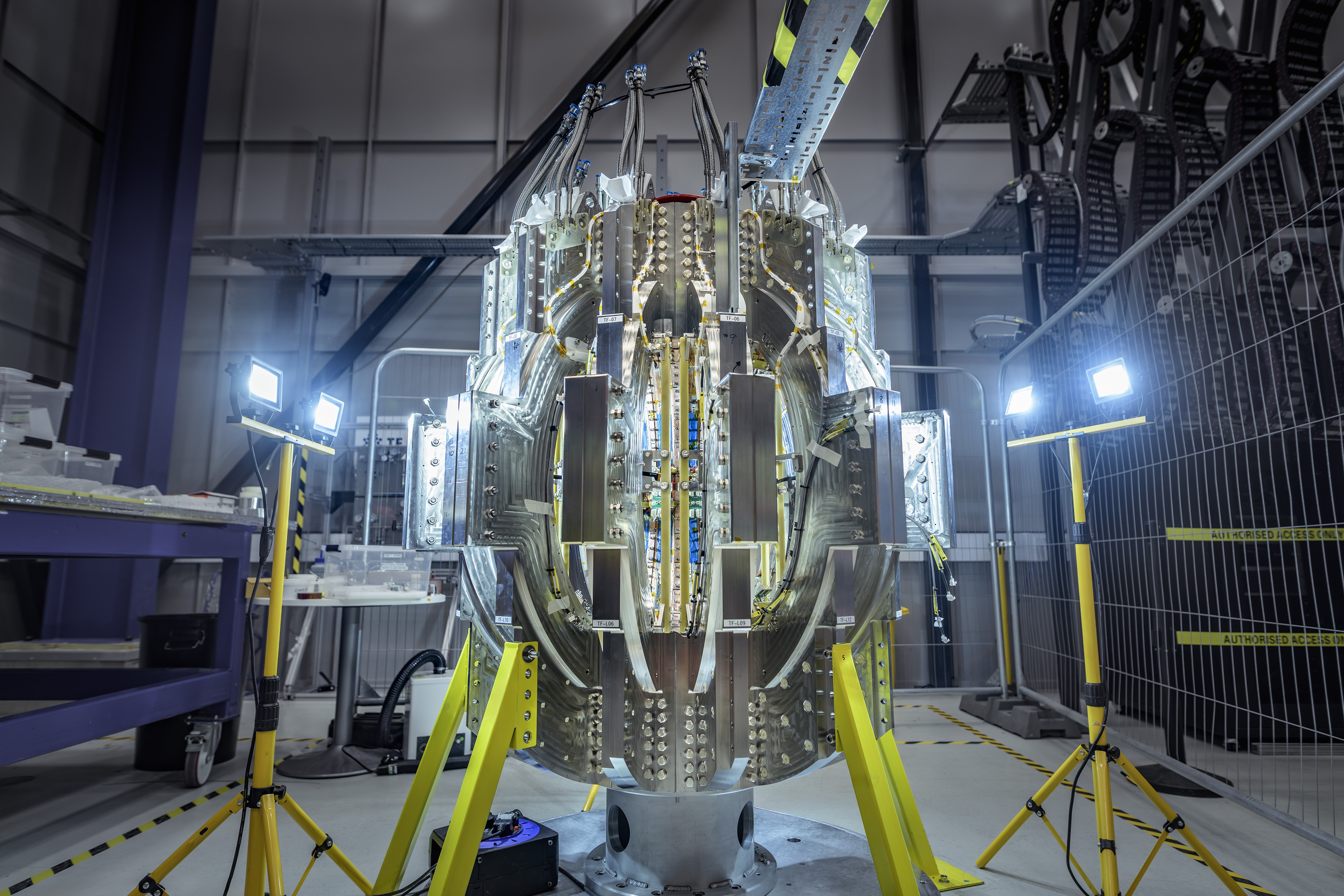
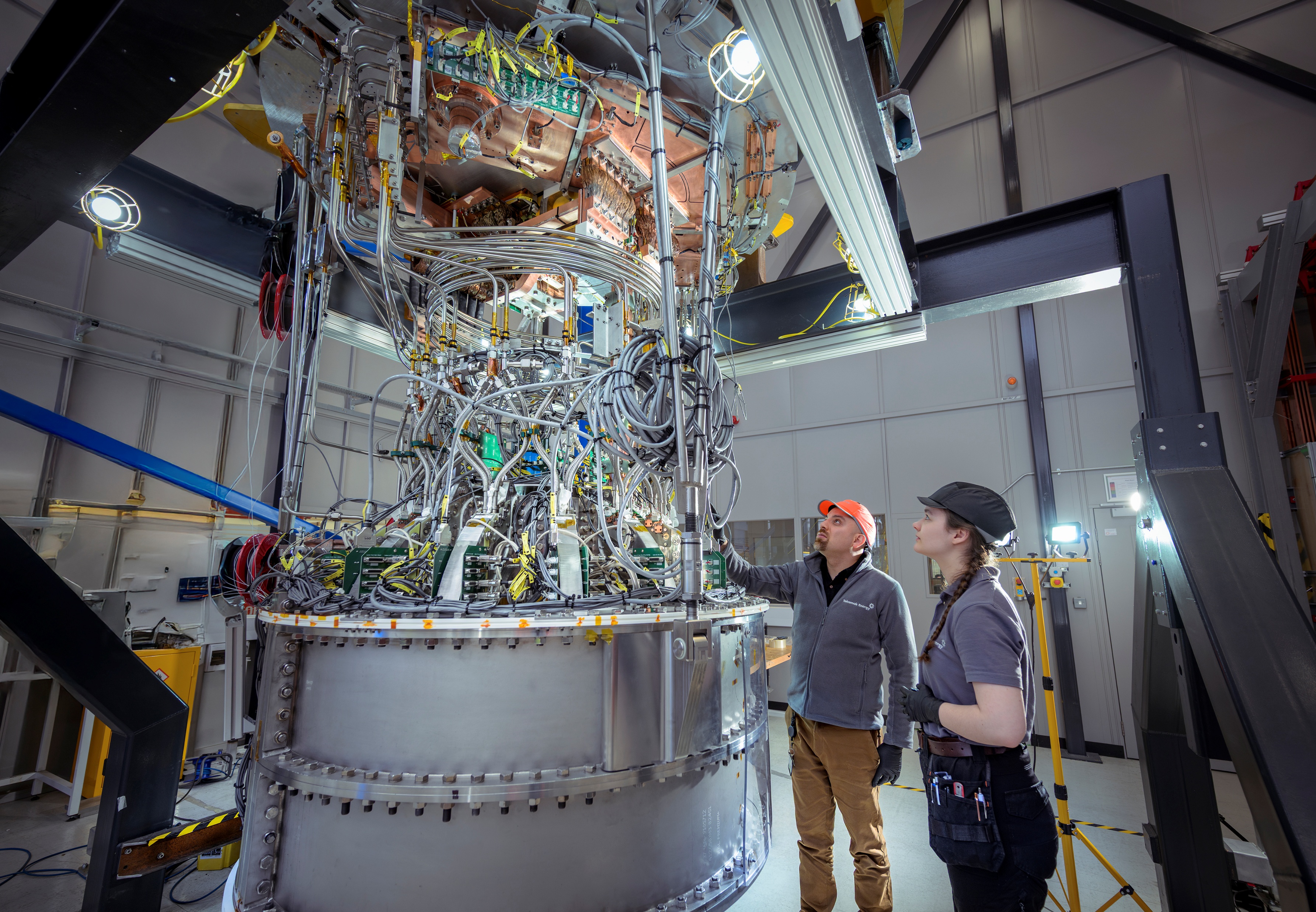
Demo4, shown in the photographs, is a different facility from ST40. It combines high-temperature superconducting magnets in a fusion-relevant spherical-tokamak arrangement for integrated testing. It tests the magnets themselves rather than producing plasma or generating electricity.
“High-temperature” superconductivity does not mean room-temperature operation. Cryogenic conditions are still necessary, and magnet performance depends on cooling, power supplies, instrumentation and control.
In September 2026, the company reported completing a 14-month Demo4 campaign and reaching a peak field of 13.7 tesla. About 10,000 operating hours covered different energisation states; the statement does not mean that 13.7 tesla was maintained for 10,000 hours. These are company-reported test results, distinct from a demonstration of electricity generation.
The engineering challenge extends beyond producing a strong field once. Engineers must understand forces and temperatures when coils operate together, as well as behaviour under abnormal conditions. In the photographs, the pipes and instrumentation connected to the metal assembly deserve attention too. Demo4 is a facility for testing magnets as a working system.
STEP connects experiments to power-plant design
In April 2026, UK Fusion Energy announced a £70 million contract appointing Tokamak Energy as magnet systems partner for STEP. The role includes magnet architecture and integration with wider tokamak engineering.
The significance lies in applying experimental knowledge to power-plant design requirements. The contract value does not establish that finished magnets have been delivered or that a power plant is complete. Progress must be assessed through the design, testing and manufacturing work actually performed.
Funding and three developments to follow
Tokamak Energy announced a $125 million funding round in November 2024, co-led by East X Ventures and Lingotto, with Furukawa Electric among the participants. The cumulative $335 million reported at that time comprised $275 million from private investors and $60 million from the UK and US governments. It is neither an entirely private-investment total nor a revenue figure.
Three separate developments are worth following. First, how ST40 improves confinement and fuelling as well as temperature. Second, how Demo4 experience translates into magnet design and manufacturing for customers. Third, what concrete deliverables and verification follow contracts such as STEP.
Understanding Tokamak Energy means asking more than one question about when it might generate electricity. Plasma research, magnet engineering and delivering technology to customers each have their own milestones. Keeping them separate produces a clearer picture of the company’s progress and remaining challenges.
The Demo4 photographs are used with permission from Tokamak Energy. Photographs courtesy of Tokamak Energy.
Logo: Tokamak Energy.
Sources
- Tokamak Energy: company profile
- DOE: ST40 high-temperature research, 12 May 2023
- DOE: joint $52 million ST40 upgrade, 5 December 2024
- Tokamak Energy: Demo4 results, 9 September 2026
- UK Fusion Energy: STEP magnet partnership, 14 April 2026
- Tokamak Energy: funding announcement, 20 November 2024
Information checked as of:2026-11-06