Heat first, then add fuel: PPPL proposes a theoretical route to fusion ignition
A theoretical study presented by PPPL on October 5 examines the order of raising temperature and density, and what wall impurities and heat losses mean for design. It is a proposal for further testing, not experimental demonstration of ignition.
Read the Japanese originalAnnouncement date:2026-10-05
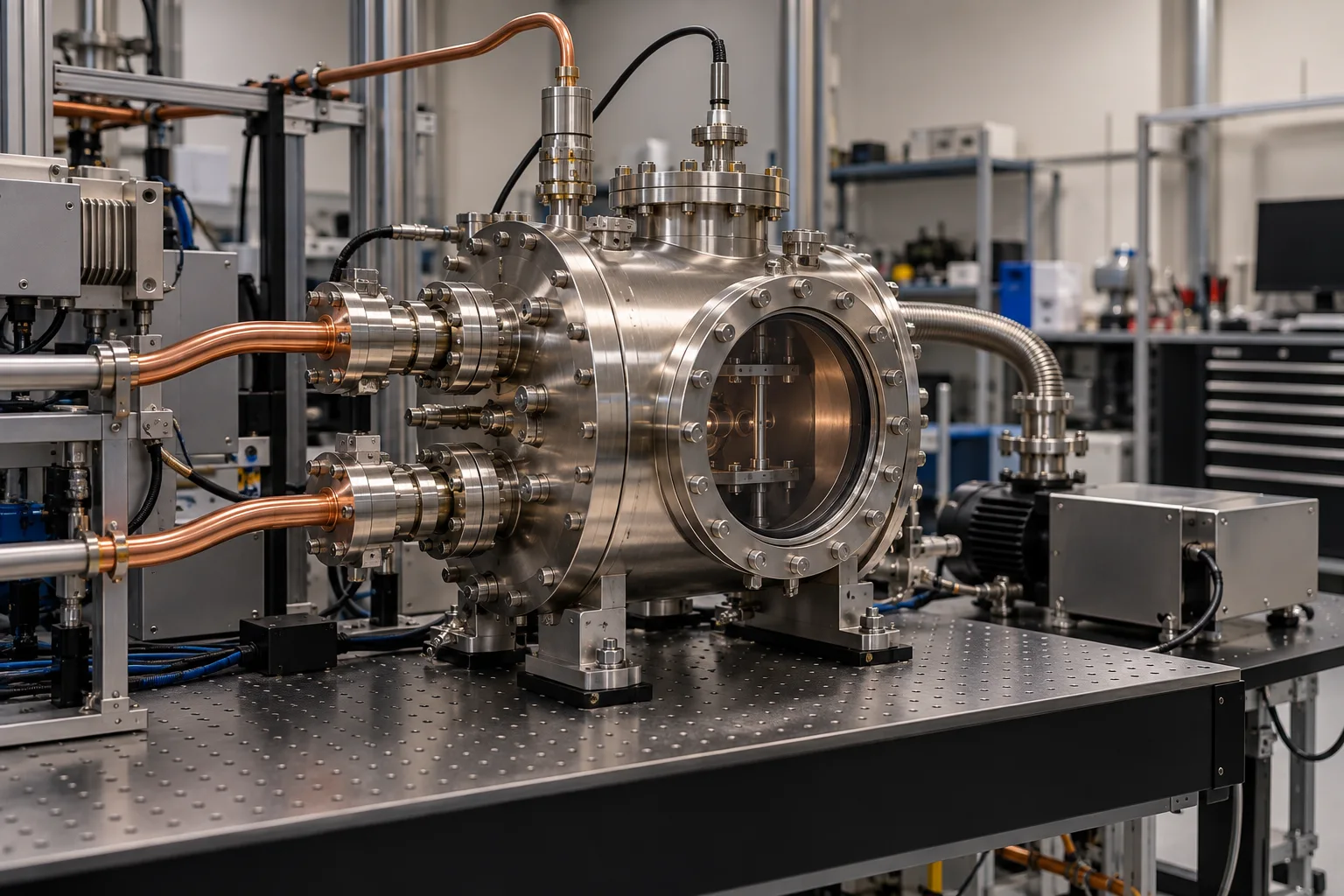
Is meeting the conditions for fusion simply a matter of making the machine bigger, adding fuel and applying more heating? A theoretical study presented by the Princeton Plasma Physics Laboratory (PPPL) on October 5, 2026 asks not only which conditions to reach, but in what order to approach them.
Its central idea is to heat the plasma first and then increase fuel density. This is not an announcement that a machine has achieved ignition. The paper was published on September 10; the laboratory's account appeared on October 5. PPPL's announcement
Ignition does not mean a completed power plant
In magnetic confinement fusion, energy carried by particles produced in fusion reactions heats the plasma itself. The US Department of Energy (DOE) describes a “burning plasma” as one in which this self-heating exceeds external heating. “Ignition” here means a further state in which temperature can be maintained without additional external heating. The two terms should not be used interchangeably. DOE's introduction
These terms describe the plasma's heat balance, not a facility ready to sell electricity. When reading the news, distinguish plasma objectives from business objectives for an entire power plant.
The order of raising temperature and density is itself a research question
Fusion requires a combination of sufficient temperature, fuel particle density and confinement that limits heat loss. Raising temperature alone or density alone does not solve the problem. The Max Planck Institute for Plasma Physics also explains the need both for sufficient particle collisions and for heat not to escape too rapidly into the surroundings. IPP's explanation of ignition conditions
The PPPL study proposes that heating before increasing density may reduce the demands along the route to ignition compared with increasing density first. The laboratory presents it as finding a more accessible path rather than climbing straight toward a steep summit.
The important qualification is that this is a calculated pathway. It does not guarantee that choosing the same sequence in a real machine will always save energy.
Losses also change before and after adding fuel
The paper, “Generalized Lawson-Cordey-Mills Accessibility of Fusion Ignition,” treats heat balance and accessibility of ignition within one framework. Its public abstract describes a zero-dimensional analysis, which does not directly resolve spatial distributions, showing that radiative losses increase the required density, temperature and pressure. The paper's public abstract
In three-dimensional considerations, the required plasma pressure is also related to magnetic stability limits. Numerical values from a heat balance assuming only ideal fuel cannot simply be transferred into a real machine design.
Without checking a model's assumptions and scope, it is not possible to conclude that a particular company's reactor will or will not work.
Wall materials cannot be separated from the heating plan
PPPL explains that helium produced by fuel reactions, impurities entering from the wall, radiation from electrons and escaping plasma heat can all change the path to ignition. Wall materials need to be assessed not only for strength but also for their effects if they enter the plasma.
The paper's abstract also indicates that these losses can resist a temperature rise and potentially help stabilize burning. The behavior of an operating plasma cannot be captured solely by a one-directional judgment that lower losses are always better.
Companies should examine operating pathways as well as peak performance
The following is editorial analysis. For companies working in heating systems, fuel supply, diagnostics or materials assessment, joint development discussions should address what is measured during startup and the order in which conditions change, alongside maximum output or individual material performance.
For example, technical discussions with a customer can distinguish whether a requirement applies in steady state or during startup, which measurement informs the decision to add fuel, and how increasing impurities will be detected. This does not mean that the study has secured orders or established a new market; it is a way to translate a research proposal into discussions of requirements.
PPPL characterizes the work as theoretical research and plans computational tests of the heat-first pathway. The next questions are not only how attractive the proposal sounds, but what assumptions it uses and how far verification has progressed.
- PPPL: A novel path to fusion ignition: heat first, then add fuel (October 5, 2026)
- Physical Review Letters: Generalized Lawson-Cordey-Mills Accessibility of Fusion Ignition (public abstract; September 10, 2026)
- DOE Explains...Burning Plasma
- IPP: Ignition conditions
Information checked as of:2026-10-13
Research news analysis. PPPL announcement: October 5, 2026; PRL paper publication: September 10, 2026. Official pages, the public abstract and DOE/IPP introductory material were read on October 13, 2026. A theoretical proposal, not experimental demonstration of ignition. The full paper was subscription-restricted and was not read; only the public abstract was used. Burning plasma and ignition are distinguished using DOE's introductory explanation. Questions for companies about requirements are editorial analysis.