Editor’s Reflections, Part 1: Fusion Energy Will Change the World
Understand fusion’s potential alongside its challenges, then find a way to participate. The first Editor’s Reflections column shares the ambition behind FUSION INDUSTRY.
Read the Japanese original
Fusion energy will change the world.
That is what I believe.
Imagine it.
A society in which everyone, everywhere, can use enough electricity when they need it.
We use electricity every day, often taking it for granted. Yet a secure supply of energy is anything but a given. Resource supplies and dependence on other countries are closely tied to national security.
Across the world, energy presents many challenges.
- Environmental impacts
- Managing and disposing of radioactive waste
- Securing resources over the long term
- Energy-security risks arising from dependence on other countries
Of course, the world is not so simple that fusion energy alone can solve everything.
But it could become a powerful tool for addressing these challenges.
That is how much potential I see in this technology.
A little fuel, enormous potential
The first astonishing thing is its energy density.
If just 1 gram of deuterium–tritium, or D–T, fuel undergoes fusion completely, it releases thermal energy comparable to burning about 8 tonnes of oil. This is a comparison of fusion fuel, not 1 gram or a spoonful of seawater. It also compares the heat released by the reaction, not the electricity a power plant can deliver.[1]
Deuterium, one of the two fuels, can be extracted from seawater. But that alone does not provide all the fuel. Producing the other fuel, tritium, from lithium and recovering and recycling it still presents development challenges.[2]
It may sound almost too extraordinary to be real.
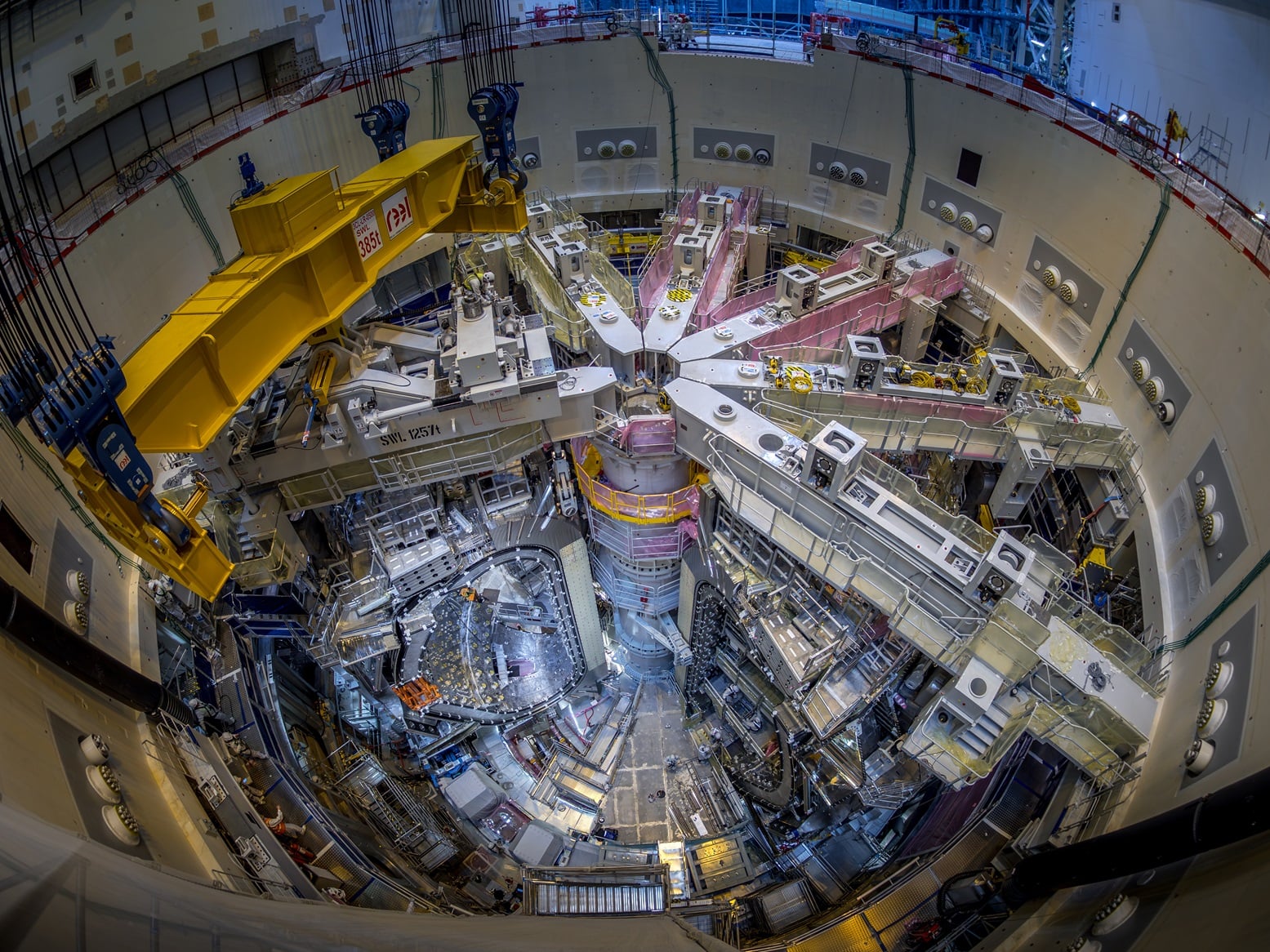
Yet fusion also powers the stars in the night sky and our own Sun. On Earth, researchers are not simply reproducing the same conditions as those inside the Sun. They are seeking to use reactions such as D–T fusion to harness the energy as electricity.[3]
Turning a dream into a working technology
The fusion reaction itself emits no carbon dioxide. That does not mean that environmental impacts disappear when plant construction, fuel production and other activities are included.[2][4]
Although it differs from spent nuclear-fission fuel, radioactive waste also arises from fusion, including components activated by neutrons. Materials choices and arrangements for maintenance, reuse and disposal are important.[5]
Fusion is not a chain reaction like nuclear fission: when the required conditions are lost, the fusion reaction stops. Even so, plant safety management remains essential, including measures addressing tritium and neutrons.[2][6]
I want to communicate both these possibilities and these challenges openly.
Not to leave fusion as merely a “dream energy source,” but to understand and develop it as a real technology.
Interest can be the beginning of a new effort
I want the possibilities of fusion energy to reach far more people.
The road to making it work is certainly not easy.
Beyond controlling plasma, many challenges remain in materials, fuel, heat extraction, maintenance and economics. The task is to connect long-term research and development with an electricity source that society can actually use.[3][4]
That accumulation of work, and the breadth of the emerging industry, can be difficult to see from everyday life. I find that frustrating.
But here is what I think.
What if more people took an interest in fusion energy?
What if more companies and investors joined the industry?
What if more people decided to take on a challenge in this field?
We should be able to give the journey toward realization greater momentum.
The number of people alone does not determine technological progress. Still, I believe it matters greatly when people, technology, funding and institutions connect, and when the environment supporting new efforts grows stronger.
I want to create a doorway into this industry
I want to build an environment in which more people can learn about fusion energy, participate in the industry and take action.
I want to create infrastructure that opens this industry not only to researchers, but also to companies, investors, students, public officials and every individual with an interest.
That is why I founded FUSION INDUSTRY.
Thank you for reading to the end.
Fusion energy is not something a small group of researchers can realize alone.
The accumulated interest and actions of many people can help move it forward.
If this ambition resonates with you, I hope you will make use of FUSION INDUSTRY and find your own way to participate in this industry.
Your next step may also be a step toward making fusion energy a reality.
References
This series is a column expressing the editor’s own views and aspirations. The scientific explanations draw on the following public sources.
- QST: How much energy is “a very large amount of energy”?
- ITER, Advantages of fusion
- IAEA, What is Nuclear Fusion?
- UKAEA, Fusion energy questions
- Research review hosted by UKAEA: Overview on the management of radioactive waste from fusion facilities
- ITER, FAQs: safety
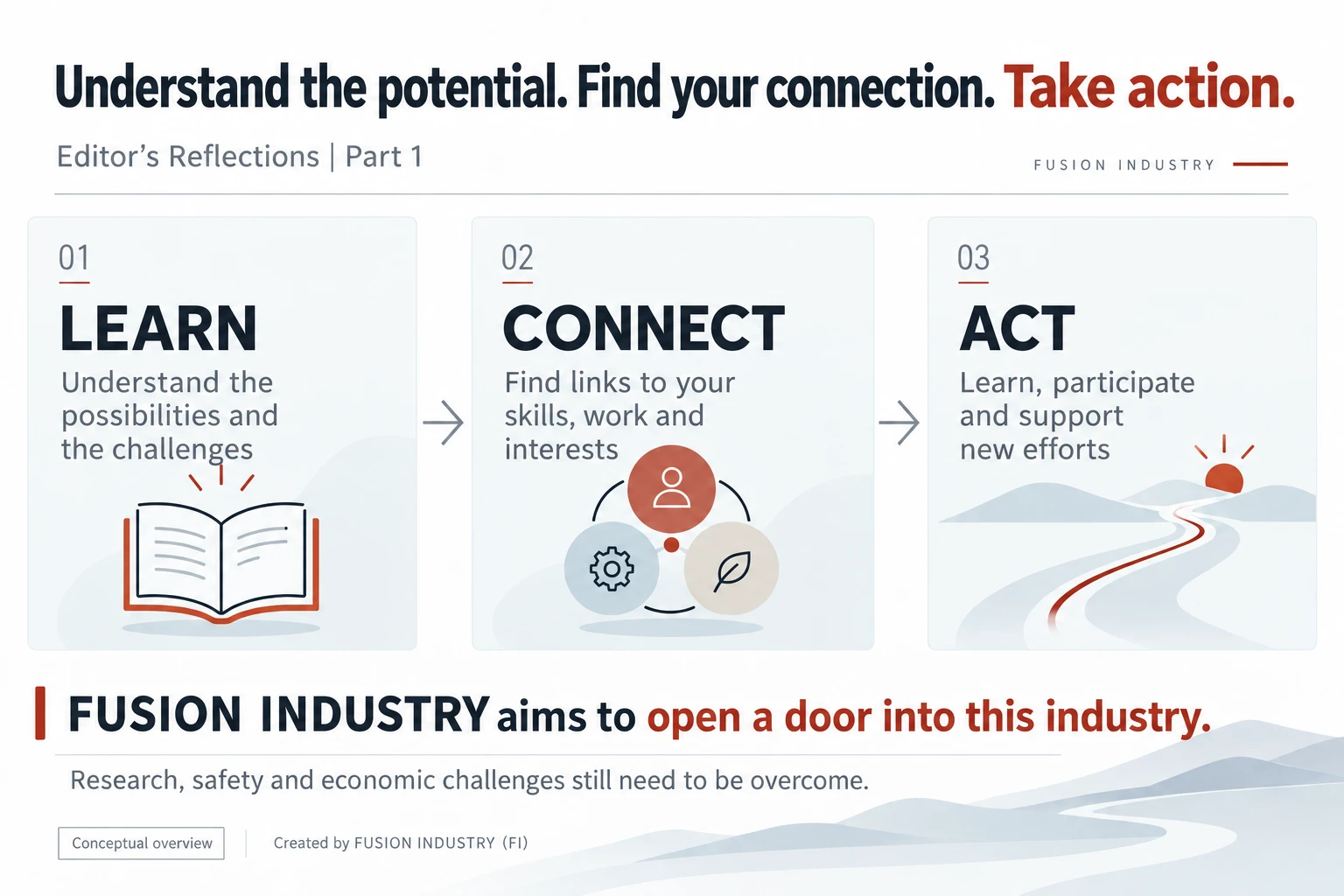
The idea in one image
Understand the enormous potential alongside the challenges. Find connections to your skills and interests. Then take action. FUSION INDUSTRY aims to create that doorway.
- QST: How much energy is “a very large amount of energy”?
- ITER, Advantages of fusion
- IAEA, What is Nuclear Fusion?
- UKAEA, Fusion energy questions
- Research review hosted by UKAEA: Overview on the management of radioactive waste from fusion facilities
- ITER, FAQs: safety
Information checked as of:Not recorded