What Does “Building a Sun on Earth” Really Mean?
The Sun and fusion reactors share the principle of obtaining energy from light atomic nuclei. Differences in fuel, confinement and the route to electricity explain what the metaphor “artificial sun” does—and does not—mean.
Read the Japanese original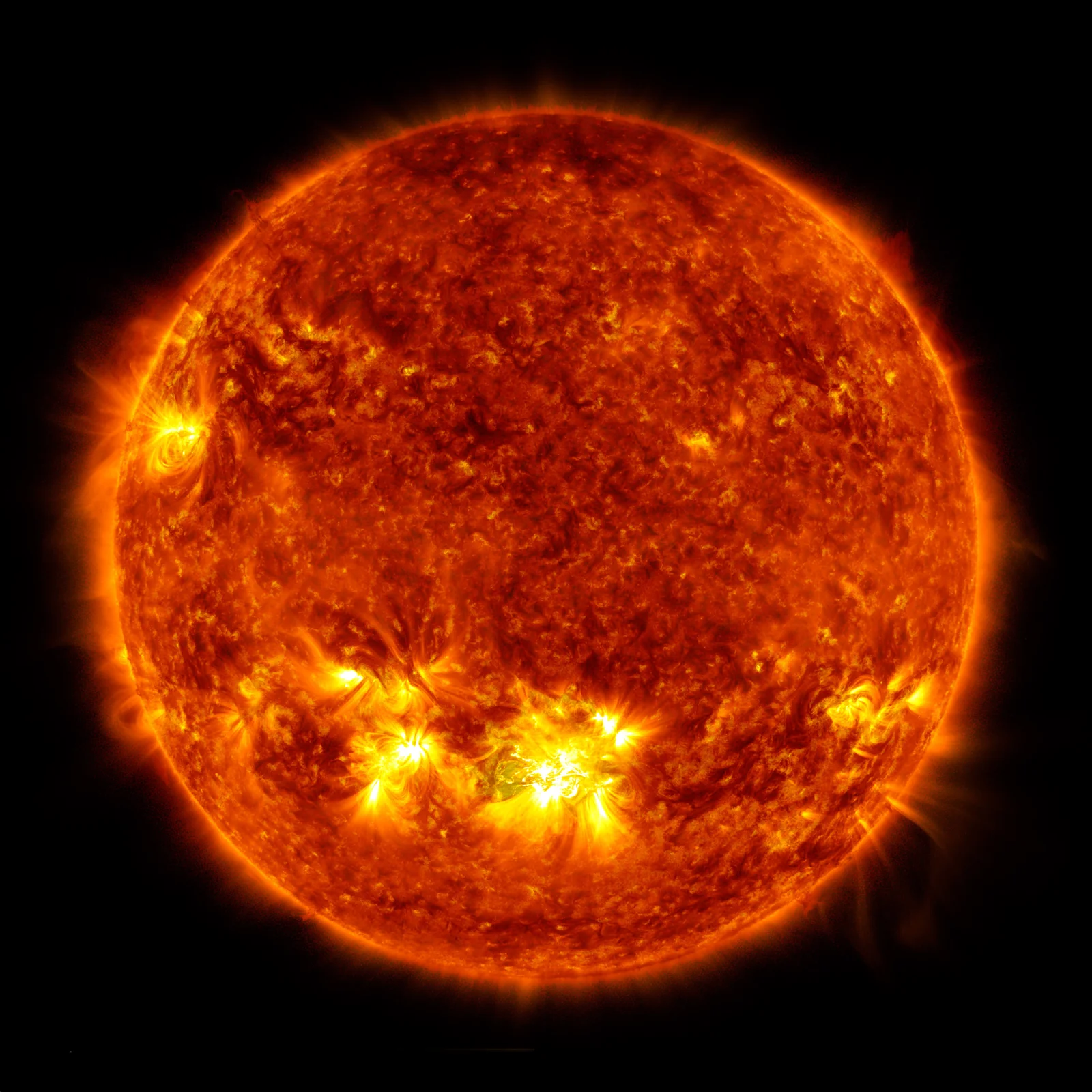
“Build a sun on Earth.” This phrase often accompanies introductions to fusion research. The aim is not to shrink the entire Sun and place it on the ground. It is to use fusion, the energy source that makes the Sun shine, in equipment that people can design and operate. Understanding where the metaphor holds and where it breaks down reveals the technical challenges behind these grand words.
The shared feature is the source of energy
At the Sun’s center, reactions that fuse light atomic nuclei generate energy. The mechanism differs from the chemical reactions involved in burning coal or gas: the Sun is not burning through a supply of oxygen.
The main process in the Sun is the “proton–proton chain,” in which protons—the nuclei of ordinary hydrogen—form helium through several steps. Energy corresponding to the mass difference before and after the reactions is released and transported outward through the Sun’s interior. The solar interior
By contrast, a leading development route on Earth combines deuterium (D) and tritium (T), relatives of hydrogen. Both have one proton but different numbers of neutrons: they are “isotopes.” A D–T reaction produces a helium nucleus and a neutron, which carry energy. Both processes fuse light nuclei, but terrestrial fusion does not simply reproduce the same reaction pathway as the Sun. D–T fusion fuel
The solar photographs shown here depict the outer atmosphere and other features observed in ultraviolet light. Bright loops and ejected material are not direct photographs of fusion reactions in the core.

Gravity supports the Sun; equipment supports fusion on Earth
The Sun has enormous mass. Its own gravity creates conditions that maintain high temperature and density inside it. Terrestrial facilities cannot exploit this kind of stellar-scale self-gravity. They therefore use other methods to create the conditions needed for reactions.
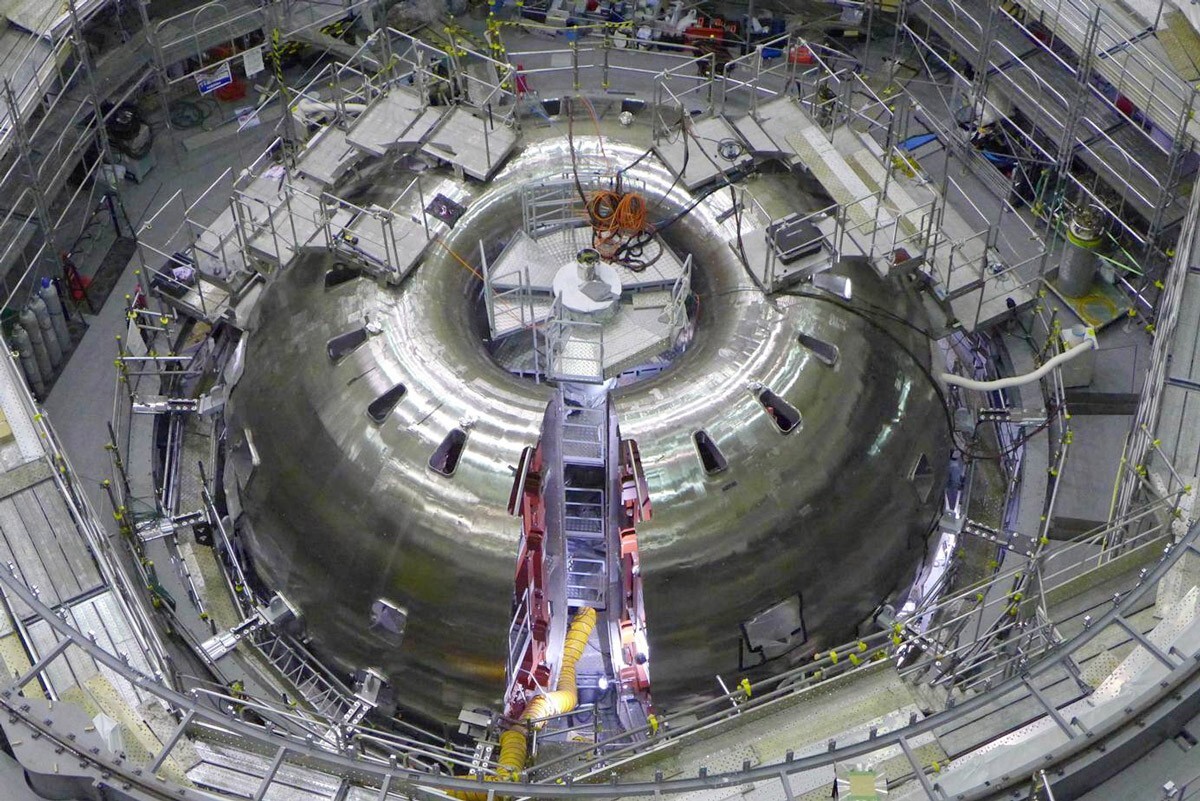
Magnetic confinement, as used by ITER, employs magnets to confine plasma, a collection of electrically charged particles. The large coil in the photograph generates the required magnetic field. In inertial confinement using lasers or other drivers, a small amount of fuel is rapidly compressed so that reactions occur during the extremely brief interval before it expands. The two confinement methods
The Sun also has magnetic fields, but the gravity that supports it as a star plays a different role from the magnetic fields used to handle plasma on Earth. The name “artificial sun” need not imply that a star is born inside the device.

A tokamak holds hot plasma with magnetic fields
A prominent approach to terrestrial fusion is the “tokamak.” Plasma is created inside a doughnut-shaped vacuum vessel, and combined magnetic fields maintain its hot state. This equipment supplies the conditions needed for reactions on Earth, where the Sun’s immense gravity is unavailable.
The key is not just the doughnut shape. External coils create a “toroidal magnetic field” along the ring. Superimposed on it is a “poloidal magnetic field,” circulating around the ring’s cross-section and produced by current flowing through the plasma itself. Together they make the field lines helical, making it harder for charged particles to escape. Additional coils adjust the plasma’s position and shape. How tokamak magnetic fields work
Magnetic confinement and heating serve different purposes. In addition to heating by current flowing through the plasma, neutral particle beams inject fast particles, and high-frequency electromagnetic waves supply energy. Rather than directly enclosing hot fuel with the vessel wall, magnetic fields and heating equipment bring it into a state suitable for reactions. Plasma heating methods
Japan’s JT-60SA and ITER, under construction in France, both use the tokamak approach. JT-60SA studies operating methods for high-performance plasmas and supports ITER and future demonstration reactors. Neither is a power station supplying electricity. Within the challenge of “building a sun on Earth,” their role is first to establish methods of handling hot fuel. JT-60SA’s objectives · How ITER differs from a power plant
Hotter than the Sun does not mean a “more powerful Sun”
The temperature at the Sun’s center is about 15 million degrees. ITER’s target plasma temperature is about 150 million degrees—roughly ten times higher. Why aim for a temperature above the Sun’s when the Sun is the inspiration?
On Earth, we cannot borrow the conditions provided by the Sun’s enormous scale and gravity. Within a limited device, we must choose fuel that reacts readily and obtain a sufficient reaction rate while countering energy losses. D–T is a leading combination that is relatively accessible experimentally, but it still requires high temperatures. Temperature is a condition determined together with fuel and confinement method, not a simple performance contest with the Sun. ITER’s explanation of fusion
This temperature also describes particle motion within the plasma. It does not mean that the building, magnets or entire device reach the same temperature. Temperature alone cannot tell us the amount of stored heat or electricity generated.
The goal is usable electricity, not a shining star
A power plant must do more than produce reactions: it must extract their energy in a usable form. The main concept for future D–T reactors is to convert neutron-carried energy into heat in equipment surrounding the reactor, transport it with a coolant and deliver it to a power-generation system.
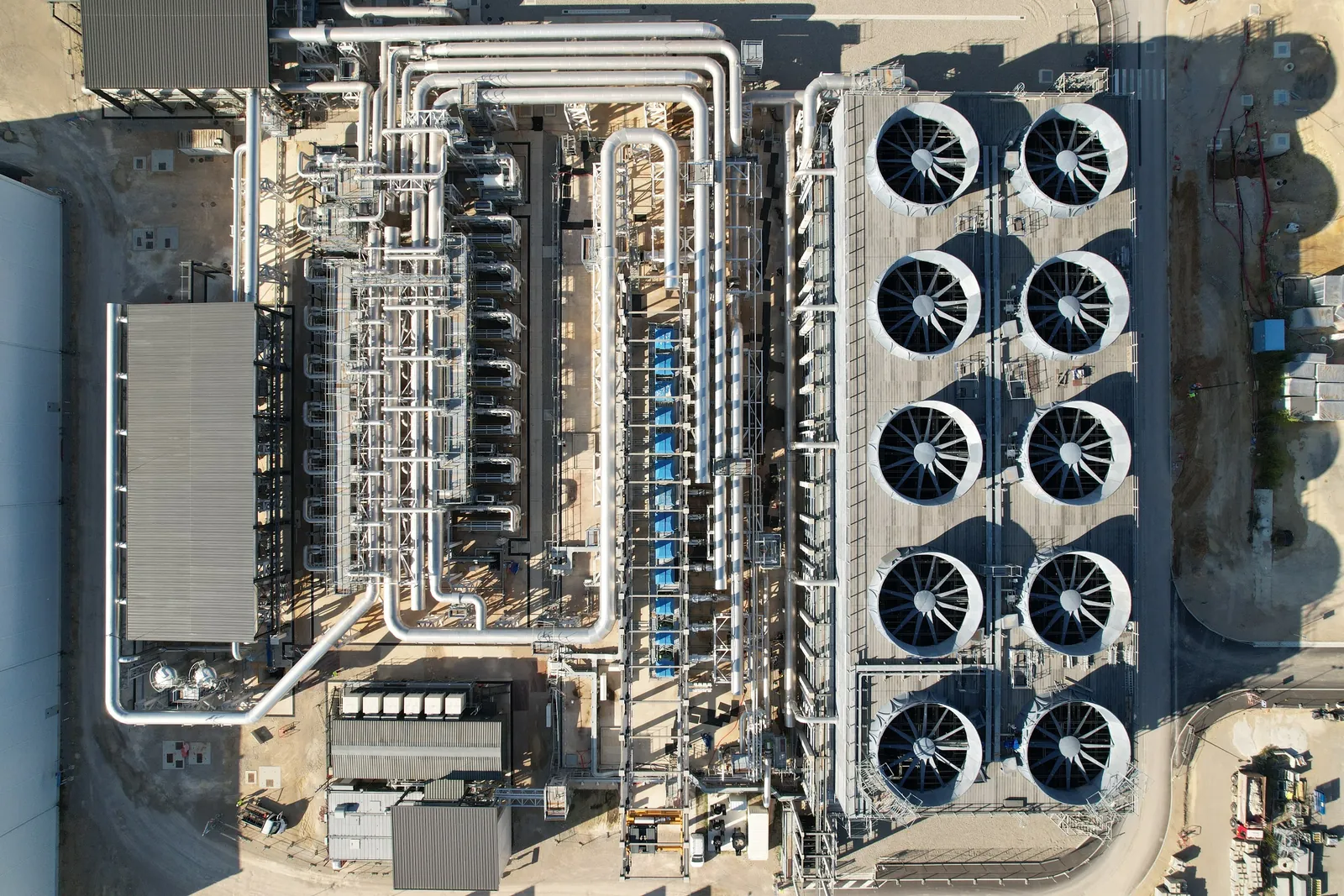
That path includes heat-receiving materials, heat exchangers, pipes and pumps. ITER’s cooling-water system, shown in the photograph, also removes heat from the machine. ITER itself, however, will not generate electricity; the extracted heat is released to the environment. Research on heat-recovery technology for generation should be distinguished from completion of a commercial facility supplying power. The route from heat to electricity
Even if hot fusion reactions succeed, separate demonstrations are needed to establish whether the facility can supply electricity after subtracting its own consumption, operate repeatedly, and achieve viable costs including maintenance and fuel supply.
Concrete work beyond the metaphor
Safety is not adequately described by a choice between “dangerous because it is a sun” and “unconditionally safe because it is fusion.” If the conditions supporting fusion collapse, the reaction cannot be sustained. Nevertheless, radioactive tritium must be managed, neutron activation of materials addressed, and equipment heat and electrical hazards controlled. ITER safety and environmental measures
For companies and workers, the question that makes a “sun on Earth” concrete is where their technology can contribute: creating magnetic fields, transporting heat, handling fuel or replacing components. Many jobs lie in translating a shared energy principle into equipment that can be maintained on Earth.
The phrase is neither a declaration of completion nor a guarantee of a commercialization date. It is a metaphor for the challenge of turning a star’s energy into technology that people can operate.
- NASA Marshall: The Solar Interior (checked 11 October 2026)
- DOE Explains: Deuterium-Tritium Fusion Fuel (checked 11 October 2026)
- DOE Explains: Plasma Confinement (checked 11 October 2026)
- ITER: What is Fusion? (checked 11 October 2026)
- ITER: Making fusion work (checked 11 October 2026)
- ITER: Turning neutrons into electricity (published 27 November 2023; checked 11 October 2026)
- ITER: Safety and the environment (checked 11 October 2026)
- NASA SVS: Active October Sun Emits X-class Flare (checked 11 October 2026)
- ITER: Construction / About to be lifted (checked 11 October 2026)
- ITER: Cooling Tower Area / From above (checked 11 October 2026)
- DOE Explains: Tokamaks (checked 13 October 2026)
- ITER: External heating systems (checked 13 October 2026)
- QST: Quantum energy research / JT-60SA objectives (checked 13 October 2026)
- ITER: What is a tokamak? (checked 13 October 2026)
- ITER International School: Ph. Moreau, Magnetic diagnostics (lecture 9 December 2024, page 3; checked 13 October 2026)
Information checked as of:2026-10-11
Solar and terrestrial fusion differ in reaction pathways and confinement methods. ITER’s temperature is a design target, and ITER itself will not generate electricity. Commercial generation also requires demonstrations of net electricity, maintenance and fuel management.