NASA-backed fusion rocket FDR: why use solar power to crush metal rings?
Why would a fusion rocket carry solar panels? NASA-backed FDR research separates the roles of electrical power, metal liners and propellant, and shows the assumptions behind short Mars-transfer studies.
Read the Japanese original
Look closely at the Fusion Driven Rocket concept and an apparent contradiction appears: a spacecraft powered by fusion carries solar panels. If its energy comes from the reaction that powers stars, why collect sunlight?
For FDR, studied by the University of Washington and MSNW with NASA NIAC support, that question opens up the design. Solar electricity would initiate the compression process. Hot metal would leave the vehicle to produce thrust. Fusion fuel, compression material and propellant have different jobs. Separating them makes the spacecraft easier to understand as an engineering proposal. University explanation
Crush the metal, then send it astern
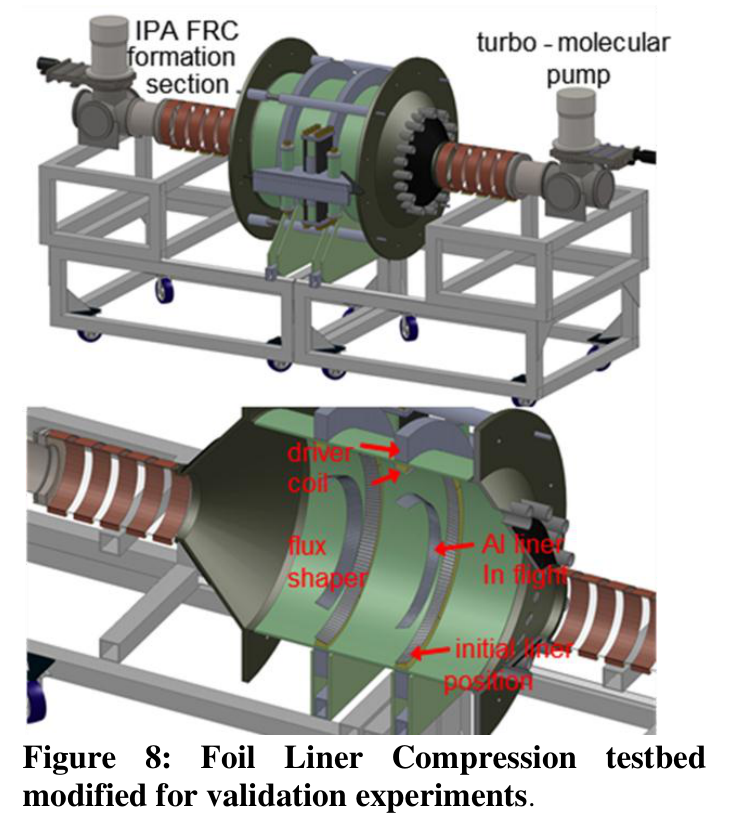
The process begins with a small magnetized plasma target. Metal rings converge around it under a powerful magnetic field, forming a shell that rapidly compresses the fuel. The intended result is a brief fusion event.
The shell then has another job. It absorbs energy from the reaction and becomes hot, ionized material. A magnetic nozzle directs that material aft to produce thrust. The rings are both the tool that compresses the fuel and the propellant ultimately expelled from the spacecraft. The material undergoing fusion and the mass ejected for propulsion serve different functions.
Electricity is needed at the beginning of this sequence. The solar panels in the concept drawing belong to the compression system: obtaining energy from fusion does not remove the need to initiate the process. Phase I report: principle and spacecraft design
A useful power plant can still be too heavy to fly
Why take this route? Why not shrink a terrestrial fusion power station and use its electricity for propulsion?
The FDR report identifies a whole-vehicle problem. Converting fusion energy to electricity requires equipment, while unused heat must be rejected through radiators. An energetic reaction is less helpful for rapid transport if the equipment needed to use it makes the spacecraft too heavy.
FDR instead proposes transferring energy into metal that is then expelled. This changes the energy-transfer architecture for space rather than simply transporting a power station. Reducing radiator burden is a research objective, not evidence that all thermal problems have been solved. Assessing the idea therefore requires looking beyond reaction performance to the mass of the power supply, magnets and complete propulsion system. Research report
The conditions attached to “30 days to Mars”
FDR mission studies examined 30- and 90-day Mars transfers. These are calculations under assumed propulsion and spacecraft conditions, not achieved journeys or announced flight schedules.
The report also examines solar-array size and burn duration. More electrical power for compression can require larger arrays, which themselves must be carried. Each expelled metal liner is consumed, so the next pulse needs another. Fusion does not make propellant requirements disappear. Reaction performance, electrical supply, carried mass and trajectory must be considered together. Mission analysis
What visitors could touch—and what had not flown
In 2013, the university reported that visitors at a NASA symposium could handle a fist-sized collapsed aluminum ring from a compression experiment. The space concept envisaged lithium; aluminum was used in the laboratory work described at the time.
That tangible result must be distinguished from a completed spacecraft. Crushing metal as intended, obtaining the required reaction from compression, and repeatedly supplying liners and producing exhaust are separate stages of validation. NASA support for the study does not establish a flight demonstration. NASA concept record
The next useful questions for a fusion-rocket announcement come before its advertised journey time: What was measured? Were power-system and spacecraft mass included? Has the supply–compression–exhaust sequence operated repeatedly? For companies building space hardware, pulsed power and materials, those are also the points where an idea becomes a specification and a test.
Solar panels on a fusion rocket are no contradiction. They make visible the difficult task of turning an energetic reaction into an engine a spacecraft can carry.
NASA NIAC: 2011 Phase I / 2012 Phase II · NASA FDR concept overview (2019-03-25) · NASA NTRS final report (2018-11-12)
- University of Washington, Rocket powered by nuclear fusion could send humans to Mars (2013-04-04)
- Slough et al., FDR Phase I Final Report (2012-09-30)
- FDR Phase I Final Report, full text
- NASA NIAC funded studies
- NASA, The Fusion Driven Rocket
- FDR final report (2018-11-12)
Information checked as of:2026-11-08
過去の一次資料に基づく研究構想の解説。飛行実証ではない。