Turn fusion events into a next business step: testing entry hypotheses in Osaka and Ibaraki
Ahead of November's Osaka exhibition and December's Ibaraki forum, prepare an entry hypothesis and five questions. Consider disclosure boundaries and how to decide on further validation after attending.
Read the Japanese original
Fusion-related events are scheduled in Osaka and Ibaraki in November and December 2026. Before attending, companies considering entry should form a hypothesis about which of their capabilities could address whose problem. Turning information from an event into the next test or internal decision requires not only a list of stands to visit but conditions to verify.
An Osaka exhibition and an Ibaraki forum
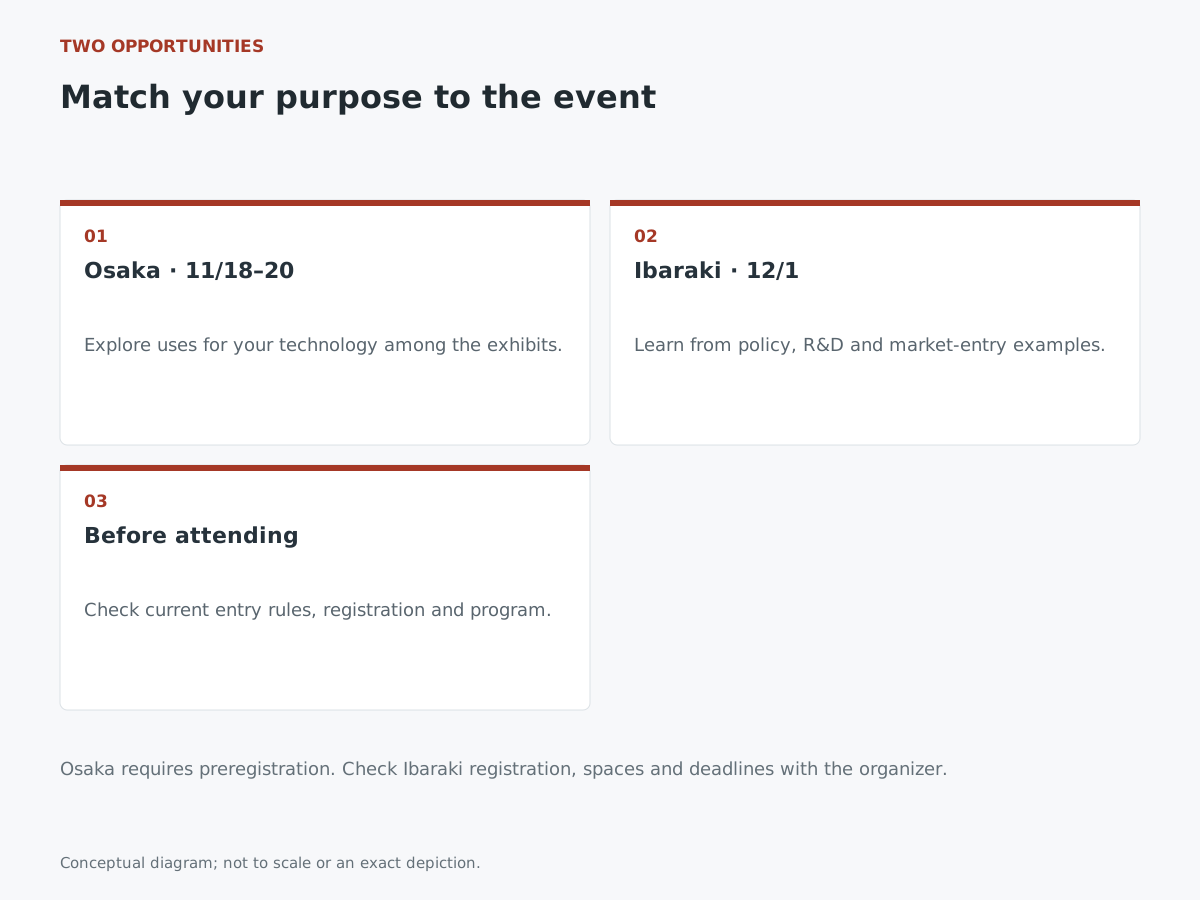
FUSION POWER WORLD is scheduled as a special exhibition within SMART ENERGY WEEK at INTEX Osaka on November 18–20, 2026. The official information lists components, structural materials, machining and welding, diagnostics and maintenance among its subjects. Visitor registration is free and advance registration is required for admission. Exhibition information / Visitor information
Ibaraki Prefecture's Fusion Energy Forum 2026 is scheduled for December 1, 13:30–17:00, at Mito Plaza Hotel and online. It targets local companies and related participants, with free admission. The announced program covers policy, R&D and corporate entry, plus networking for on-site participants. The prefectural page explains how to apply; check the organizer's latest information for current acceptance, remaining places and deadlines before participating. Prefectural event information
Our editorial suggestion is to use Osaka to explore applications for products and technologies, and Ibaraki to learn development approaches from policy and entry examples. This does not guarantee individual meetings, buyer contacts or orders. Recheck current exhibitors, speakers and participation conditions when deciding to attend.
Put the entry hypothesis on one page before leaving
The following is preparation advice for business development, not a specific application's conditions. Summarize the technology offered, its possible use, the effect to test and unresolved conditions on one page.
A joining-technology company might hypothesize that its process could reduce inspection rework during experimental equipment assembly. Present evidence from existing sectors, then ask how materials, geometry and operating environments differ in fusion. Clearly distinguish existing experience from performance already demonstrated in fusion.
Define useful outcomes in advance too. Identifying one necessary evaluation test, finding the correct technical contact or discovering a condition the current product cannot readily meet can all inform decisions after returning.
Bring five questions to the venue
In a short conversation, first establish the other person's responsibilities, then select relevant questions.
- Application: Which machine, process or function has a problem?
- Conditions: How do temperature, pressure, load or operating duration differ from existing applications?
- Evaluation: What would an initial test measure, and who judges the result?
- Responsibilities: Who should discuss specimens, facilities, costs and data management?
- Next step: Which documents should go to which contact to advance consideration?
If someone cannot answer, ask where public documentation or the appropriate contact can be found. Record the speaker's role, assumptions and date for oral explanations, and do not bring them back as formal specifications or agreements.
Decide what to bring and what may be disclosed
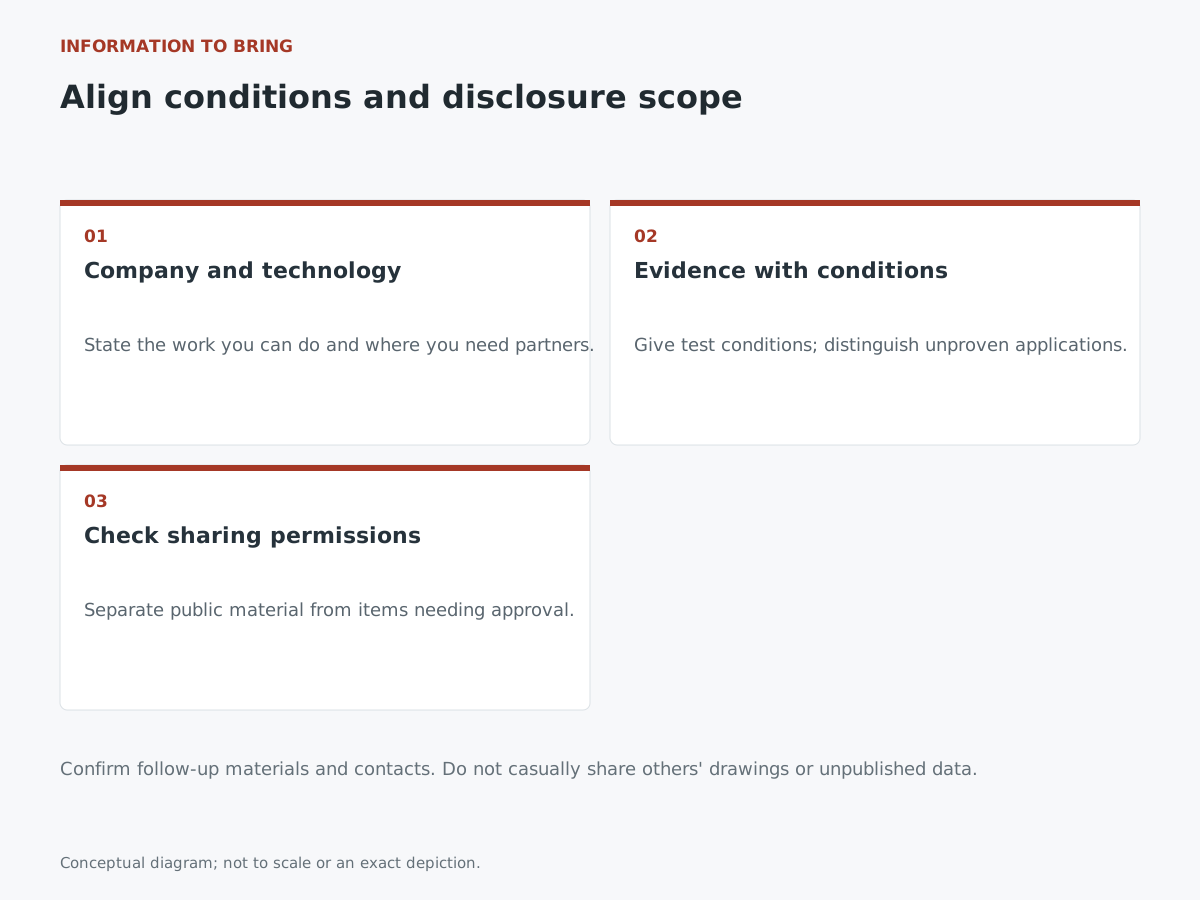
Bring a company introduction, evidence stating test conditions and a question sheet. Attach measurement conditions to dimensional and performance figures, and distinguish processes you can handle from those requiring partners. Concrete information makes it easier for the other side to decide whether further checks are needed.
Internally, separate public information from material requiring a confidentiality agreement or other approval. Do not casually hand over another company's drawings, customer names or unpublished test results. When exchanging business cards, confirm the content of any later materials and the contact address to make follow-up easier.
Osaka's visitor FAQ prohibits photography inside the venue by visitors and exhibitors. Plan to use handouts or supplied digital material rather than photographs. Visitor information also includes networking details from 2025, which must be distinguished from this year's plans. Visitor FAQ and publication years
After returning, decide whether to fund the next validation
Separate acquired facts, the other party's views and your own inferences. For promising contacts, record the problem, missing evidence, next costs and responsible people, then carry out agreed follow-up such as sending materials.
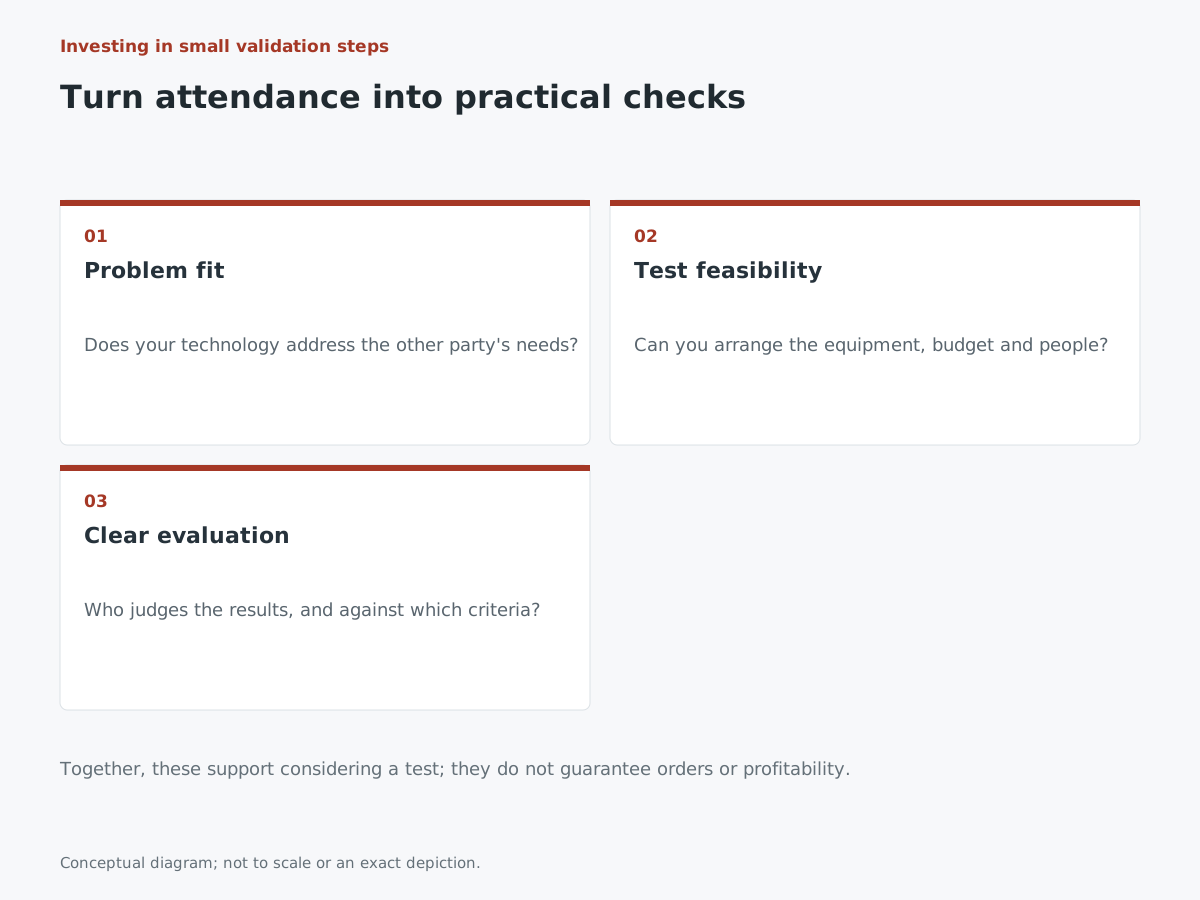
Use three decision criteria: whether the problem fits your technology, whether further testing is feasible, and whether the counterpart and next verification method are clear. If conditions do not fit, narrow the application. If important information is missing, continue research. Once the test method and the counterpart's evaluation scope become concrete, consider internal investment in a small validation.
For companies using events as an entry point to fusion, the value to bring home is clarity about what to verify next.

- RX Japan | FUSION POWER WORLD exhibition and 2026 Kansai dates
- RX Japan | 2026 Kansai visitor information, registration and FAQ
- Ibaraki Prefecture | Fusion Energy Forum 2026 (updated September 15, 2026)
Information checked as of:2026-10-09
Both events are scheduled. Osaka requires advance registration. Ibaraki has published application instructions, but current acceptance, remaining places and deadlines should be checked in the organizer's latest guidance. Preparation advice does not guarantee business discussions or orders.