How laser fusion works: a 3D guide
Trace NIF’s indirect-drive geometry from the chamber to the tiny central target.
Principle and characteristics
Laser fusion compresses fuel to high density and temperature for a short time before it expands. NIF illustrates indirect drive: laser light enters a hohlraum, whose X rays drive compression of the fuel capsule inside. This differs from long magnetic confinement.
Rotate the model. Explore the structure.
Select parts to inspect their position and purpose.
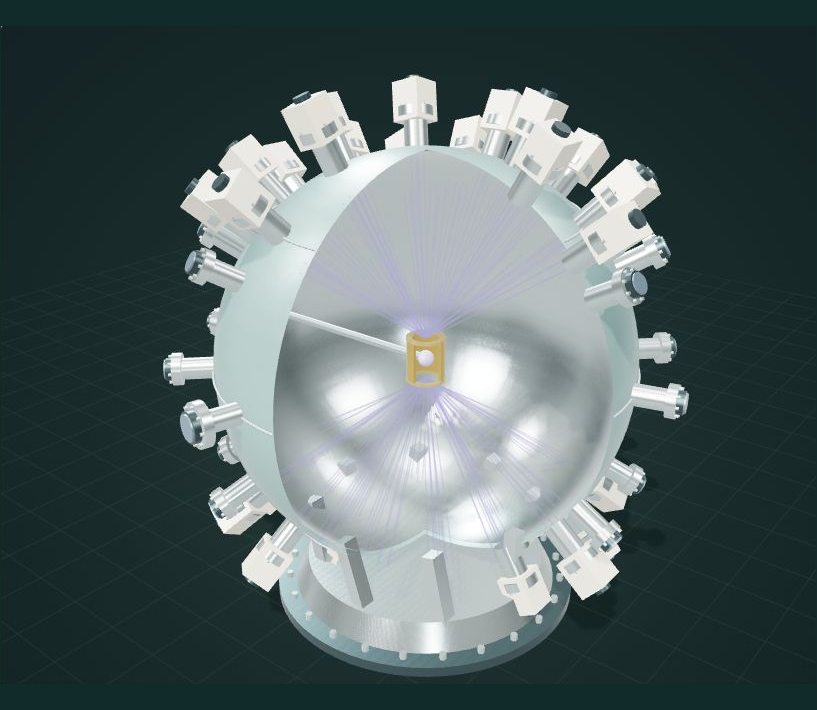
Laser fusion — look inside
The model loads when you choose to open it.
You can read the guide before loading 3D.
An independently authored educational model based on public references. It does not reproduce exact dimensions, private designs, or calculated fields and particle trajectories. Plasma and beams are static position guides; cutaway and exploded views are not maintenance procedures.
Follow the principle, part by part
Optics and beam directions
Inspect 48 beam-entry assemblies and 192 static paths. Their width and color are explanatory, not an observed image of a shot.
From hohlraum to capsule
Zoom in to distinguish the hohlraum from the capsule. Follow the sequence: laser irradiation, X-ray generation, then fuel implosion.
Diagnostics around the target
Select diagnostic ports and supports to inspect access for target positioning and measurements of symmetry and reaction output.
Enabling technologies
- High-energy lasers, optics and precision targets
- Pulse shaping, target positioning, X-ray and neutron diagnostics
Experiments and institutions
This approximates NIF’s target-area layout. The target is enlarged relative to the chamber. It does not represent every laser approach, including direct drive.
Questions for research and development
Power generation also requires target production and delivery, repeated shots, efficient lasers and heat extraction. Target-level energy accounting is not the same as facility-wide electricity accounting.
Primary sources and model scope
This approximates NIF’s target-area layout. The target is enlarged relative to the chamber. It does not represent every laser approach, including direct drive.
These independently authored educational reconstructions use public references. Static plasma and beam shapes explain positions; they are not field or particle simulations. Devices are not shown at a common scale, and their appearance does not establish power performance.
Compare other approaches
These categories overlap: FRC names a magnetic configuration, while MTF describes compression of magnetized fuel. They are different classification axes, so a compression experiment can also use an FRC.