Five fusion approaches in 3D
Understand fusion through the positions of magnets, vessels and fuel. Explore all five models, then follow the connections to technology, experiments and industry.
 01
ITER
Tokamak
Inspect ITER’s D-shaped coils, central solenoid and vacuum vessel.
 02
Wendelstein 7-X
Helical / stellarator
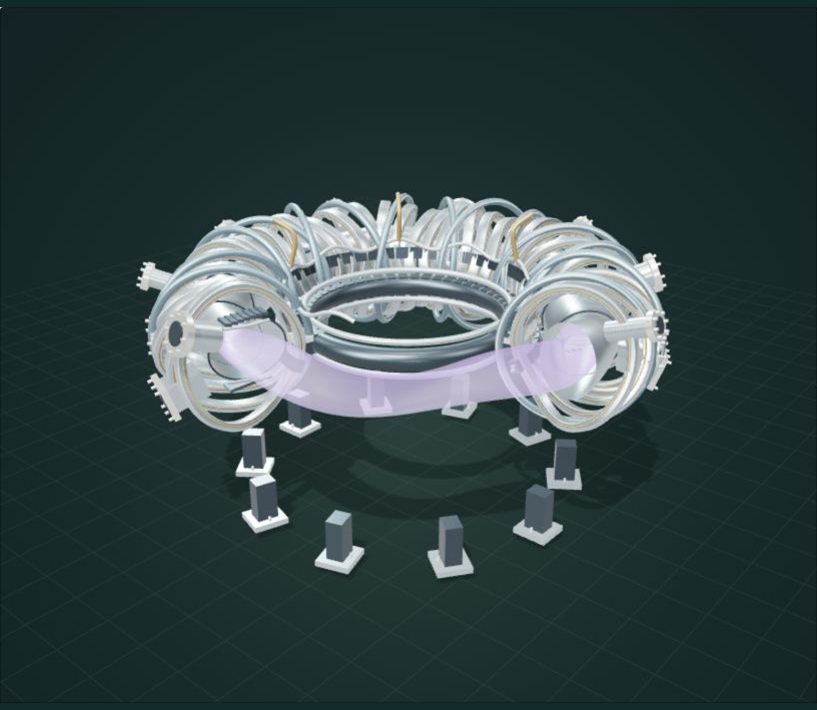
Explore W7-X’s modular non-planar coils and distinguish them from LHD’s helical coils.
 03
NIF
Laser fusion
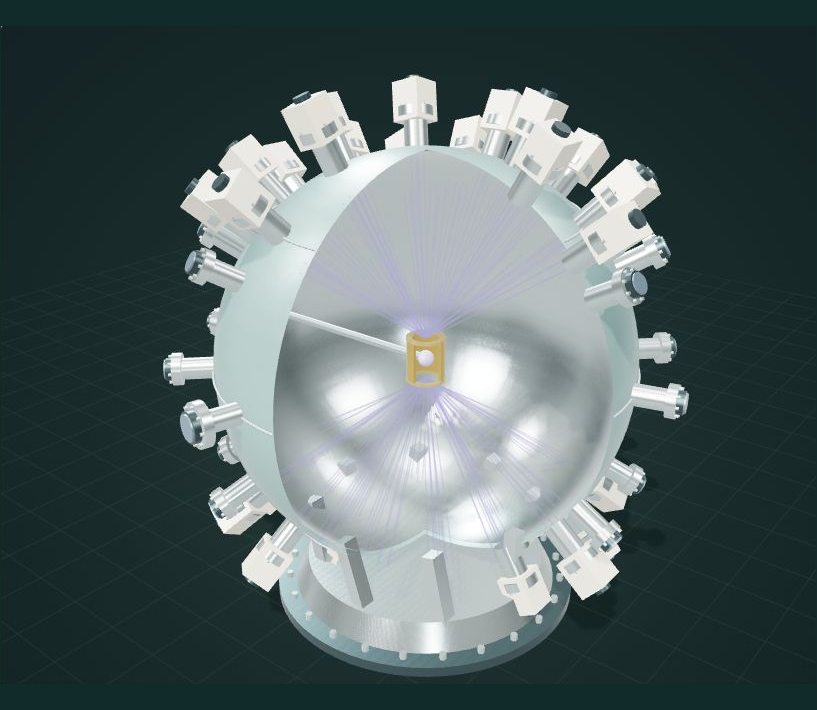
Trace NIF’s indirect-drive geometry from the chamber to the tiny central target.
 04
Helion Trenta
Field-reversed configuration (FRC)
Explore formation, transfer and compression regions in a Trenta-inspired linear device.
 05
General Fusion LM26
Magnetized target fusion (MTF)
Inspect the relationship between magnetized plasma, lithium liner and compression system in an LM26-inspired model.
Rotate the model. Explore the structure.
Select parts to inspect their position and purpose.
Tokamak — look inside
The model loads when you choose to open it.
You can read the guide before loading 3D.
An independently authored educational model based on public references. It does not reproduce exact dimensions, private designs, or calculated fields and particle trajectories. Plasma and beams are static position guides; cutaway and exploded views are not maintenance procedures.
Compare other approaches
These categories overlap: FRC names a magnetic configuration, while MTF describes compression of magnetized fuel. They are different classification axes, so a compression experiment can also use an FRC.
Compare five fusion approaches →These independently authored educational reconstructions use public references. Static plasma and beam shapes explain positions; they are not field or particle simulations. Devices are not shown at a common scale, and their appearance does not establish power performance.